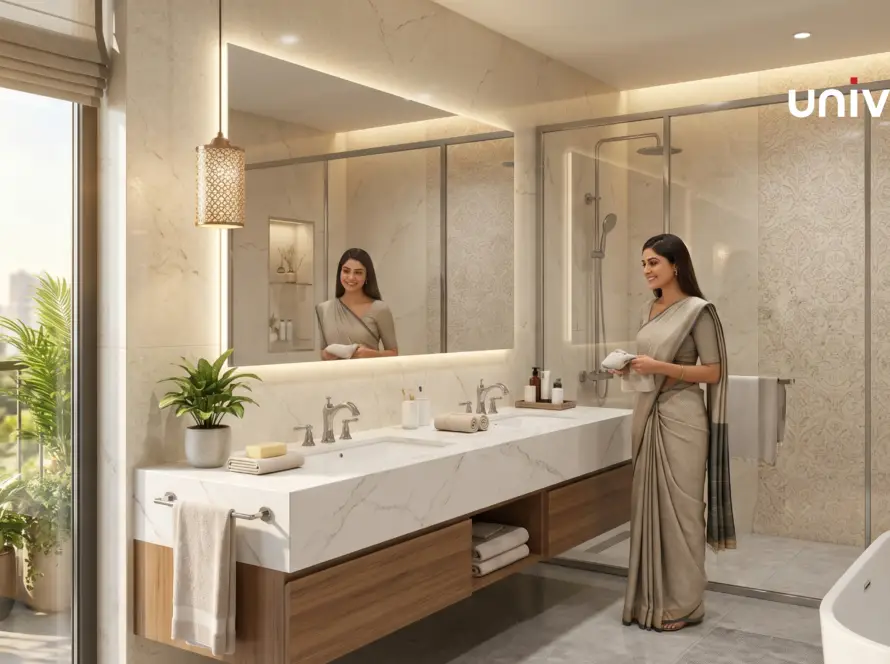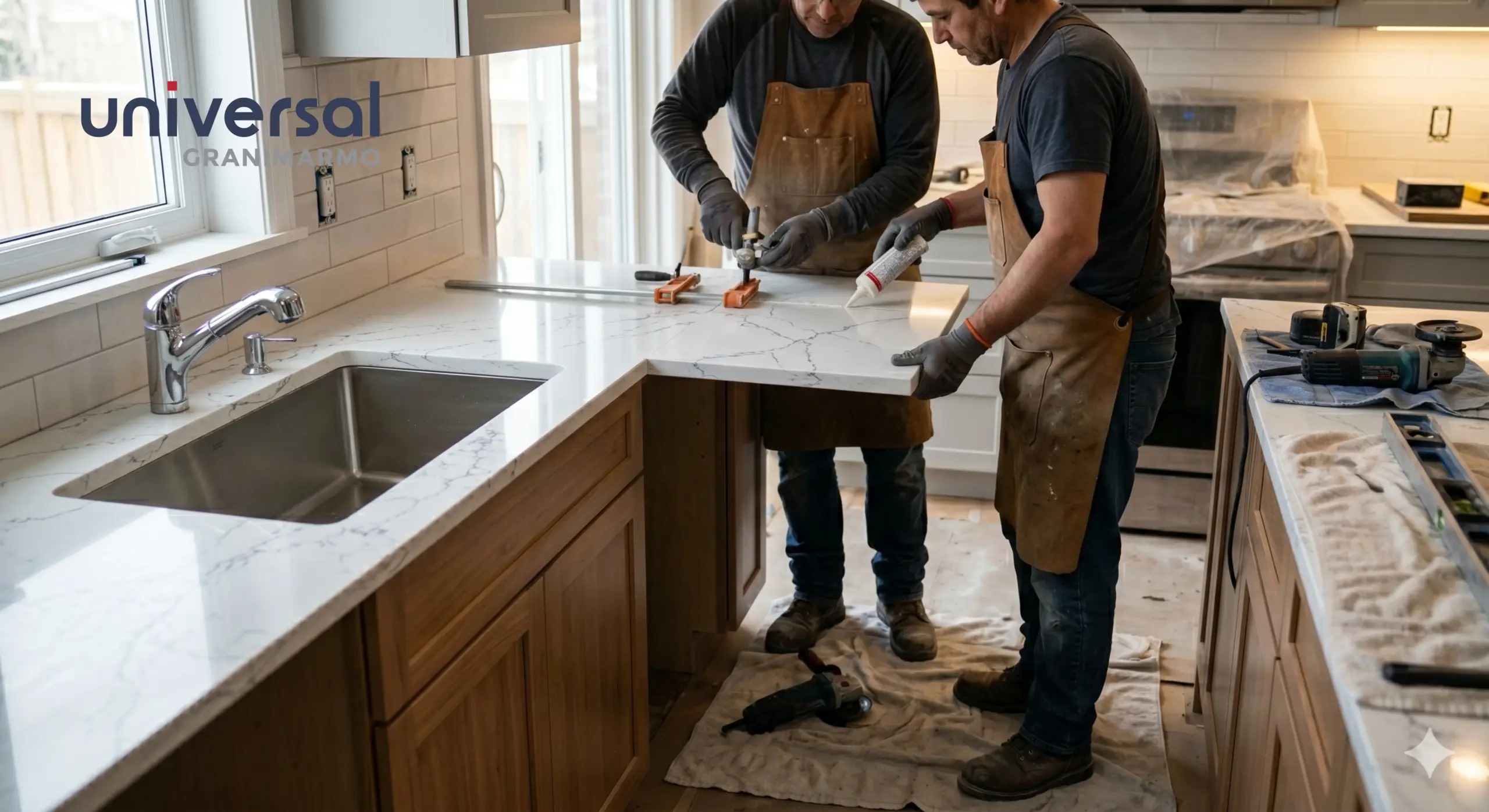
India’s construction and renovation industry moves fast. Builders, developers, and homeowners across the country are under constant pressure to complete projects faster, reduce site labour costs, and deliver consistently high-quality finishes without the delays and disruptions that traditional on-site stone fabrication creates.
Pre-fabricated quartz surfaces — a manufacturing approach that Universal Quartz has developed and refined over two decades — are the answer to all three of these pressures. Yet despite being one of the most practical innovations in the Indian surface materials sector, pre-fab quartz remains poorly understood by most homeowners and even by a significant portion of the construction industry.
This guide explains exactly what pre-fab quartz is, how it is made, what it costs compared to site-fabricated alternatives, and why it is the logical choice for India’s growing modular construction, rapid renovation, and mass-residential development markets.
1. What is pre-fabricated quartz? The clear definition
Pre-fabricated quartz (pre-fab quartz) refers to engineered quartz surfaces — countertops, vanity tops, window sills, shelf inserts, and panels — that are fully manufactured and finished at the production facility before being transported to the installation site.
Standard quartz vs pre-fab quartz: the key difference
| Stage | Standard site-fabricated quartz | Pre-fab quartz |
| Measurement | Taken on site after cabinet installation | Taken from approved architectural drawings |
| Slab cutting | CNC-machined at the factory to ±1mm tolerance | Factory CNC-profiled to the specified edge type |
| Edge profiling | Done on site with manual or semi-auto edger | CNC-cut at the factory — zero on-site cutting dust |
| Cutouts | Cut on site (sink, hob, tap holes) — dust on site | Fully polished at the factory — no site finishing |
| Polish / finish | Some site polishing of cut edges required | Some site polishing of cut edges is required |
| Quality control | Variable — dependent on on-site conditions | Factory QC at every stage before dispatch |
| On-site work | 4–8 hours cutting, edging, fitting, polishing | 1–2 hours fitting and silicone sealing only |
| Site dust/mess | Significant — stone cutting dust, water, vibration | Zero cutting — no dust, no vibration on site |
2. The Universal Quartz pre-fab manufacturing process
Understanding the process clarifies why pre-fab quartz delivers higher precision and consistency than site-fabricated alternatives. Every Universal Quartz pre-fab unit passes through six controlled manufacturing stages:
Drawing approval and measurement verification.
The process begins with an architect or designer’s drawings — kitchen layout, vanity top plan, or office countertop spec. Universal Quartz’s pre-fab team reviews the drawings, confirms measurements, and flags any tolerance issues before production begins. For residential projects, a site measurement visit is conducted after cabinet installation is confirmed to be within tolerance. Digital measurement tools (laser measuring and CAD conversion) are used for complex layouts. No slab is cut until measurements are signed off.
Slab selection and batch matching
For pre-fab orders, slabs are selected from the same production batch to ensure colour and pattern consistency across multiple pieces — a kitchen island, a window sill, and a bathroom vanity top in the same project should all come from the same batch for a cohesive interior. Universal Quartz’s inventory management system tracks batch codes for every slab in stock, enabling precise batch-matching for large residential and commercial pre-fab orders.
CNC precision cutting
Approved drawings are converted to CNC (Computer Numerical Control) machine code. The slab is placed on the CNC cutting bed and cut to exact dimensions — length, width, and any diagonal or curved cuts — to a tolerance of ±1mm. CNC cutting eliminates the human error inherent in on-site angle grinder cutting, where tolerances of ±5–10mm are common. For complex kitchen layouts with multiple corner joins, CNC cutting ensures every piece fits perfectly the first time.
Edge profiling and cutouts
After cutting, the slab piece passes to the CNC edge profiling station. The specified edge profile — bullnose, bevelled, waterfall miter, ogee, or straight — is machined to exact specification. Cutouts for sinks, hobs, tap holes, and soap dishes are also CNC-cut at this stage. CNC edge profiling produces a perfectly consistent edge radius, depth, and finish at every point — eliminating the variation that manual on-site edging creates, particularly at corners and around cutouts
Factory polishing and quality inspection
All cut edges and surfaces are polished at the factory. The final piece is inspected against the original drawing: dimensions checked to ±1mm, edge profile verified, cutout positions measured, surface inspected for any chips, marks, or colour variation. Any piece that does not pass QC is recut — the client never receives a substandard unit. QC documentation is attached to each piece for traceability.
Protective packaging and logistics to the site
Finished pre-fab pieces are wrapped in foam padding and secured in custom-built transport frames. Each piece is labelled with its installation position (e.g., ‘Kitchen — Left Run’, ‘Vanity — Master Bathroom’) to enable rapid, error-free on-site installation. Universal Quartz coordinates delivery directly to the site at the confirmed installation date, with pieces delivered in installation sequence to minimise on-site handling.
Read More: What is quartz
3. Pre-fab quartz cost savings: a realistic breakdown
The perception that pre-fab quartz costs more than site-fabricated quartz is widespread but incorrect when the full cost picture is considered. Here is a realistic cost comparison for a standard Indian modular kitchen (approximately 45 sq ft of countertop):
| Cost element | Site-fabricated quartz | Pre-fab quartz |
| Slab material cost (45 sq ft @ Rs 350/sqft) | Rs 15,750 | Rs 15,750 (same material) |
| On-site fabrication labour | Rs 4,500–7,000 | Nil (all done at factory) |
| On-site edge profiling | Rs 1,200–2,000 | Nil (factory profiled) |
| Site cleaning after cutting | Rs 500–1,000 (dust, water) | Nil (no on-site cutting) |
| Risk of on-site measurement error | Rs 2,000–8,000 (rework risk) | Nil (CNC ±1mm tolerance) |
| Additional site visits (fitting/rework) | 1–2 additional visits common | Single installation visit |
| Total on-site day cost | Rs 6,200–18,000+ | Rs 800–1,200 (fitting only) |
| TOTAL ESTIMATED COST | Rs 21,950–33,750 | Rs 16,550–16,950 |
| Savings with pre-fab | — | Rs 5,000–16,800 per kitchen |
4. Time savings: the most undervalued benefit
In India’s construction and renovation market, time on site is money for contractors, developers, and homeowners equally. Pre-fab quartz delivers measurable time savings at every stage of a project:
| 60–70% | reduction in on-site installation time for quartz countertops when pre-fab is used instead of site-fabricated, based on Universal Quartz installation data across residential and commercial projects in India. |
| 1–2 hrs | Typical on-site installation time for a standard pre-fab kitchen countertop set, compared to a full day (6–8 hours) for site-fabricated quartz with cutting and edging. |
| 3–5 days | reduction in overall kitchen or bathroom handover timeline when pre-fab quartz is used, as no post-installation dust cleaning or rework period is required. |
Why time savings matter for different buyer segments
- Residential homeowners: Kitchen and bathroom renovations in occupied homes are massively disruptive. Every day the kitchen is unusable has a real-life cost. Pre-fab installation in 1–2 hours vs a full day of cutting, dust, and noise is not just a cost saving — it is a quality-of-life saving.
- Developers (residential projects): For a 100-unit apartment project, shaving 3–5 days off the kitchen handover timeline per unit can represent a project-wide schedule saving of months. Pre-fab quartz is now specified by default in most premium residential development projects in Delhi NCR, Mumbai, and Bengaluru.
- Commercial fit-out contractors: Office fit-outs operate under strict landlord-imposed timelines. Site-fabricated stone cutting creates dust that contaminates adjacent areas still under fit-out. Pre-fab quartz eliminates this contamination risk and allows surfaces to be installed in the final days of fit-out without disrupting other trades.
- Hotel and hospitality projects: Bathroom and kitchen surface replacement in operating hotels requires absolute minimisation of guest disruption. Pre-fab quartz can be installed in an occupied room’s bathroom in under two hours — making mid-stay renovation feasible for the first time.
Read More kitchen design
5. Who should specify pre-fab quartz?
Pre-fab quartz is not only for large developers. Here is a clear framework for deciding whether pre-fab is the right choice for your project:
| Project type | Pre-fab recommended? | Primary reason |
| Single-home kitchen renovation | Yes — always | Minimises disruption in occupied home. Faster completion. |
| New-build single home | Yes — recommended | Consistent quality, faster handover, lower on-site labour. |
| Residential developer (10+ units) | Yes — strongly recommended | Major time and cost savings at scale. Consistent finish across units. |
| Commercial office fit-out | Yes — standard practice | No cutting dust on site. Fits tight fit-out timelines. |
| Hotel/hospitality renovation | Yes — essential | Minimises room downtime. Occupied hotel compatibility. |
| Single bathroom renovation | Yes — recommended | Vanity tops are ideal pre-fab candidates. Fast, precise, clean. |
| Complex bespoke kitchen (many angles) | Yes — especially recommended | Higher precision needed. On-site complex cuts have high rework risk. |
| Outdoor installation | Assess case-by-case | Logistics and climate conditions affect pre-fab delivery suitability. |
| Emergency replacement (damage/flood) | Yes — fastest option | Pre-fab can be produced in 5–7 working days for urgent projects. |
6. Pre-fab quartz adoption in India’s construction market
India’s pre-fab quartz market has grown significantly over the past five years, driven by the rapid growth of large-format residential development and the professionalisation of the kitchen and bathroom interiors sector. Here is how adoption varies by market:
- Delhi NCR (Gurugram, Noida, Greater Noida): The most advanced pre-fab quartz market in India. Large residential developers in the Gurugram and Noida corridors — building 500–2,000 unit projects — routinely specify pre-fab quartz for all kitchens and bathrooms. The time savings at scale are transformational. Universal Quartz supplies pre-fab units to multiple major NCR developers.
- Mumbai Metropolitan Region (MMR): Compact apartment sizes in Mumbai make site fabrication particularly disruptive. Pre-fab quartz is increasingly the default specification for Mumbai kitchen renovations. The Mumbai hospitality sector — hotels and serviced apartments — is an emerging pre-fab customer segment given the occupied-site advantage.
- Bengaluru: Technology company campuses with large cafeteria and workstation surface requirements are specifying pre-fab quartz for batch consistency and rapid installation across multi-floor fit-outs. The residential developer market in Bengaluru’s outer ring road corridors is also adopting pre-fab at scale.
- Pune (Hinjewadi, Kharadi, Magarpatta): India’s fastest-growing mid-market residential development corridor. Pre-fab quartz at competitive price points is enabling Pune developers to deliver premium surface finishes within constrained project budgets. Universal Quartz’s pre-fab programme has seen particularly strong growth in this market.
- Tier-2 cities (Jaipur, Ahmedabad, Surat, Lucknow, Indore): The next growth wave for pre-fab quartz. As modular kitchen adoption reaches tier-2 cities, pre-fab supply chains are being established. Universal Quartz’s Jaipur manufacturing base is well-positioned to serve tier-2 markets in North and West India with shorter logistics distances than competitors.
7. The Universal Quartz pre-fab difference: manufacturing precision
Not all pre-fab quartz is equal. The quality of a pre-fab unit depends entirely on the underlying manufacturing quality of the slab being fabricated. Universal Quartz’s pre-fab programme is built on the same manufacturing foundations that have made our slabs India’s most certified engineered stone surface:
- CNC precision to ±1mm: Our CNC equipment is calibrated to a ±1mm cutting tolerance. On-site angle grinders typically work to ±5–10mm. For kitchen countertops with multiple fitted pieces, the difference between these tolerances is visible in the finished result — either seamless joins or visible gaps.
- Christobalite powder integration: Universal Quartz’s manufacturing process incorporates christobalite powder as a performance-enhancing additive in our slab composition. This increases surface density, which reduces micro-porosity at cut edges — a critical factor in pre-fab units where cut edges are fully exposed before installation. Denser edges are more resistant to chipping during transport and installation.
- Same-batch slab matching: For multi-piece projects, Universal Quartz’s inventory system ensures all pieces come from the same production batch, guaranteeing visual consistency that post-fabrication colour matching cannot reliably achieve.
- Full certification applies: Pre-fab units carry the same ISO, CE, GREENGUARD Gold, and NSF certifications as standard Universal Quartz slabs — certifications that follow the material, not the fabrication method.
Frequently asked questions
What is pre-fab quartz?
Pre-fab quartz is engineered quartz stone that is cut, edged, polished, and finished at the factory to precise measurements before delivery to the site. Unlike site-fabricated quartz — where cutting and edging happen on the day of installation — pre-fab units arrive ready to install, requiring only silicone sealing and fitting. Universal Quartz pre-fab surfaces are CNC-machined to ±1mm tolerance.
Is pre-fab quartz cheaper than site-fabricated quartz?
Yes, in most cases. While the slab material cost is identical, pre-fab eliminates on-site fabrication labour (Rs 4,500–7,000 for a standard kitchen), edge profiling charges, site cleaning after cutting, and the risk of costly rework from measurement errors. Total savings for a standard Indian kitchen are typically Rs 5,000–16,800 compared to site fabrication.
How long does pre-fab quartz installation take?
A standard kitchen pre-fab installation takes 1–2 hours on site, compared to 6–8 hours for site-fabricated quartz. This includes positioning each pre-cut piece, applying silicone adhesive and sealant, and fitting appliances into pre-cut openings. There is no dust, no cutting, and no mess — the site is fully usable within a few hours of the installation team leaving.
What is the lead time for Universal Quartz pre-fab surfaces?
Standard pre-fab orders — for projects with approved drawings and confirmed measurements — have a production lead time of 7–14 working days. For urgent replacement projects, an express lead time of 5–7 working days is available for standard configurations. Large-scale developer pre-fab programmes with advanced batch planning can operate on a rolling 5-day replenishment cycle.
Can pre-fab quartz be made for any kitchen shape?
Yes. Universal Quartz CNC equipment can produce pre-fab units for straight runs, L-shaped, U-shaped, and peninsula kitchen layouts, including diagonal cuts, curved fronts, mitered corner joins, and custom island shapes. Complex layouts benefit most from CNC pre-fabrication because the risk of measurement error in on-site cutting increases with complexity.
Does pre-fab quartz quality differ from site-fabricated quartz?
Pre-fab quartz from Universal Quartz is higher quality in precision and edge finish than most site-fabricated alternatives. CNC cutting achieves ±1mm tolerance vs ±5–10mm for on-site cutting. Factory-polished edges are more consistent than on-site polished edges. All Universal Quartz pre-fab units carry the same ISO, CE, GREENGUARD Gold, and NSF certifications as standard slab products.