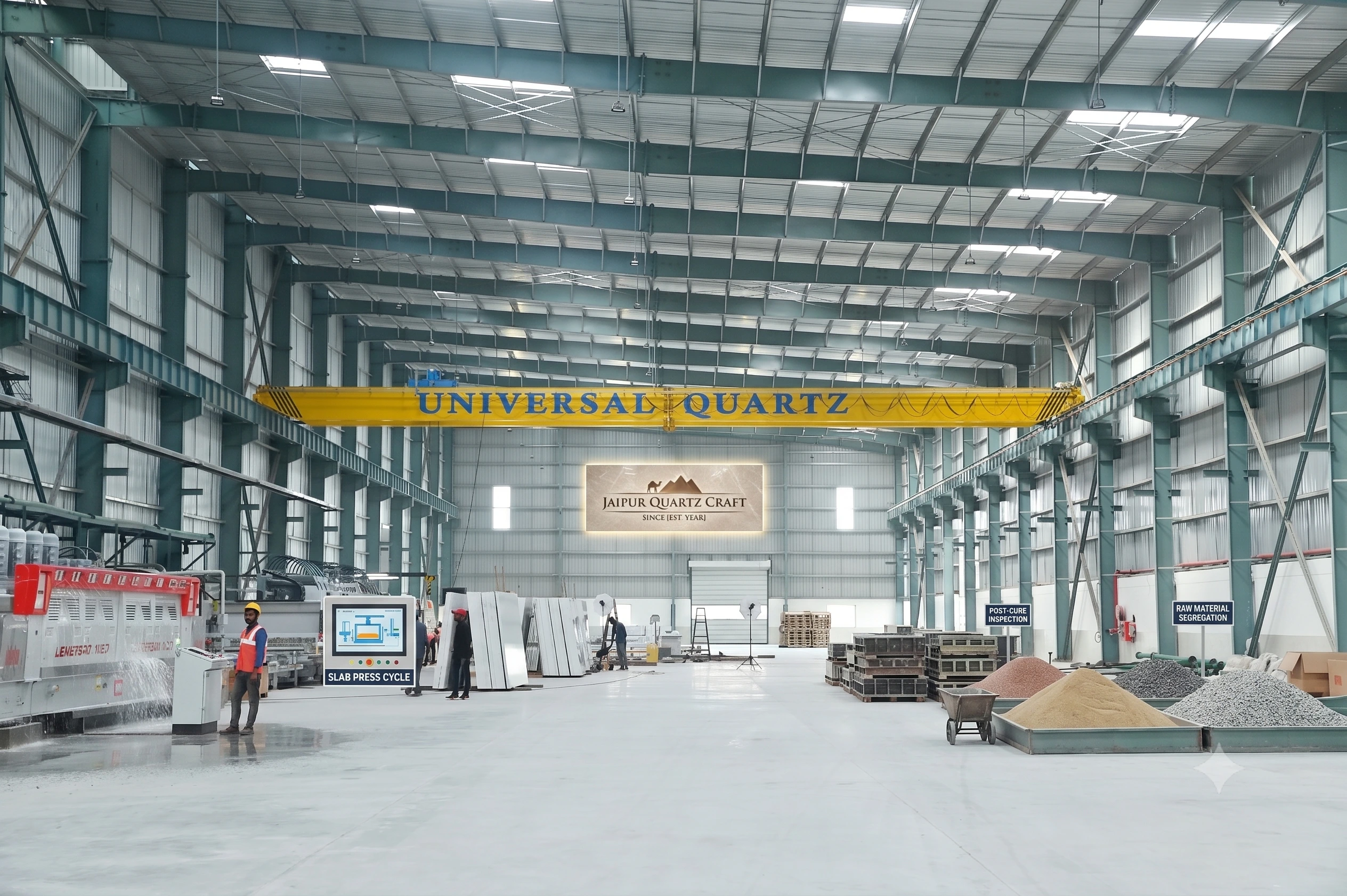
Every slab tells a story. Behind the flawless surface of a Universal Quartz worktop — the one installed in a high-end kitchen in Mumbai, a hotel lobby in Dubai, or an architect’s award-winning project in Bengaluru — is a precise, multi-stage manufacturing process that begins right here in Jaipur. This is that story.
Why Jaipur? The Strategic Logic Behind Our Location
Jaipur is not an accidental choice. Rajasthan sits at the heart of India’s natural stone belt — a region historically synonymous with marble, sandstone, and granite. Over decades, this geography has cultivated an ecosystem of skilled craftsmen, mineral suppliers, raw material processors, and stone industry expertise that is genuinely difficult to replicate elsewhere in the country.
Universal Quartz has been operating from Jaipur for over 20 years, and that longevity has allowed us to build deep supply chain relationships, attract highly specialised manufacturing talent, and refine our processes in ways that directly impact the quality of every slab that leaves our facility.
Our Jaipur factory is the production backbone of a brand that today exports to multiple countries and supplies architects, interior designers, builders, and fabricators across India — from our branch network spanning Delhi/NCR, Mumbai, Chandigarh, Bengaluru, Tamil Nadu, and Gujarat.
What Is Engineered Quartz, Really?
Before we walk you through the factory floor, it helps to understand what you are actually looking at when you see an engineered quartz slab.
Engineered quartz is a composite surface — typically comprising around 90–93% natural quartz crystals bound together with approximately 7–10% polymer resins, pigments, and other additives. Unlike natural stone, which is quarried and cut as it is found in the earth, engineered quartz is manufactured. That distinction matters enormously: it means consistency, it means controlled performance properties, and it means the ability to engineer outcomes — colour, pattern, texture, strength — rather than simply accept whatever nature provides.
Quartz itself is one of the hardest minerals on earth, rating 7 on the Mohs hardness scale. When you compress and bind it under high pressure and vibration, you produce a surface that is harder, denser, and more uniform than most natural stone alternatives.
This is what Universal Quartz manufactures. And here is how we do it.
Stage 1: Raw Material Selection and Quality Control
Everything begins with quartz. The quality of the input material directly determines the quality of the finished slab, which is why raw material selection at Universal Quartz is not a purchasing function — it is an engineering function.
We source high-purity quartz aggregate that meets strict internal specifications for particle size distribution, silica content, and freedom from contaminants. The quartz arrives in multiple grades — coarse, medium, and fine — each serving a different structural and aesthetic role in the final mix.
A critical differentiator in our manufacturing process is the use of Christobalite Powder — a high-temperature polymorph of silica that enhances surface hardness, scratch resistance, and overall structural integrity. This is not a standard ingredient in all engineered quartz production; it is a conscious technical choice that elevates the performance profile of our finished slabs.
In addition to quartz aggregate, this stage involves the careful selection and preparation of:
- Polymer resins — the binder that holds the composite together, influences flexibility, and determines chemical resistance
- Pigments and colourants — selected for UV stability and consistency across production batches
- Performance additives — components that contribute to specific functional attributes such as antimicrobial properties or thermal stability
Every incoming batch of raw material is tested before it enters the production line. No batch passes on assumption.
Stage 2: Mixing and Blending
With raw materials cleared, production begins in the mixing room.
Quartz aggregates of different grades are combined in precise ratios with resins and colourants in large industrial mixers. The ratios are formulated recipes — proprietary to each product series — that have been developed and refined over years of production experience.
This is the stage where a slab’s eventual aesthetic is born. The colour recipes that define our product families — from the deep blacks of our Jupiter Series to the soft whites of our Venus Series, the warm tones of the Saturn Series, the fresh neutrals of the Mercury Series, the earthy richness of the Mars Series, and the cooler tones of our Neptune and Uranus Series — are mixed at this stage with a precision that ensures colour consistency across every slab in a production run.
Consistency is the standard. When an architect specifies a particular shade of Universal Quartz for a large commercial project, they need to know that slab 1 and slab 200 will match. This is only possible through disciplined, documented mixing protocols.
The blended mix is checked for homogeneity and then transferred to the pressing station.
Stage 3: Pressing — The Heart of the Process
Pressing is where engineered quartz becomes engineered quartz.
The blended mixture is distributed evenly across a mould — typically sized to produce slabs of 3050 mm × 1440 mm, though specific dimensions may vary by product line. The filled mould is then placed into a high-performance vibro-compaction press.
Under this process, the slab is simultaneously subjected to:
- High pressure — which compacts the mixture into a dense, void-free mass
- Vibration — which ensures the quartz particles and resin distribute uniformly throughout the slab, eliminating air pockets and micro-weaknesses
The result is a “green” (uncured) slab with remarkable structural uniformity. The pressing process is what gives engineered quartz its characteristic density and dimensional consistency — properties that natural stone can never guarantee, given its inherently variable geological formation.
Pressing parameters — pressure, vibration frequency, duration — are monitored and logged for every production run. These are not set-and-forget variables; they are actively managed to maintain output quality within tight tolerances.
Stage 4: Curing
The green slab exiting the press is structurally intact but not yet fully hardened. It now enters the curing stage.
Curing involves controlled exposure to heat — the slab is passed through industrial curing ovens where carefully managed temperatures cause the polymer resin to polymerise fully, locking the quartz particles permanently into the composite matrix.
The curing cycle is precisely timed and temperature-controlled. Under-curing leaves residual resin that can affect hardness and chemical resistance. Over-curing can introduce stress into the slab. Neither is acceptable.
At the end of curing, the slab has achieved its full hardness, density, and structural integrity. What was a blended mixture of minerals and resin is now a high-performance surface.
Stage 5: Surface Finishing
The cured slab now has its final chemistry but not yet its final appearance. Surface finishing transforms it from a raw industrial output into a product ready for specification and installation.
Calibration is the first step — the slab is passed through calibrating machines that grind the surface to a precise, uniform thickness. Thickness consistency is critical for fabricators who need to work to tight dimensional tolerances.
Polishing follows. The slab moves through a series of polishing heads — progressively finer abrasive compounds — that bring the surface to its finished state. For the majority of Universal Quartz products, this means a high-gloss mirror polish. For select products, the process is adjusted to produce a honed or textured finish.
The polishing stage is where the true visual character of the slab emerges. The movement, the depth, the luminosity of the surface — all of it becomes fully visible for the first time as the polishing heads work their way across the slab.
Stage 6: Quality Inspection
No slab exits the finishing line without passing through quality inspection. At Universal Quartz, this is a structured, documented process — not a cursory visual check.
Inspectors assess each slab for:
- Surface defects — pinholes, voids, cracks, inclusions, or finish irregularities
- Dimensional accuracy — length, width, thickness, and squareness
- Colour consistency — comparison against the approved colour standard for that batch
- Edge integrity — checking for chips or damage introduced during processing
Slabs that pass inspection are classified, batch-coded, and cleared for stock. Slabs that do not pass are rejected — they do not ship.
This commitment to inspection is inseparable from our certification framework. Universal Quartz holds ISO 9001:2015 certification for quality management systems, and our manufacturing and finished products carry CE marking, GREENGUARD Gold certification for low chemical emissions, and NSF certification — alongside recognition under Green Building / LEED / IGBC frameworks.
These certifications are not marketing ornaments. They are the formal audit trails of a manufacturing operation that takes quality seriously.
Stage 7: Pre-Fabrication Capabilities
One capability that distinguishes Universal Quartz from many manufacturers is our in-house pre-fabrication.
For many customers — particularly large-scale commercial projects, hospitality developments, and export orders — receiving slabs and then fabricating locally is not the optimal model. Universal Quartz can receive project specifications and deliver pre-cut, pre-finished quartz components: worktops cut to size, edge profiles machined, cutouts routed, pieces matched and packed for installation.
This capability shortens project timelines, removes a layer of supply chain complexity for our clients, and ensures that any precision work done on our quartz is done under controlled conditions by teams who work with the material daily.
Stage 8: Packaging, Stock, and Dispatch
Approved slabs are carefully packaged for transport — each slab protected to prevent surface damage during handling, loading, and transit. Slabs are typically palletised in A-frame configurations that distribute weight evenly and allow safe forklift handling.
Our Jaipur facility maintains a stocked inventory across our active product ranges, enabling rapid fulfilment for both domestic orders and export shipments. With branch offices and dealer networks across India’s major metro regions, the logistics chain from the Jaipur factory to the project site is well-established and actively managed.
For export customers — Universal Quartz has an active international business — slabs are prepared and packed to meet specific destination requirements, with all necessary documentation, compliance certificates, and quality records accompanying the shipment.
The Standard Behind Every Slab
Manufacturing engineered quartz at scale is not difficult. Manufacturing it consistently — to a standard that architects can specify with confidence, that fabricators can work with precision, that end users can trust for decades — that requires something more than equipment.
It requires a culture of quality that runs through every stage described above: the raw material purchasing decision, the recipe development, the pressing parameters, the curing protocols, the inspection criteria, and the packaging discipline.
Universal Quartz has been building and refining that culture in Jaipur for over 20 years. Our product series — Jupiter, Saturn, Venus, Mercury, Mars, Neptune, Uranus, Harmony — each represents a defined aesthetic vision backed by the same underlying manufacturing discipline.
When you specify Universal Quartz, you are not buying a slab. You are buying 20+ years of manufacturing knowledge, encoded into 30mm of high-performance composite stone.
Specify Universal Quartz for Your Next Project
Architects, interior designers, and builders are welcome to request samples, technical data sheets, and project support from our team. Our branch offices across Delhi/NCR, Mumbai, Chandigarh, Bengaluru, Tamil Nadu, and Gujarat are staffed with teams who understand project specifications and can support you from initial selection through to delivery.
Visit universalquartz.in to explore our product ranges, download technical documentation, and connect with the nearest branch.