To clean quartz correctly, you first need to understand what it is made of. Engineered quartz is composed of approximately 90–93% natural quartz crystals, bound together with polymer resins and pigments under high pressure and temperature. The result is a surface that is denser, harder, and more uniform than most natural stones.
The critical property for maintenance is this: quartz is non-porous. Unlike granite, which has microscopic pores that absorb liquids and bacteria, or marble, which etches and stains from acids, quartz has no open pores for substances to enter. This is why it does not need annual sealing and why it resists bacteria naturally.
However, the polymer resin that creates this non-porous structure has its own sensitivities. It reacts badly to strong alkaline chemicals, concentrated acids, and prolonged heat. Understanding this — that the resin is the component to protect, not the quartz crystal itself — is the foundation of correct quartz care.
At Universal Quartz, all our surfaces carry NSF certification (confirming food-safe surface performance), GREENGUARD Gold certification (confirming low chemical emissions, safe for kitchens and children’s environments), and ISO 9001 quality management certification. These standards inform how we advise customers to clean and maintain our products.
Daily cleaning: what actually works
The most effective daily cleaning routine for quartz is also the simplest.
What you need:
- Warm water
- A few drops of mild, pH-neutral dish soap
- A soft microfibre cloth
How to do it:
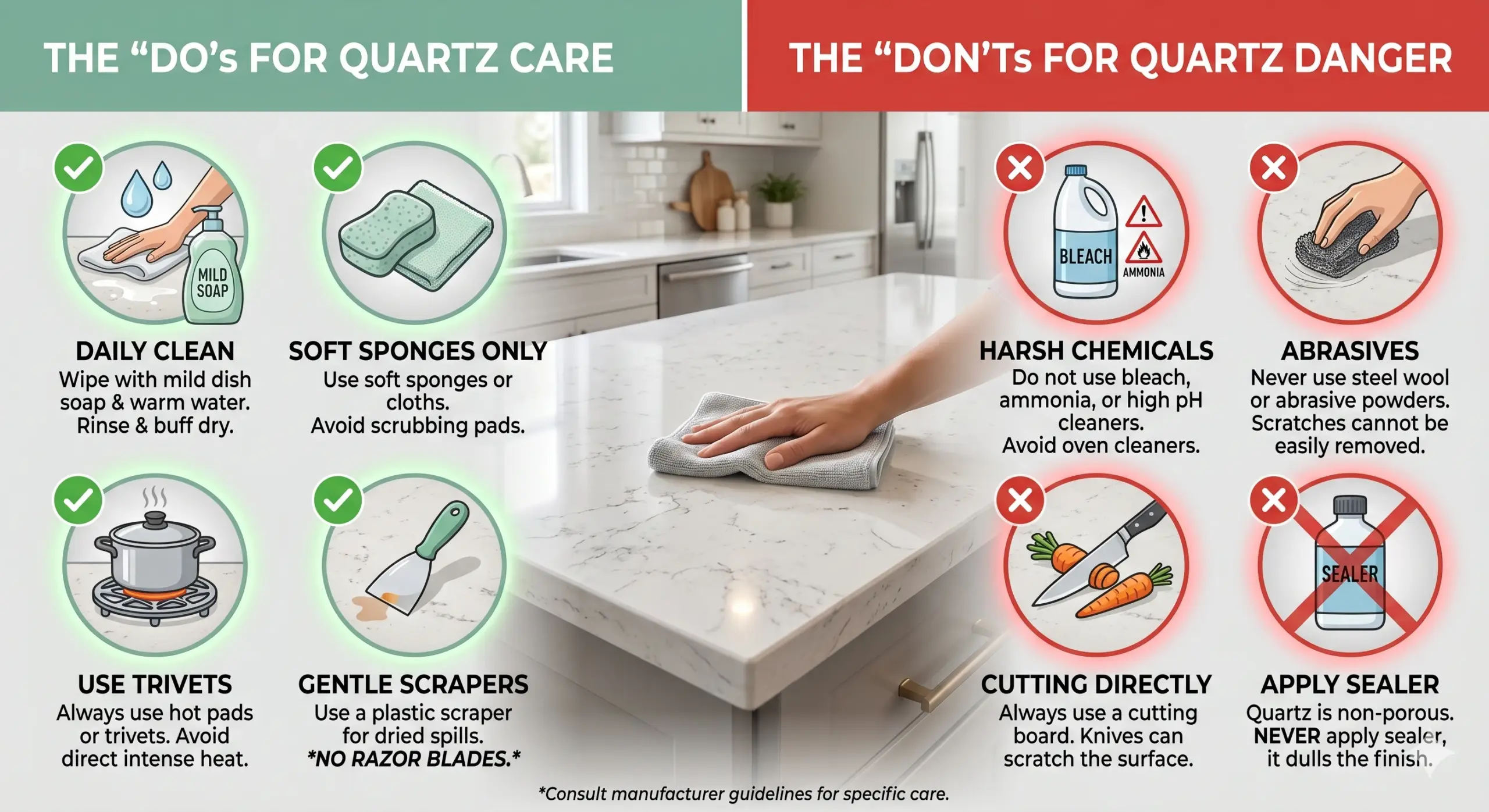
Dampen your cloth with warm water, add a small drop of soap, and wipe the surface in gentle circular motions. Rinse the cloth with clean water and wipe again to remove all soap residue. Finish by drying with a clean dry cloth.
In our quality testing lab, we run accelerated surface wear simulations using this exact routine — mild soap, microfibre cloth, daily frequency — and surfaces show zero degradation of polish or resin after the equivalent of 10 years of daily use. This is the method we recommend to every customer, from homeowners in Delhi to hotel projects in Mumbai.
The single most important habit: wipe spills immediately. Quartz’s non-porous surface means most spills sit on the surface rather than penetrating it — but allowing acidic or pigmented liquids to sit for hours increases the chance of surface-level staining on the resin layer.
How to remove common stains
Kitchen Countertop: turmeric, curry, oil, and chai
Indian kitchens’ countertops are the toughest test for any surface. From personal experience auditing customer feedback across our Jaipur, Delhi, and Mumbai distributor network, the four most common stain complaints are turmeric, curry paste, cooking oil, and tea or chai.
Turmeric: Act within minutes. Wipe fresh turmeric immediately with a damp cloth. For dried or set turmeric stains, apply isopropyl alcohol (70% concentration) to a soft cloth and rub gently. Rinse thoroughly with water after. Do not use bleach — it reacts with the resin binder and causes permanent discolouration that cannot be reversed.
Curry paste and masala: Similar to turmeric. Isopropyl alcohol on a soft cloth, gentle pressure, then rinse. For older stains, a paste of baking soda and water applied for five minutes before wiping can help lift pigment.
Cooking oil and ghee: Apply mild dish soap directly to the greasy area, work in gently with a soft sponge, and rinse. Oil left overnight forms a thin hazy film — this responds to the same soap-and-water treatment if caught within a day or two.
Tea and chai: Baking soda paste (mix with water to a toothpaste consistency) applied for five minutes, then wiped away with a damp cloth, removes tannin stains effectively.
Bathroom: soap scum, hair dye, and toothpaste
Soap scum and hard water deposits: These are particularly severe in North Indian cities, including Jaipur, Delhi NCR, Chandigarh, and Lucknow, where groundwater TDS (total dissolved solids) levels are high. A diluted white vinegar solution — one part vinegar to three parts water — applied with a cloth for two to three minutes removes mineral deposits effectively. Rinse thoroughly after. Do not use undiluted vinegar repeatedly; prolonged acid contact dulls the resin surface over time.
Hair dye: This is one of the most time-sensitive stains. Hair colouring products contain oxidising agents that can bond with quartz resin if left even for twenty to thirty minutes. Wipe immediately with a damp cloth. If the colour has set, isopropyl alcohol is the safest treatment. Never place hair dye bottles directly on quartz vanity tops.
Toothpaste residue: Toothpaste is mildly abrasive. Rinse away completely with water and avoid scrubbing dried toothpaste with anything other than a soft cloth.
Office and reception: ink, markers, and surface haze
Ink and permanent marker: Isopropyl alcohol on a soft cloth, applied with light pressure. Work from the outside of the stain inward to prevent spreading. Rinse with water after.
Surface haze in commercial settings: A common complaint in offices where quartz reception desks are cleaned with multi-surface sprays is gradual haziness. This is almost always caused by chemical residue from products containing ammonia or solvents. Strip the haze by wiping with plain warm water and drying thoroughly. A quartz-specific polish product applied monthly can restore and maintain the original sheen.
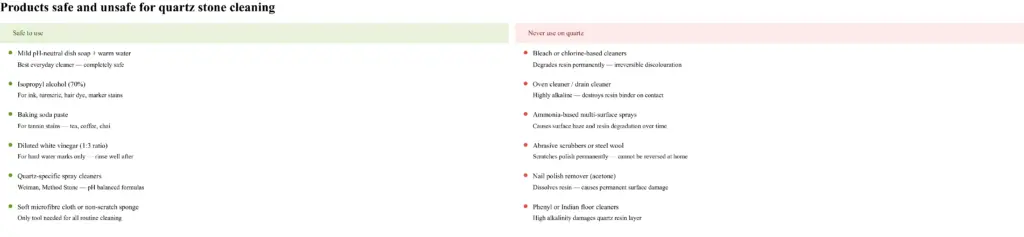
Products safe for quartz — and products that will damage it
Seasonal care guide for Indian conditions
India’s climate creates maintenance challenges that homeowners in Europe or the US simply do not face. Here is how to adapt your care routine seasonally.
Summer (March–June): High temperatures mean cooking vapours, oil residue, and evaporation happen faster. Wipe down the kitchen quartz after every cooking session. Ensure ventilation near countertops to prevent prolonged exposure to cooking steam.
Monsoon (July–September): Humidity accelerates soap scum and mineral deposit buildup, particularly in bathrooms. Clean bathroom quartz every two to three days rather than weekly. Dry surfaces after use — standing moisture in the monsoon season leaves mineral rings faster than any other time of year.
Winter (November–February): Cooking with more ghee and oil for festive meals means increased oil residue. Increase weekly deep-clean frequency during Diwali and wedding season cooking.
Every six months — sealant line inspection: The silicone sealant lines around your quartz installation are not quartz — they are a different material that can discolour and develop mould over time. Clean sealant lines with diluted bleach applied only to the sealant (keeping it away from the quartz surface). If the sealant has cracked or separated, have it professionally re-applied.
What our quality testing reveals about surface longevity
In Universal Quartz’s internal testing laboratory in Jaipur, we subject every product series to accelerated durability testing before it enters the market. For surface maintenance specifically, our tests show:
Surfaces cleaned daily with mild soap and microfibre cloths retain a full polish rating after the equivalent of 15 years of use. Surfaces exposed to bleach-based cleaners just three times show measurable resin degradation within our testing parameters. Surfaces exposed to direct heat above 150°C show micro-fractures in the resin layer that are invisible initially but widen with repeated thermal cycles.
These findings directly shape the care advice we give. They are not marketing claims — they come from the same testing infrastructure we use to achieve and maintain our ISO, NSF, and GREENGUARD certifications.
When to call a professional
Some situations go beyond DIY care. Contact your Universal Quartz distributor or a certified installer if you notice:
Deep scratches that go below the surface polish layer. A chip or crack at a corner, edge, or join. Persistent staining that does not respond to isopropyl alcohol or baking soda treatment after two or three attempts. A section of slab that looks permanently hazy despite correct cleaning.
Attempting to sand, grind, or apply repair compounds without professional guidance almost always causes secondary damage. Our distributor network across Jaipur, Delhi NCR, Mumbai, Chandigarh, Nagpur, Chennai, and Gujarat can connect you with certified installation and repair professionals.
Frequently asked questions
Can I use Lizol, Colin, or Harpic on quartz surfaces?
No. Lizol and Harpic contain strong acids and disinfectants that damage quartz resin. Colin glass cleaner contains ammonia, which causes surface haziness with repeated use. Stick to mild soap and water or a quartz-specific spray for all routine cleaning.
My quartz looks dull even after cleaning — what is causing it?
Dullness is almost always caused by one of three things: soap residue left from insufficient rinsing, hard water mineral film from not drying after cleaning, or chemical haze from an incompatible cleaning product used previously. Wipe with plain warm water and dry thoroughly. For chemical haze, a quartz-specific polish product applied with a microfibre cloth can restore sheen. If dullness persists, contact our technical team.
Does quartz need to be sealed like granite or marble?
No. Engineered quartz is inherently non-porous due to the manufacturing process. Sealing products designed for natural stone should not be applied to quartz — they can leave a film that is difficult to remove and may interfere with the surface’s natural properties.
How do I remove renovation cement or grout accidentally left on quartz?
Use a plastic scraper (never metal) to lift dried cement gently. Follow with isopropyl alcohol on a cloth to remove residue. For stubborn grout haze, a diluted phosphoric acid solution applied briefly and rinsed immediately can work — but this should ideally be done by your installer, not as a DIY step.
Is quartz safe for food contact? Can I place food directly on the surface?
Yes. Universal Quartz surfaces are NSF certified, which means they have been independently tested and confirmed as safe for food contact. The non-porous surface does not harbour bacteria or absorb food residue. That said, we always recommend using a cutting board — not because of food safety concerns, but to protect the surface from knife scratches.
Conclusion
Quartz is one of the most rewarding surfaces to own precisely because good maintenance requires so little. Mild soap, a soft cloth, prompt attention to spills, and keeping bleach and abrasives away — that is the complete picture for most households.
The India-specific considerations — hard water, turmeric, monsoon humidity, heavy cooking — are manageable with small adjustments to routine. After 17 years in this industry, the surfaces I have seen that look brand new after a decade are not the ones that were over-cleaned. They are the ones that were cleaned consistently and correctly, with the right products.
For any questions about your specific Universal Quartz product, maintenance advice for your application, or to explore our certified quartz surfaces for kitchens, bathrooms, offices, and reception areas, contact our team directly.
Email: info@universalquartz.in
Phone: +91 92160 14223
Catalogue: Download the Universal Quartz 2026 Catalogue