Quartz Stone for Kitchen in India — Certified, Non-Porous, Built for Daily Use
Quick Answer: Quartz is the best-performing kitchen surface for Indian homes because it is non-porous, NSF/ANSI 51 certified food-safe, resists stains from turmeric and tamarind, and never needs sealing. Universal Quartz manufactures it in Jaipur, with 20+ years of experience and eight collections suited to both modular and traditional kitchens.
Your kitchen counter absorbs more daily wear than almost any other surface in your home — chai spills, turmeric stains, chopped vegetables, hot vessels, and heavy cookware, day after day. Universal Quartz engineered stone is engineered to withstand that punishment without compromising its finish, hygiene, or structural integrity, which is why it’s specified by architects and interior designers for residential, hospitality, and commercial kitchen projects across India.
Manufacturer Credentials at a Glance
- ISO 9001:2015 Certified Manufacturing
- NSF/ANSI 51 Certified — Food-Safe Surface Contact
- GREENGUARD Gold Certified — Low Chemical Emissions for Indoor Air Safety
- CE Marked — Meets European Material Safety Standards
- Green Building Council Approved — LEED & IGBC Project Ready
- 20+ Years of Manufacturing Experience | Headquartered in Jaipur, Rajasthan
What Is Quartz Stone for Kitchen — and Why Does It Matter?
Quartz stone for kitchen surfaces is an engineered material made from roughly 93% natural quartz crystals bound with 7% polymer resins and pigments, then cured under controlled factory conditions. Because it’s manufactured rather than quarried, every slab avoids the weak points, fissures, and colour inconsistency that occur naturally in granite and marble.
For a surface that has to survive heat, acidic ingredients, cooking oils, scrubbing, and heavy vessels every single day, that manufacturing consistency translates directly into kitchen performance:
- Non-porous surface — bacteria, viruses, fungi, and food residue cannot penetrate it, making it one of the most hygienic countertop materials on the market.
- Stain resistance — turmeric, coffee, red wine, tamarind, and citrus acids leave no permanent mark.
- Scratch resistance — 7 on the Mohs hardness scale, harder than most kitchen tools, resists scoring from knives and utensils.
- Batch-consistent appearance — every slab is engineered to match, so there’s no colour drift between pieces from the same order.
- Zero sealing, ever — unlike granite or marble, it never needs an annual sealing treatment.
Where You Can Use Quartz in the Kitchen
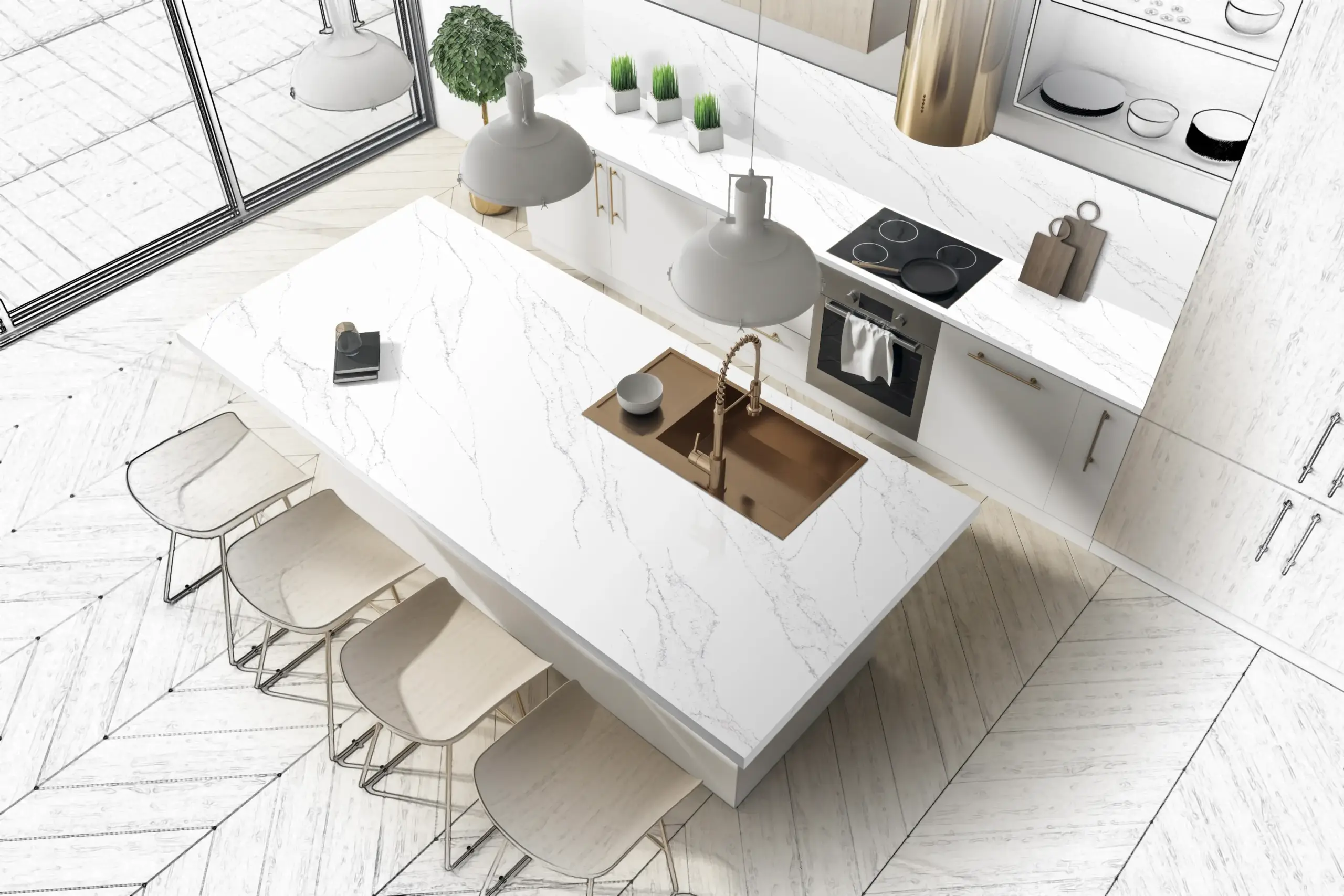
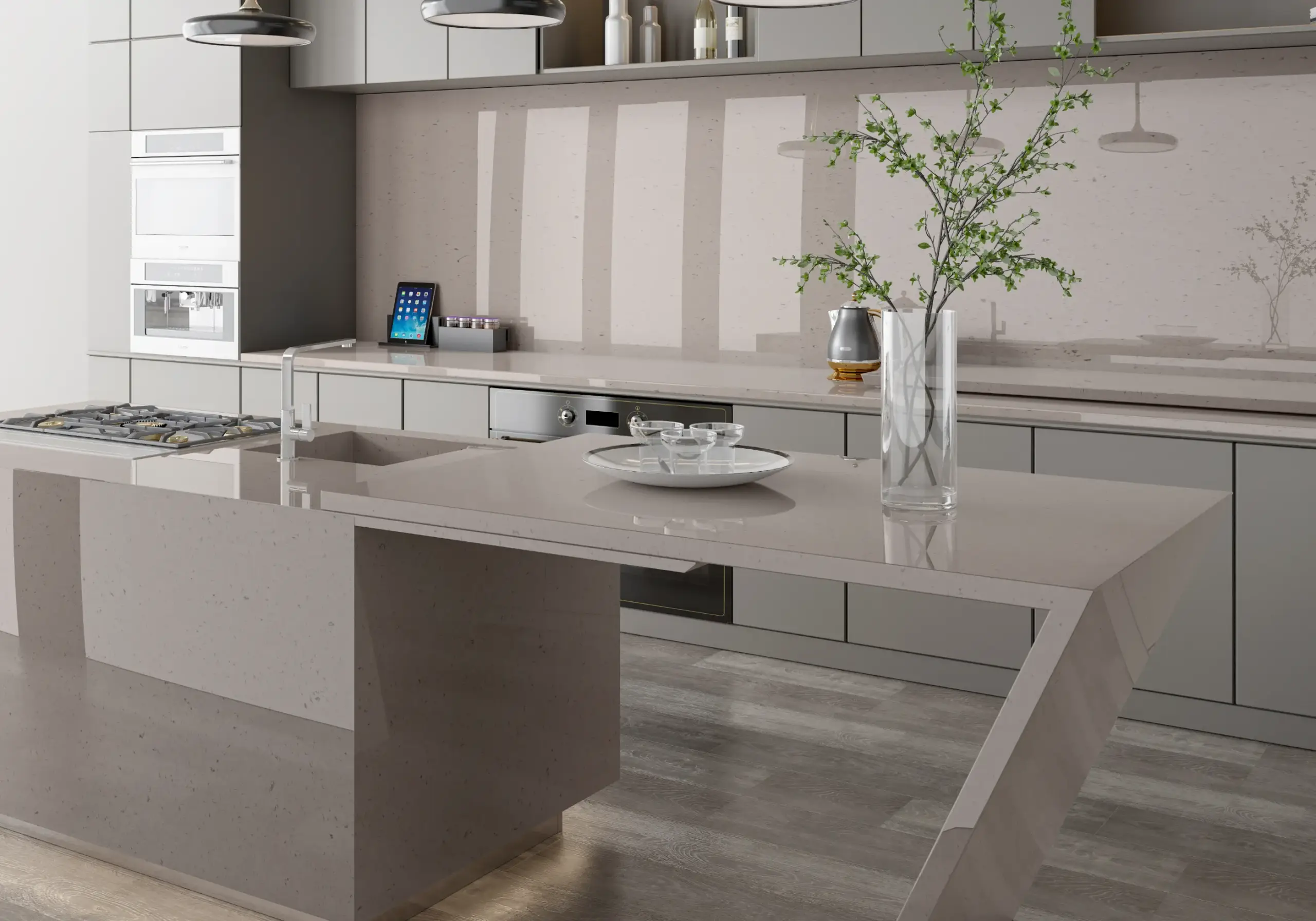
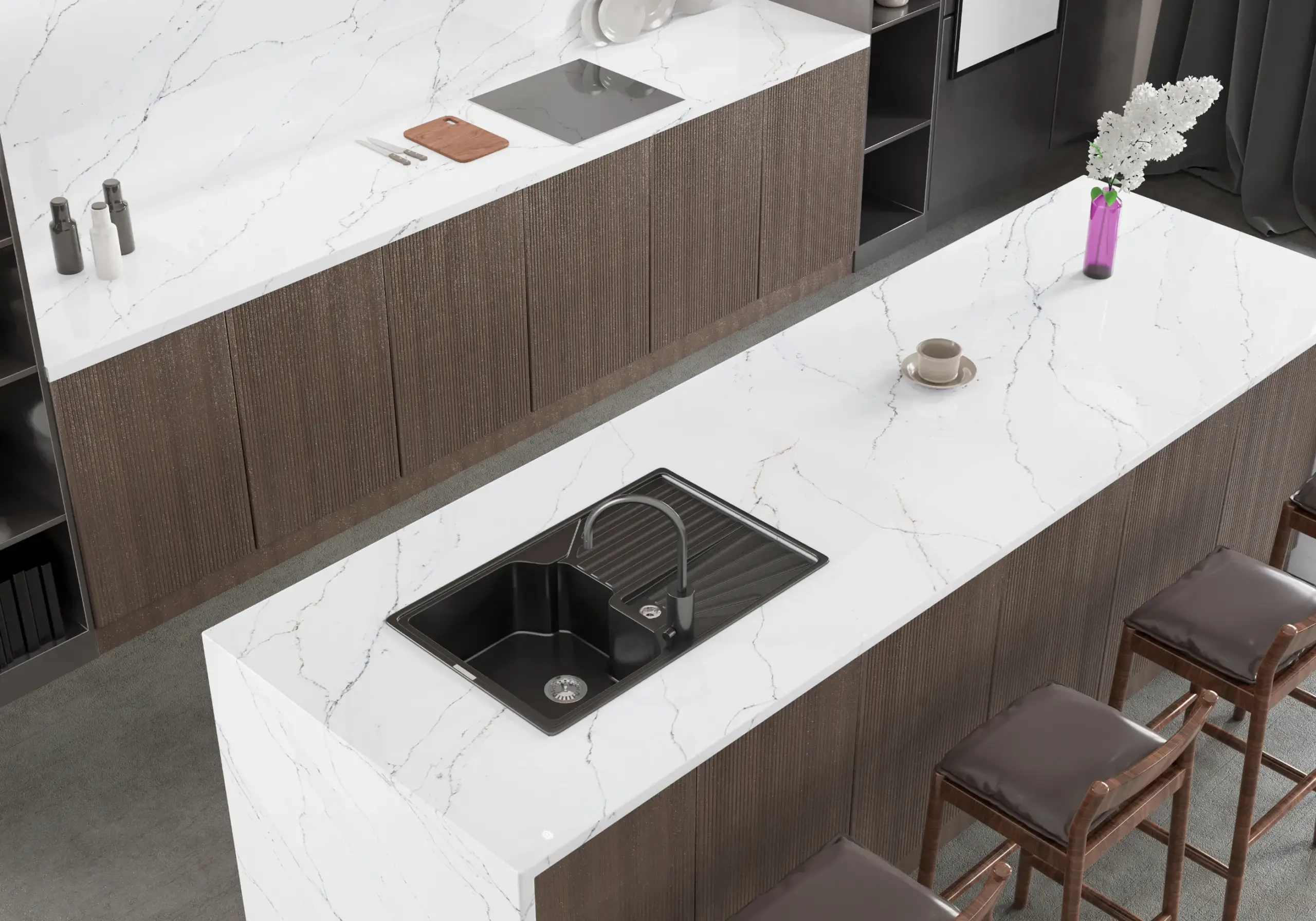
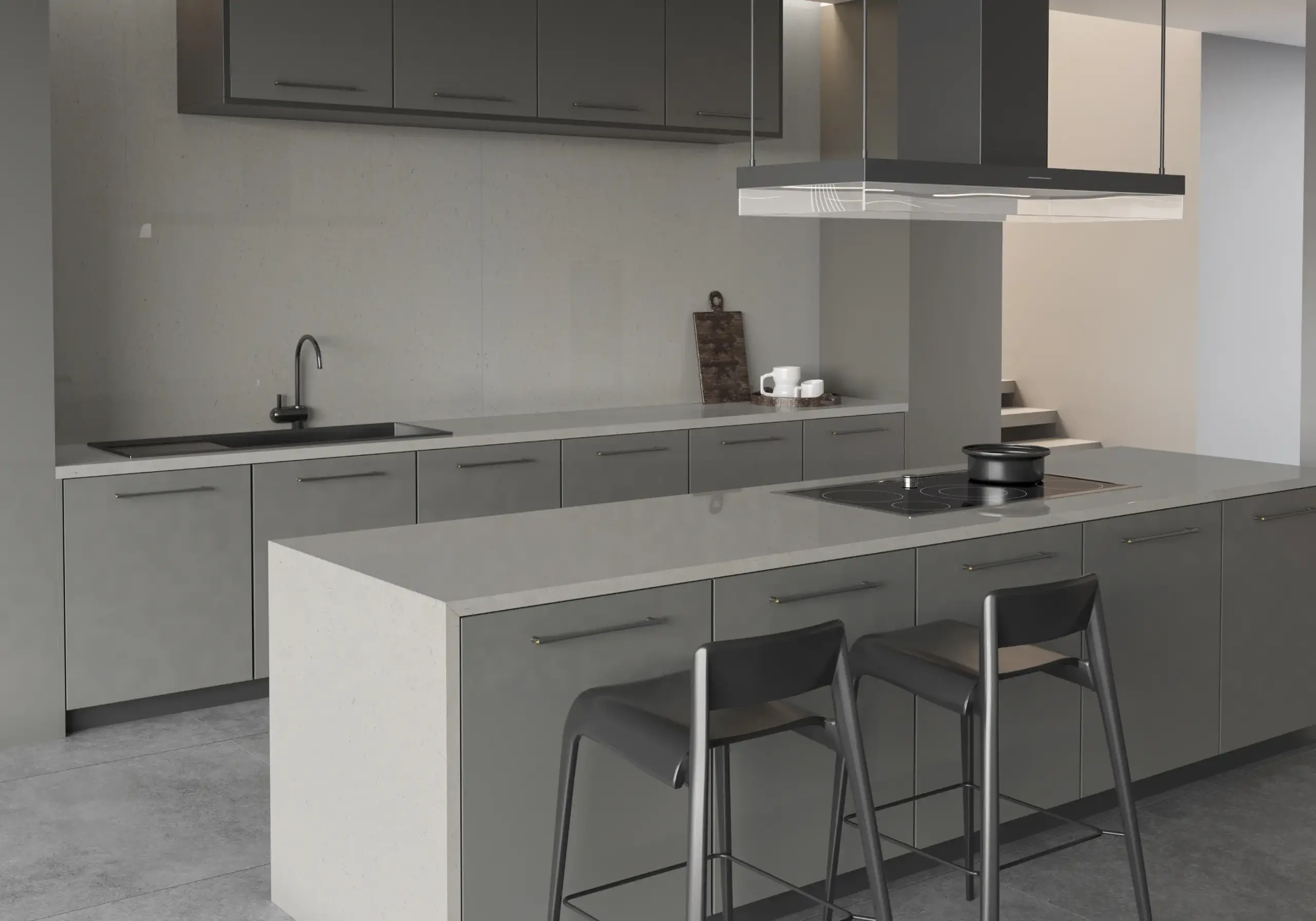
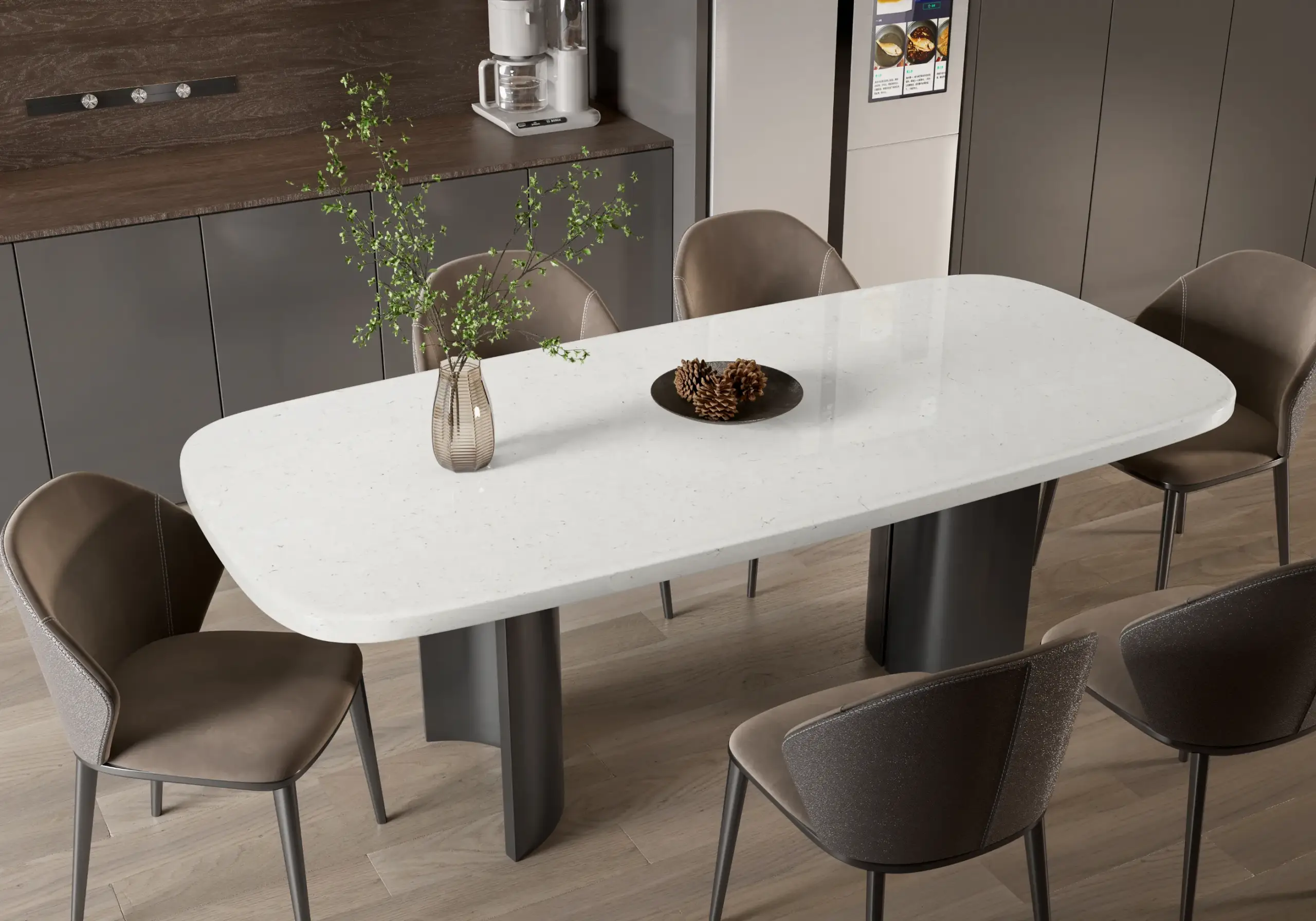
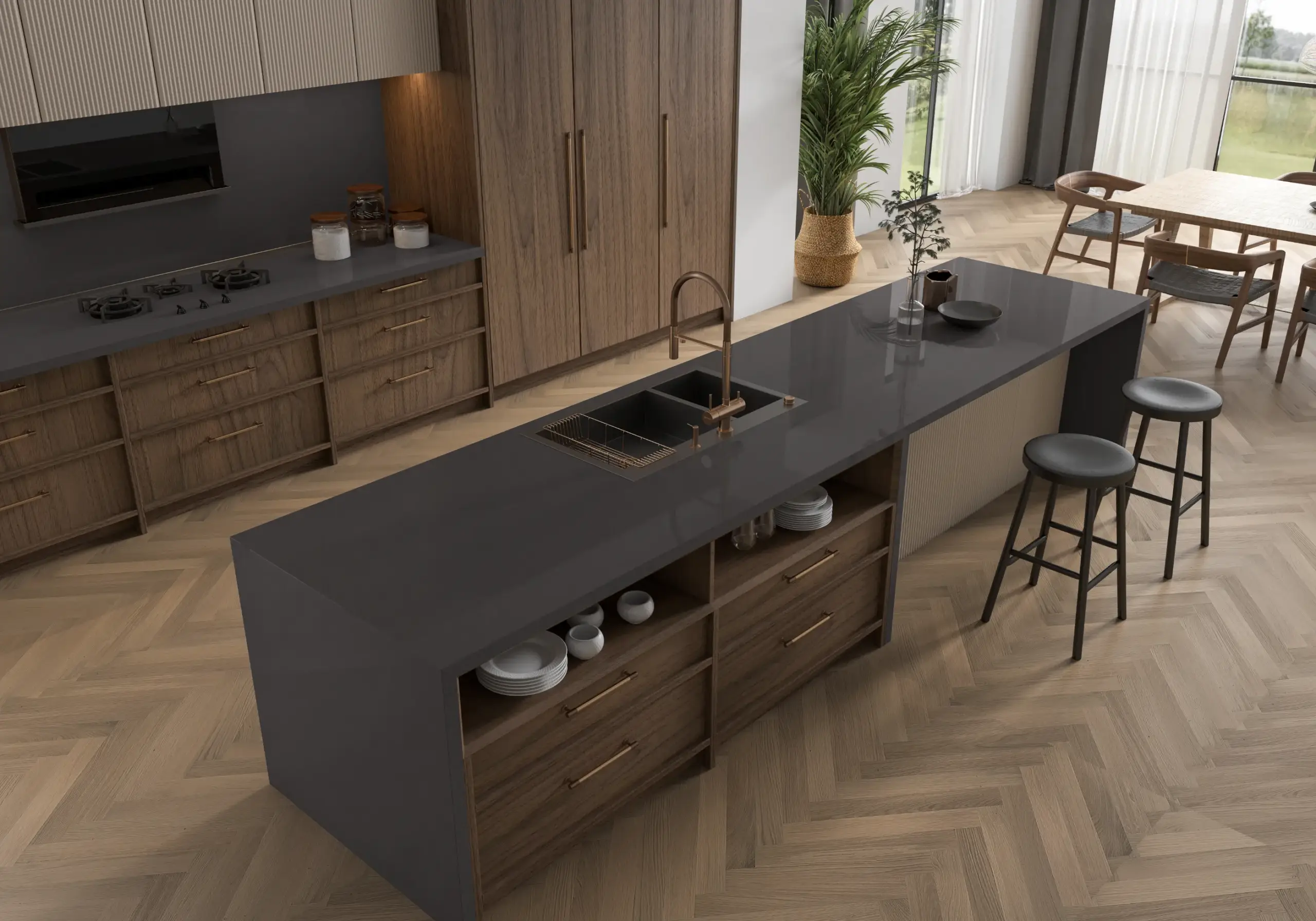
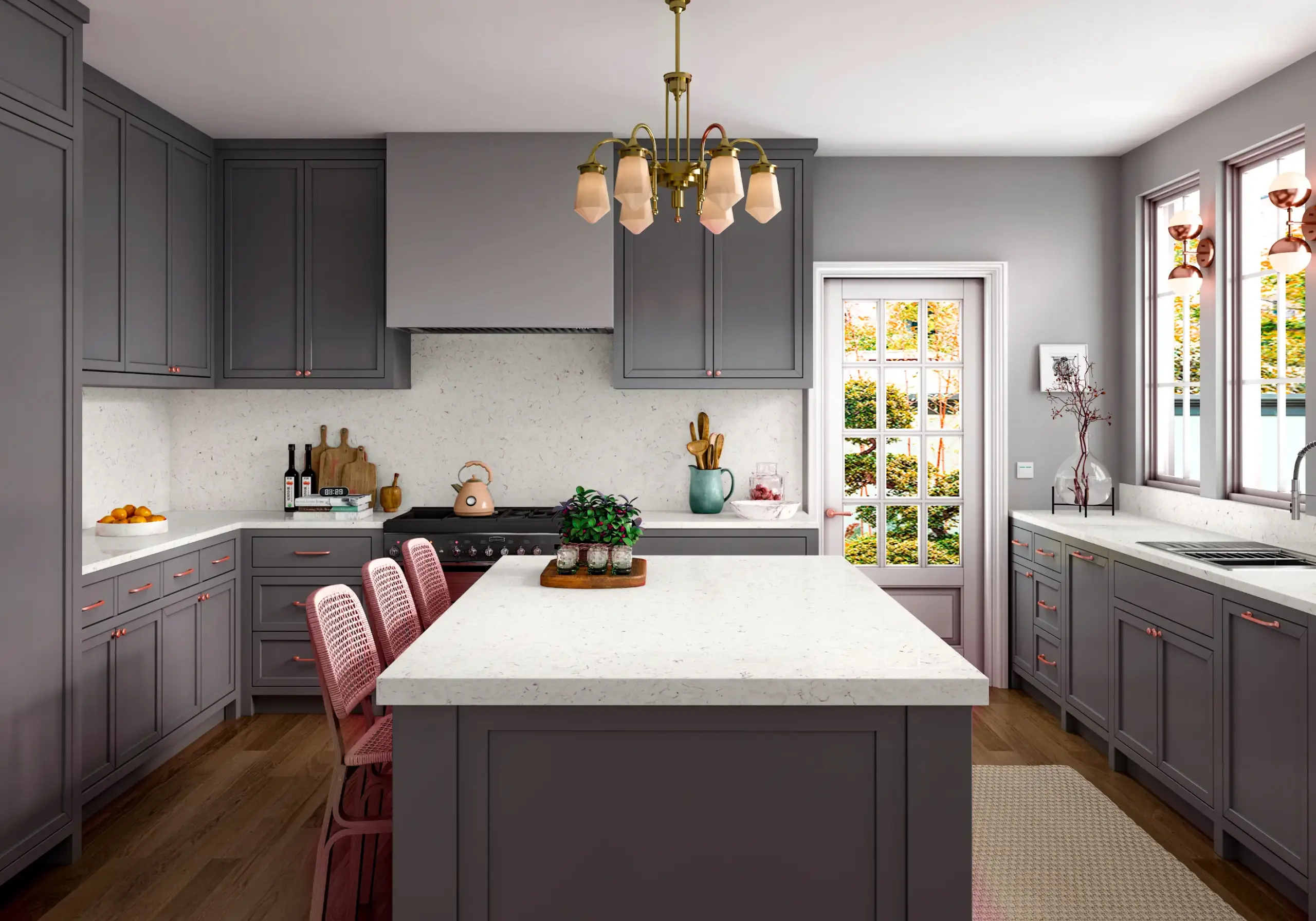
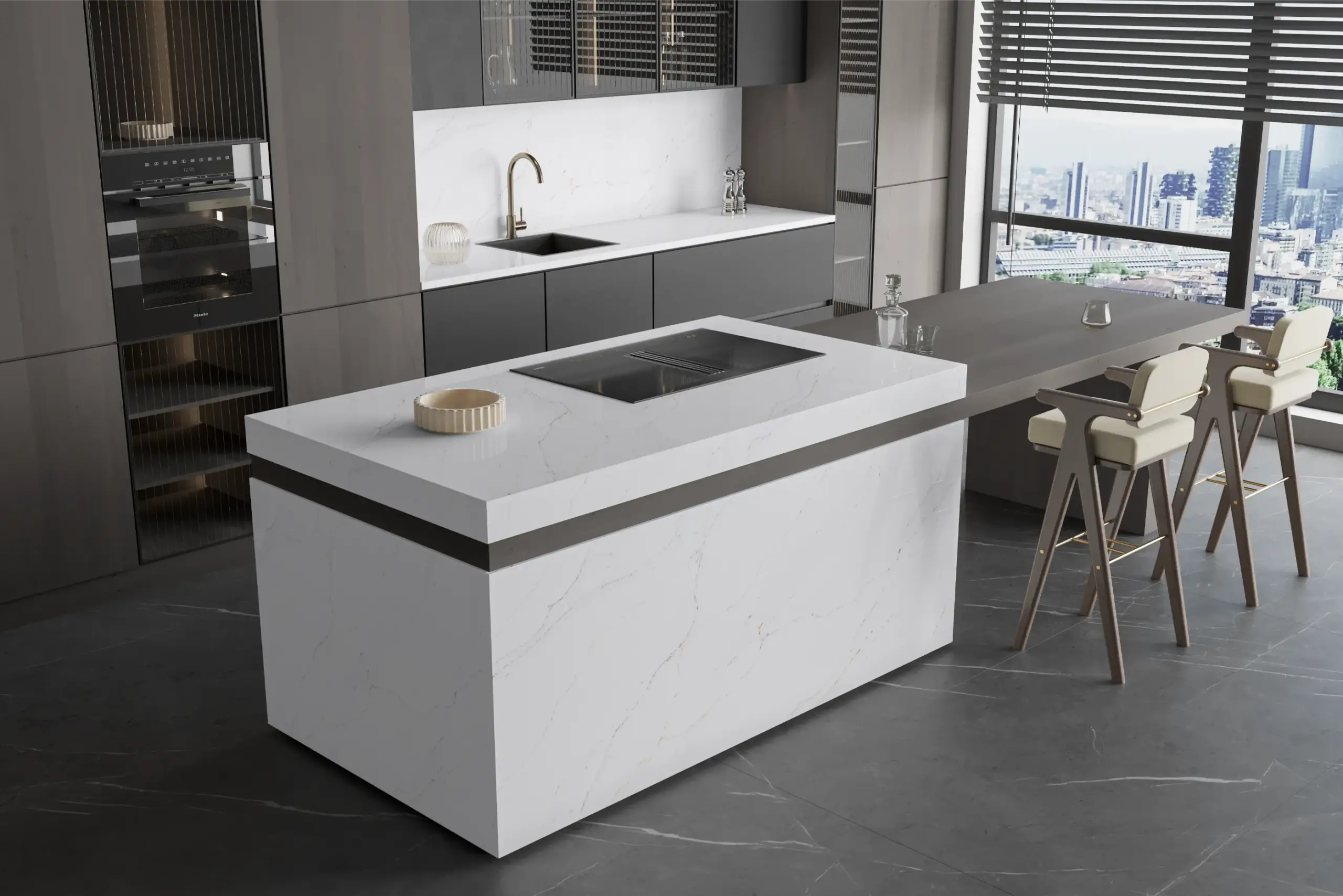
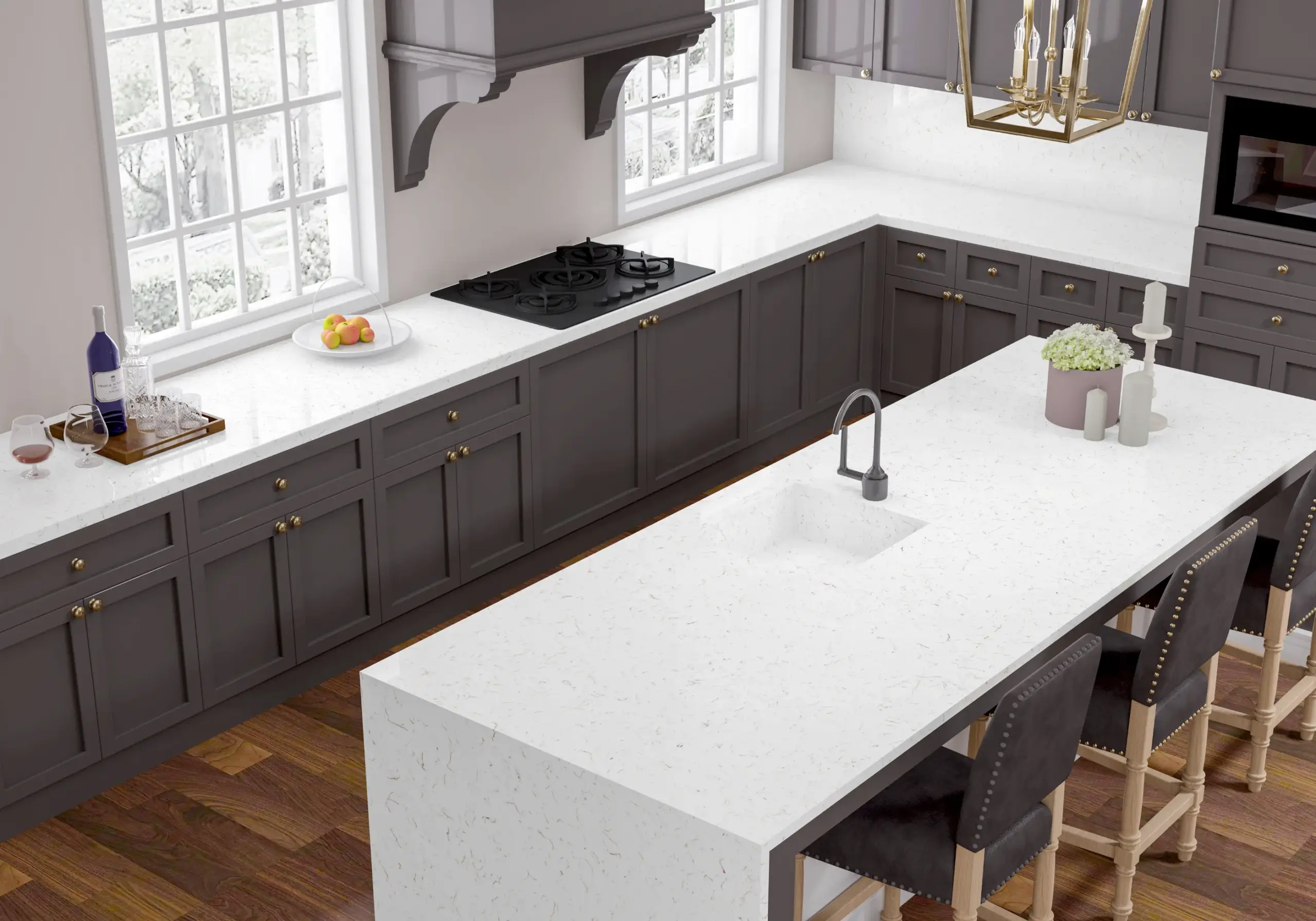
Kitchen Countertops
The primary application — a seamless, easy-to-clean, heat-tolerant workspace available in polished, matte, and leathered finishes to suit anything from minimalist modern to traditional Indian kitchen design.
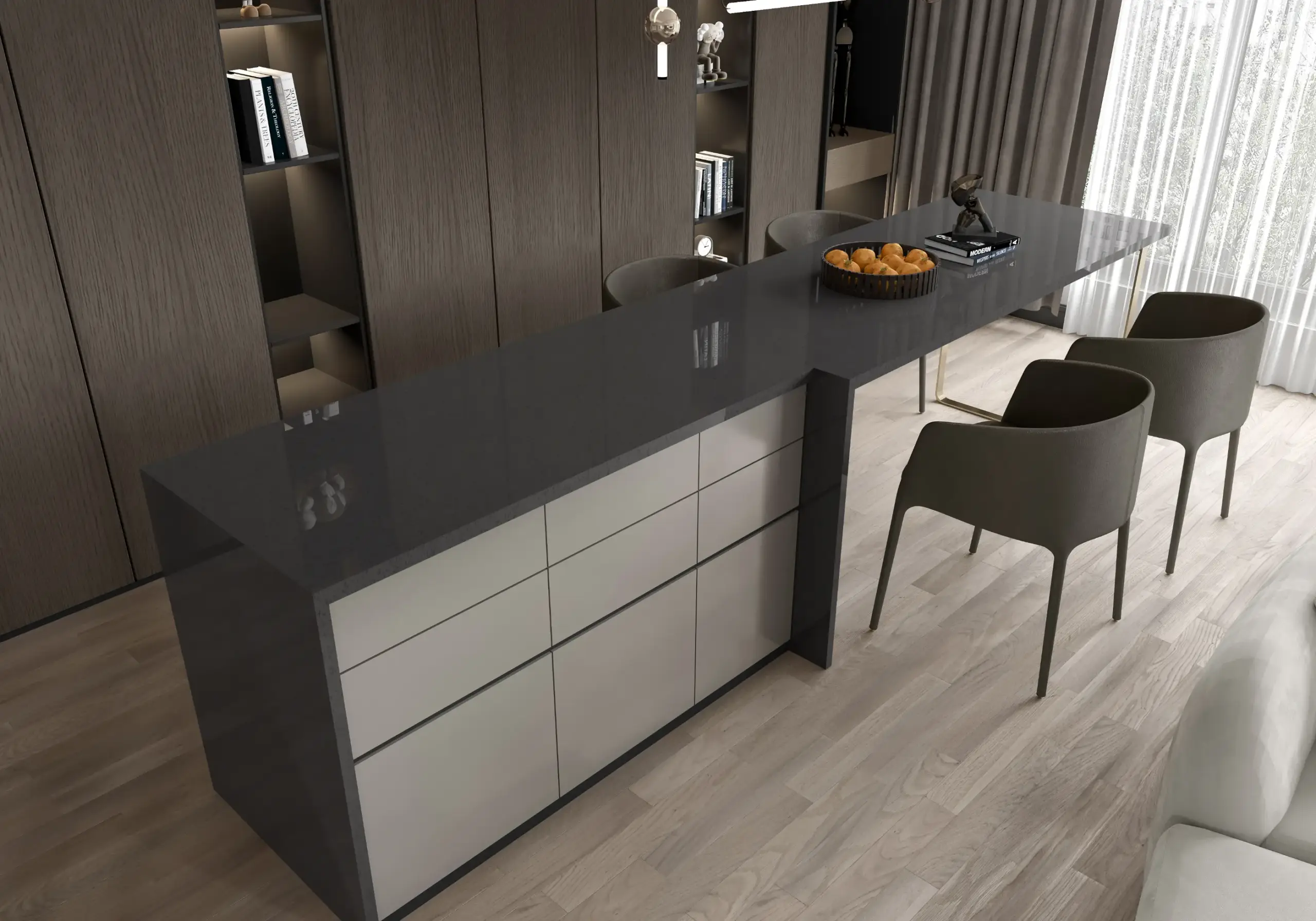
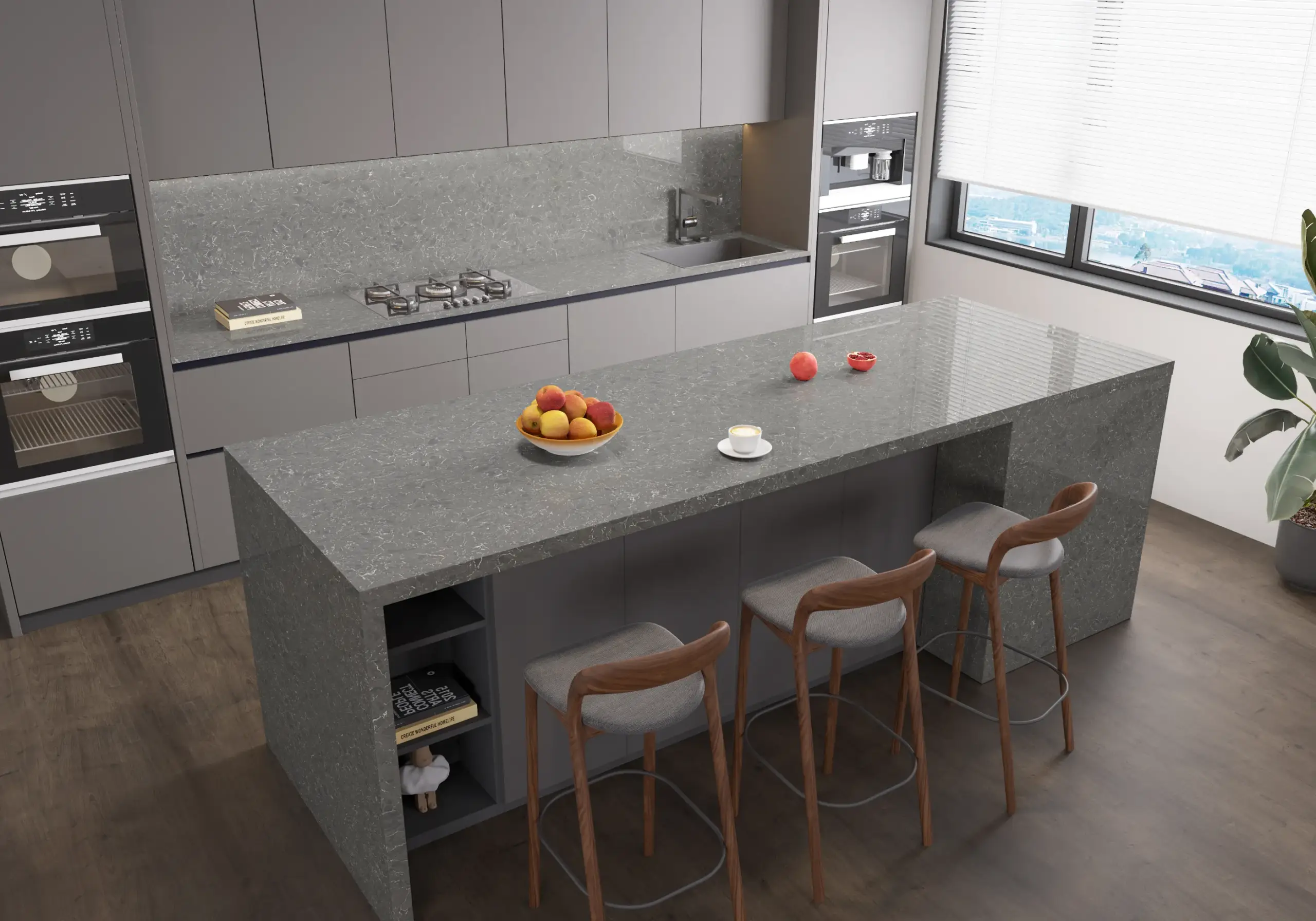
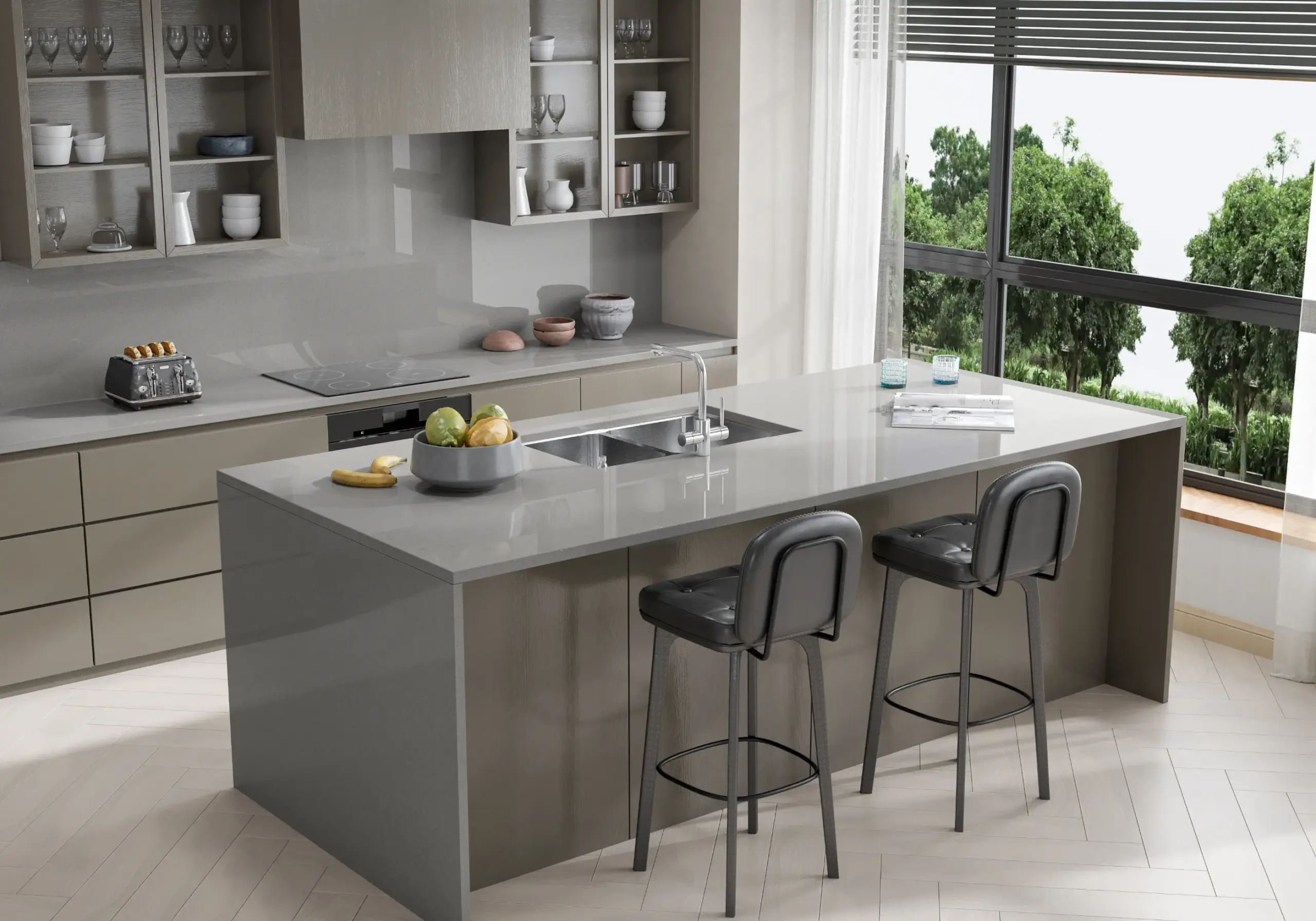
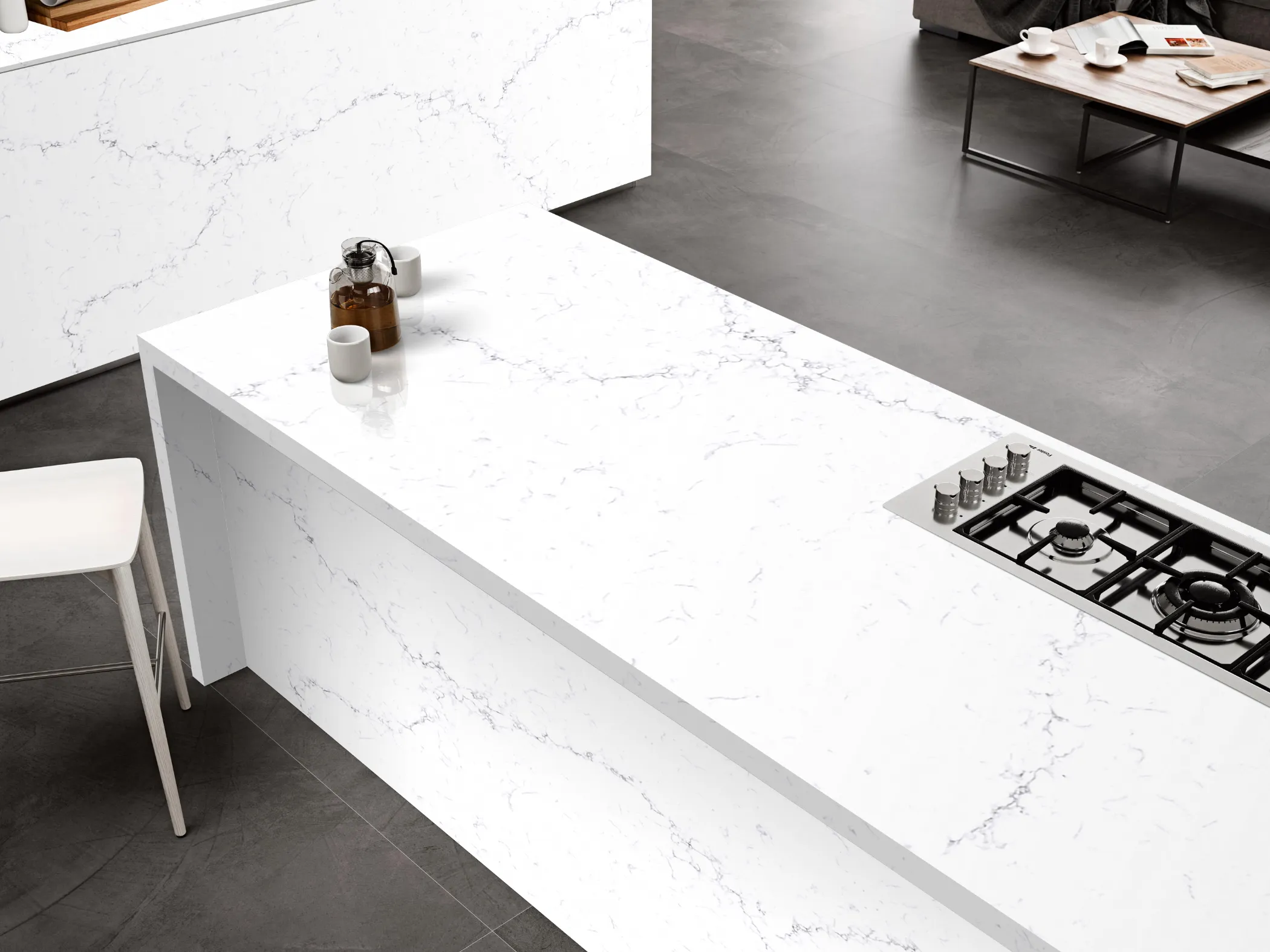
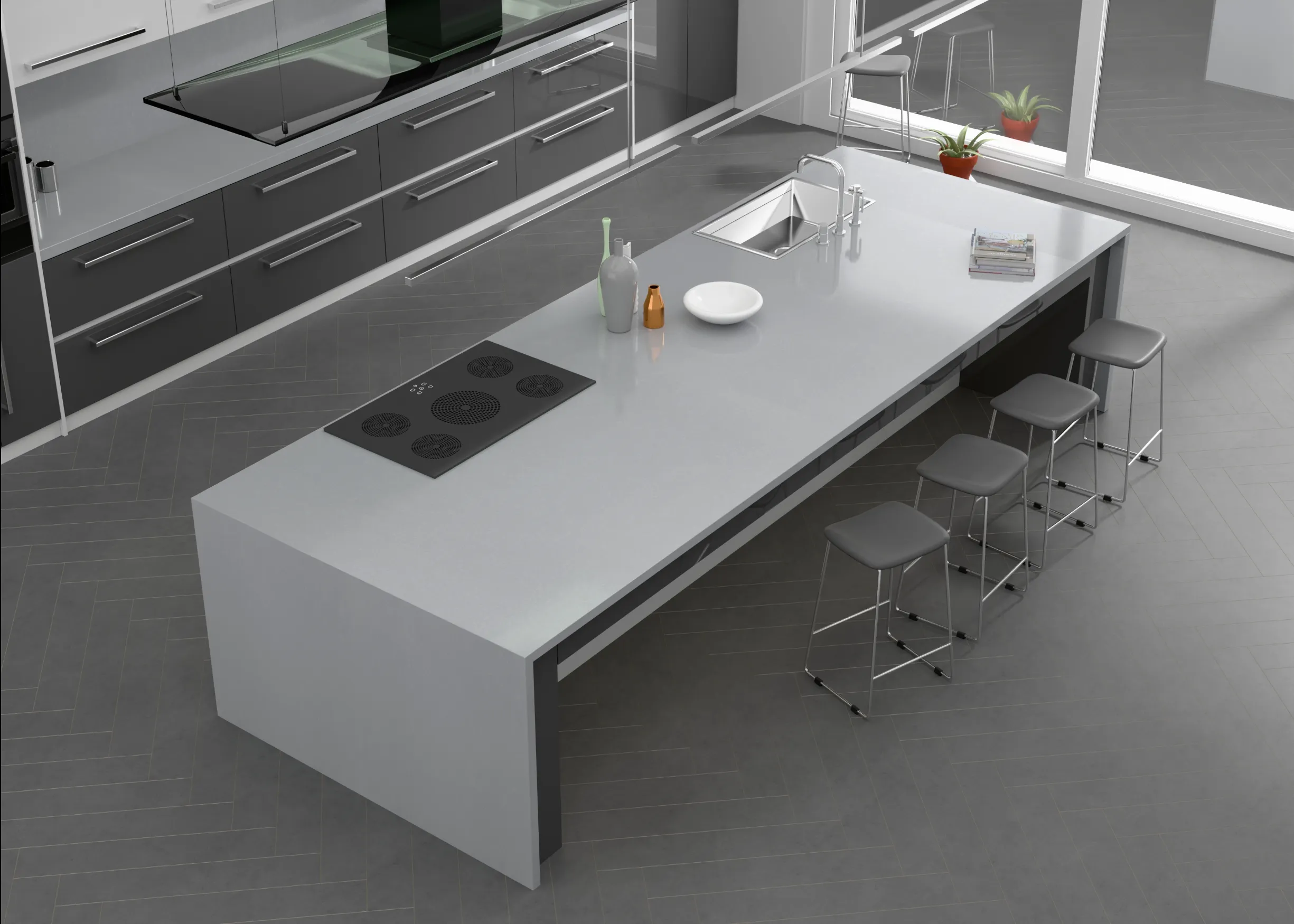
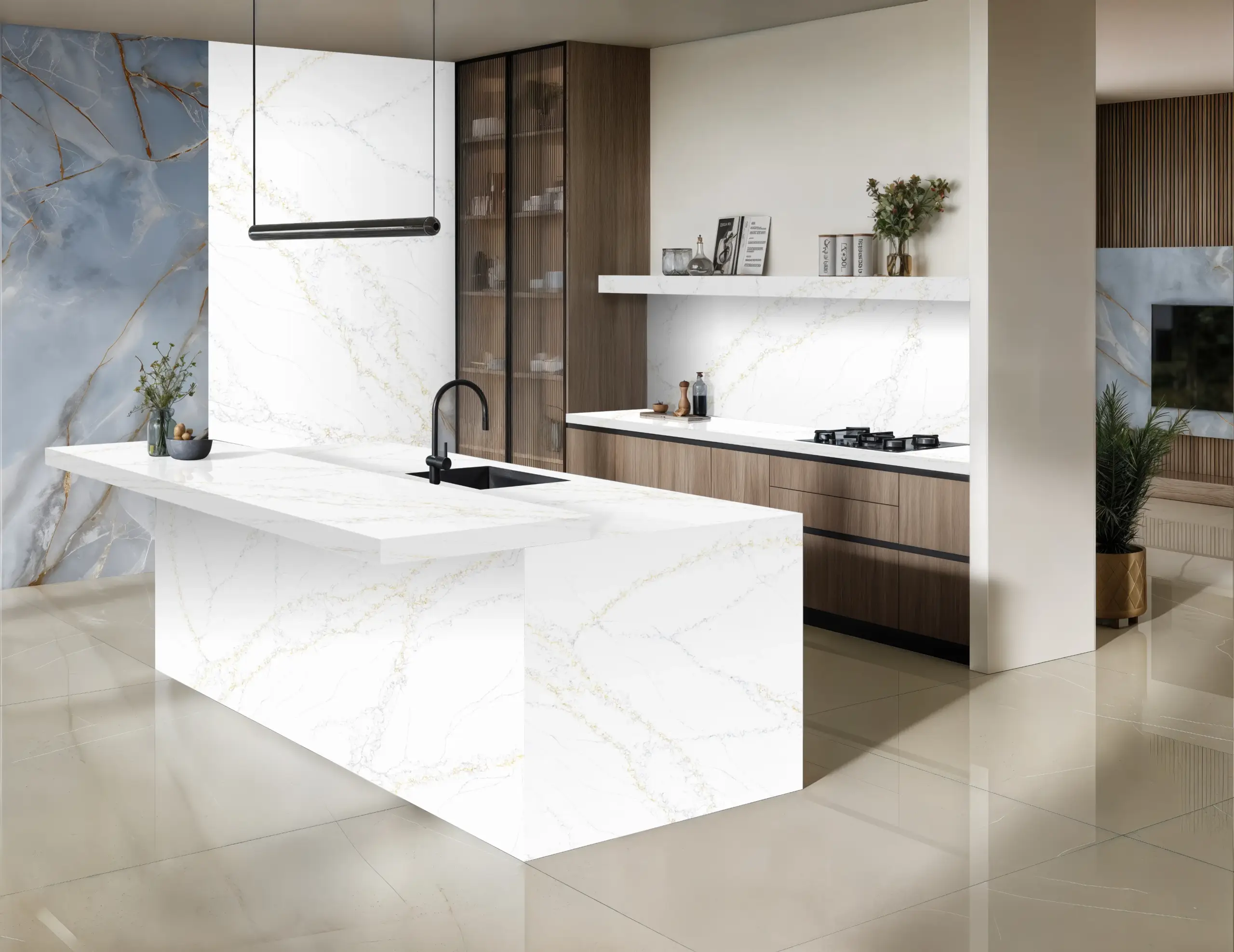
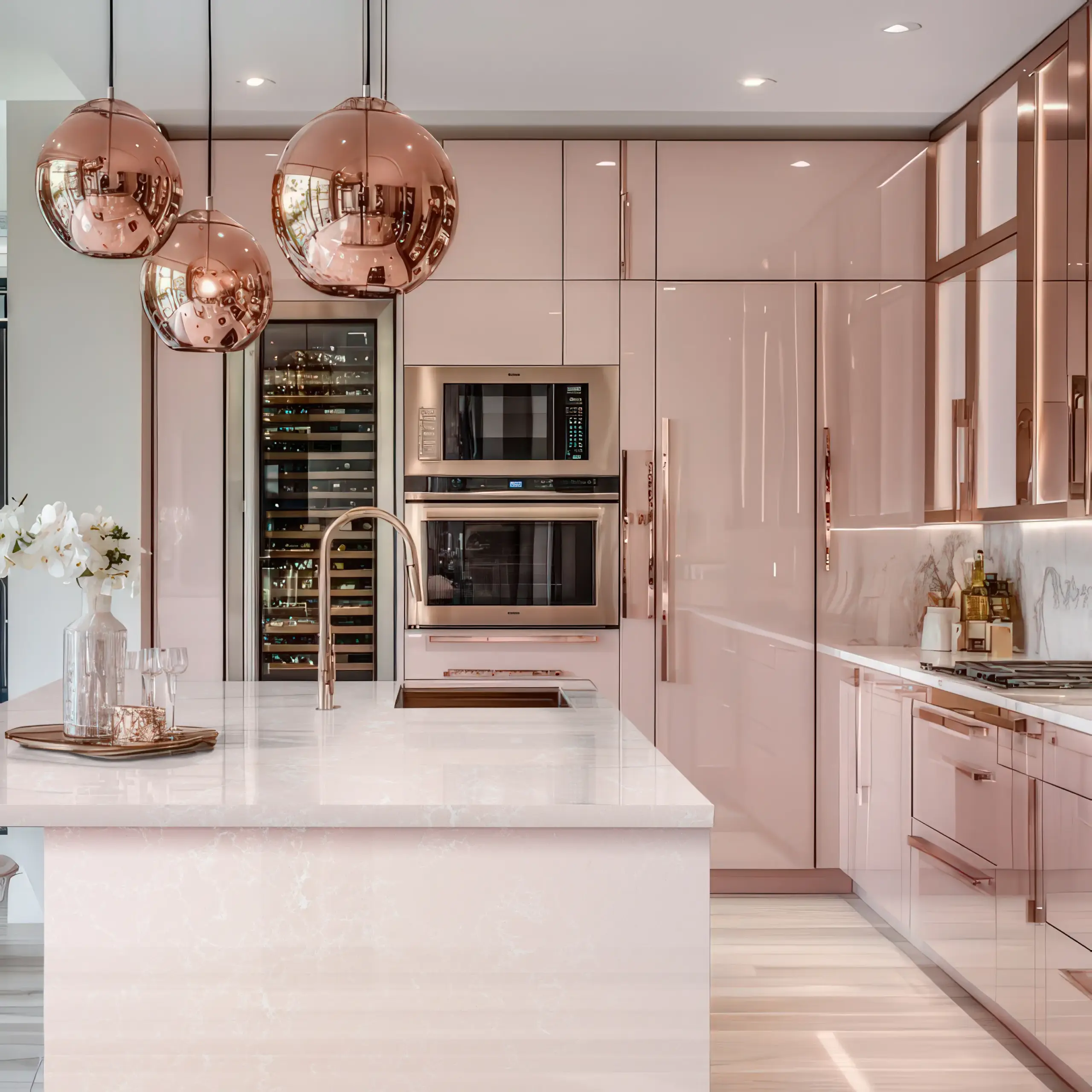
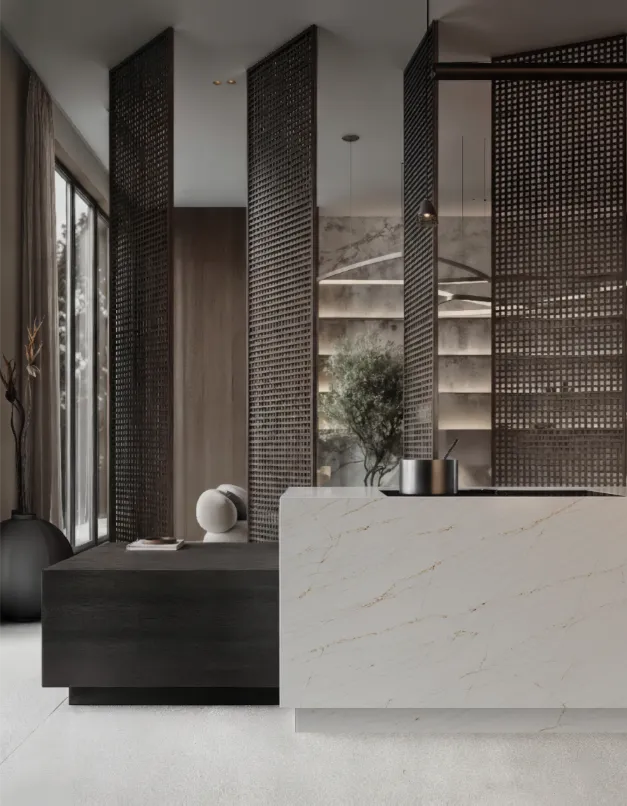
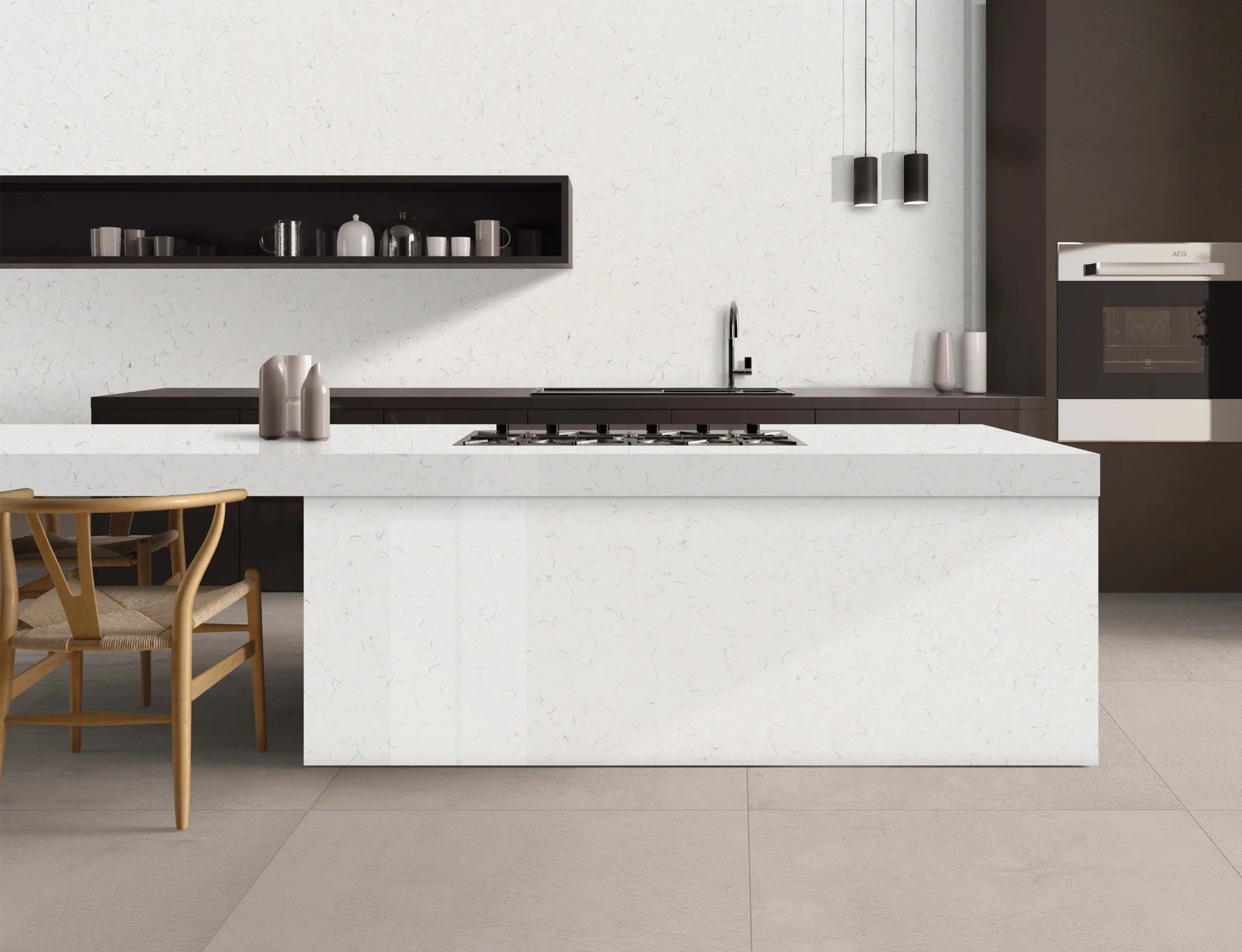
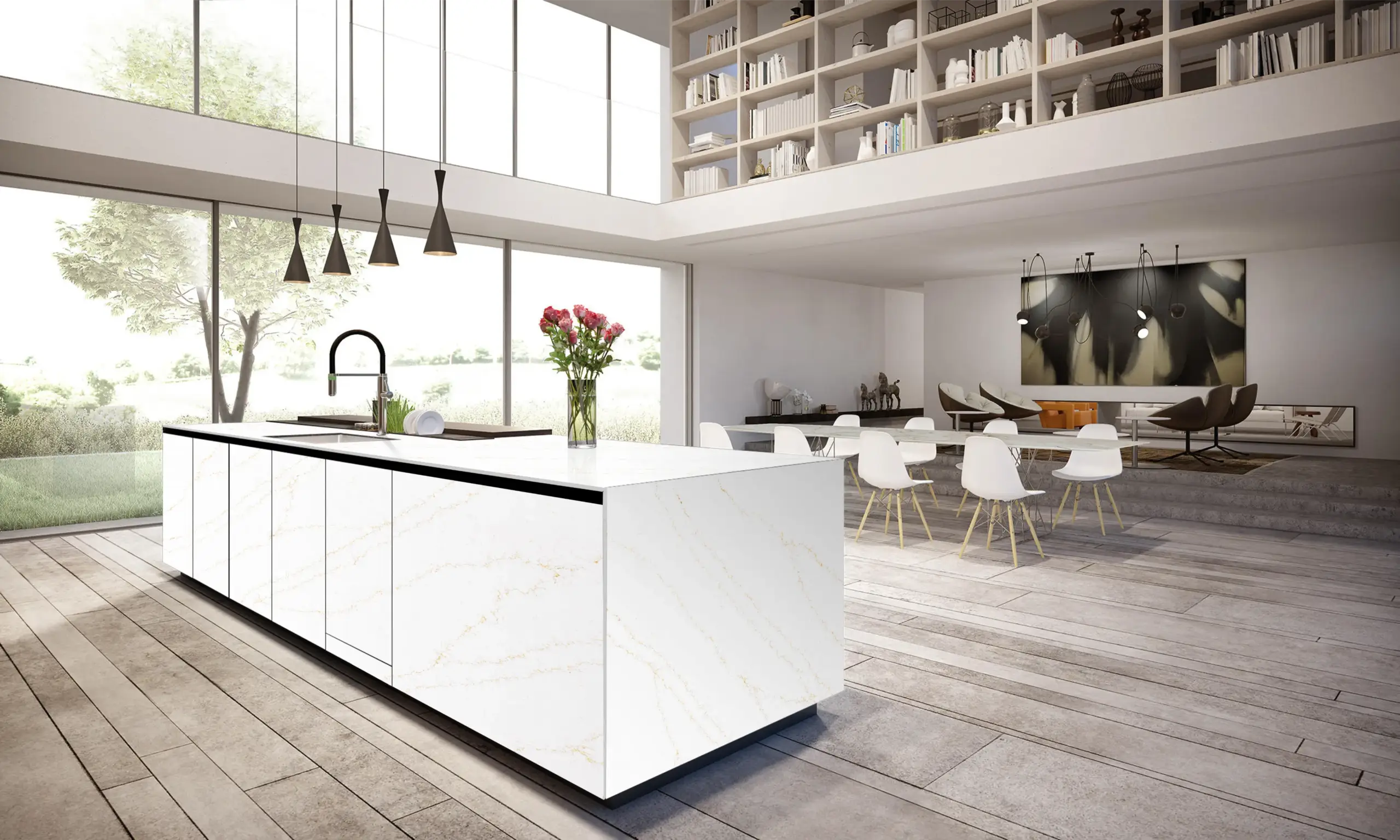
Kitchen Islands
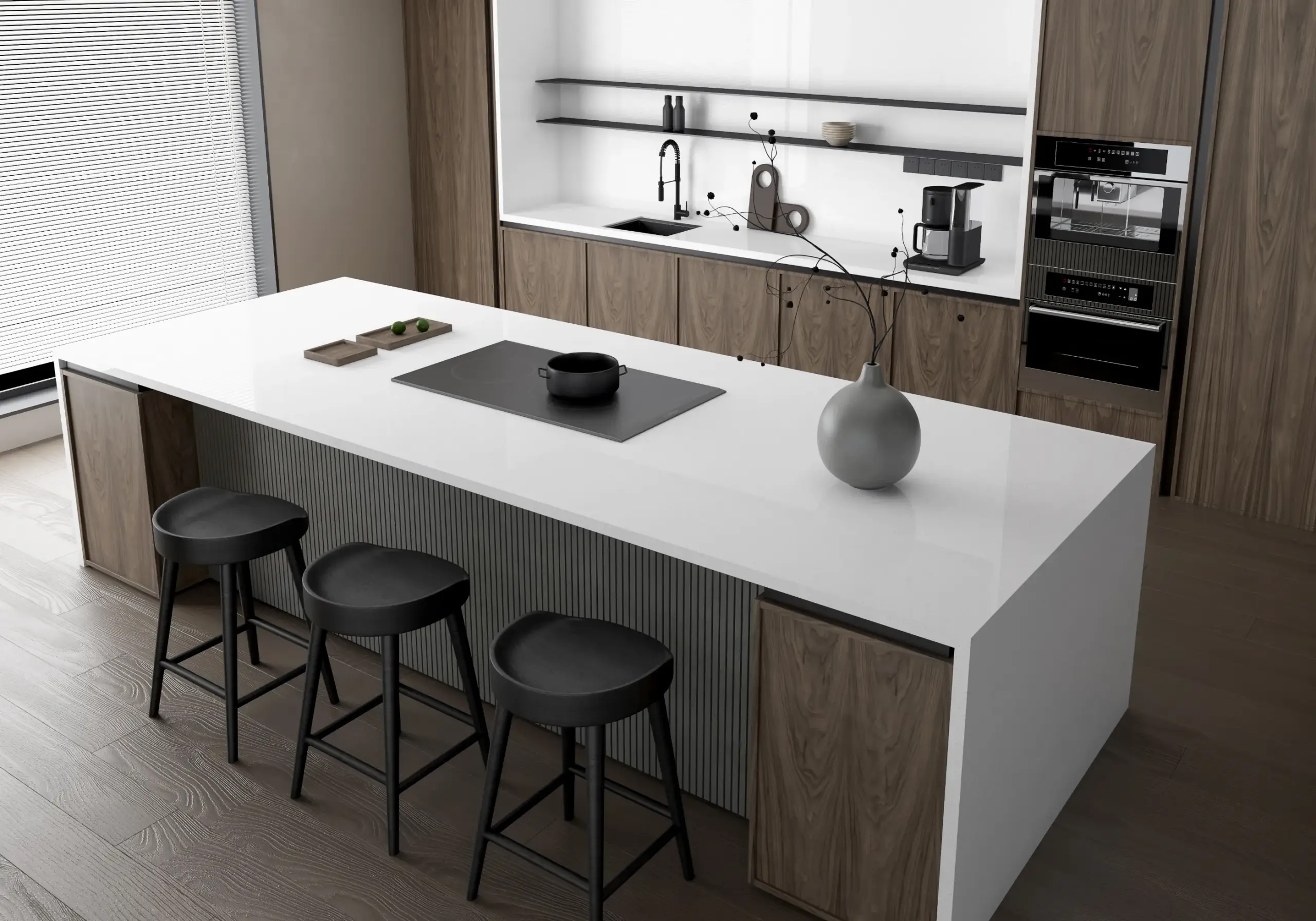
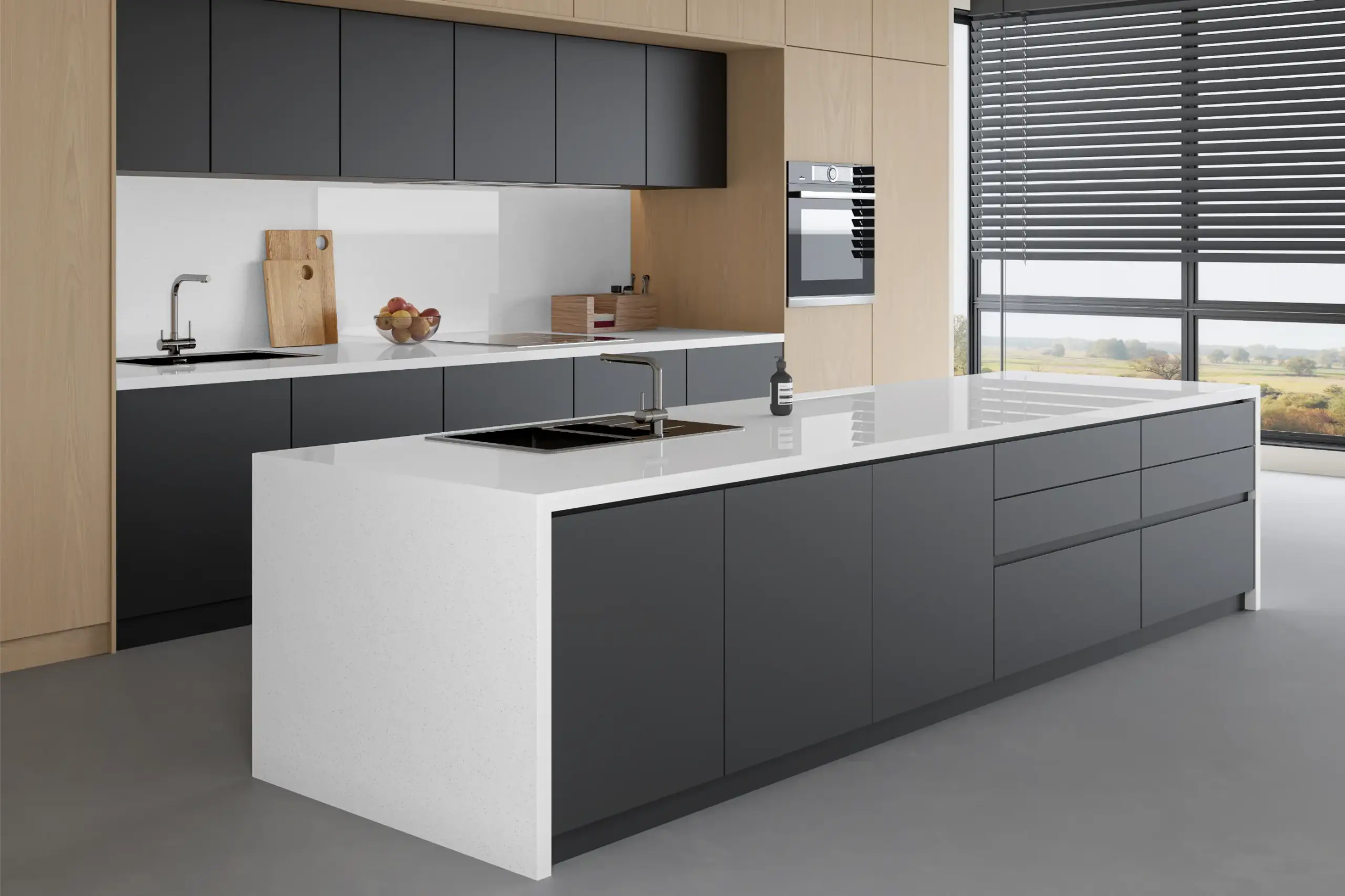
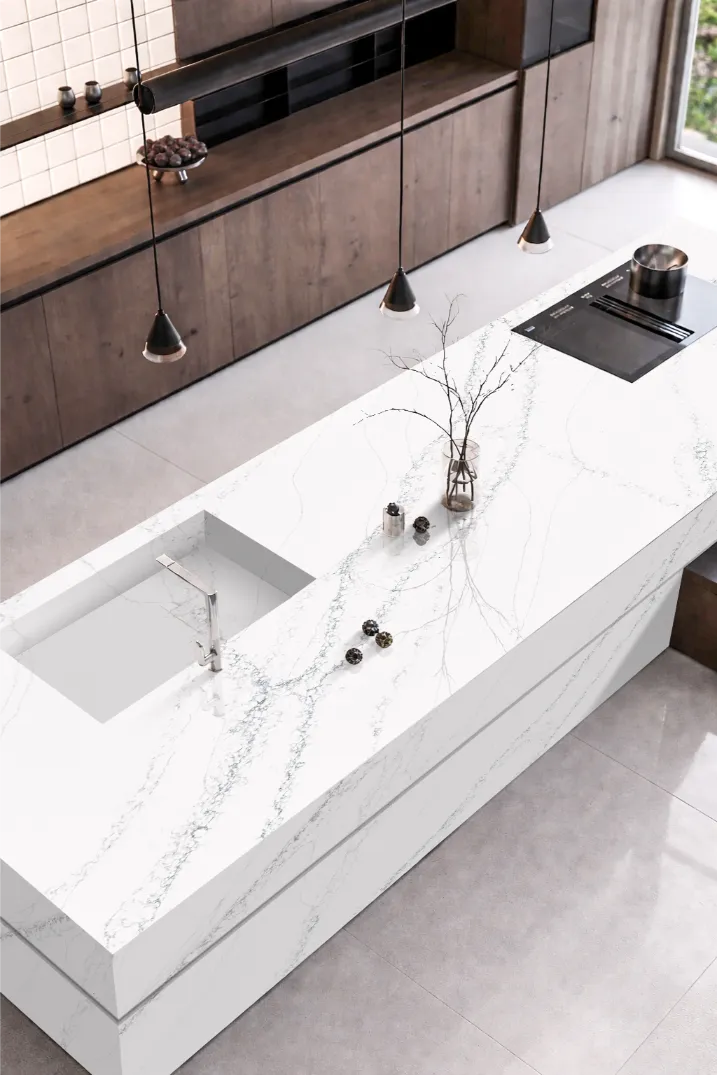
Islands absorb the heaviest daily load — prep station, dining ledge, and display surface at once. Quartz handles that multi-purpose use without chipping, staining, or dulling over years.
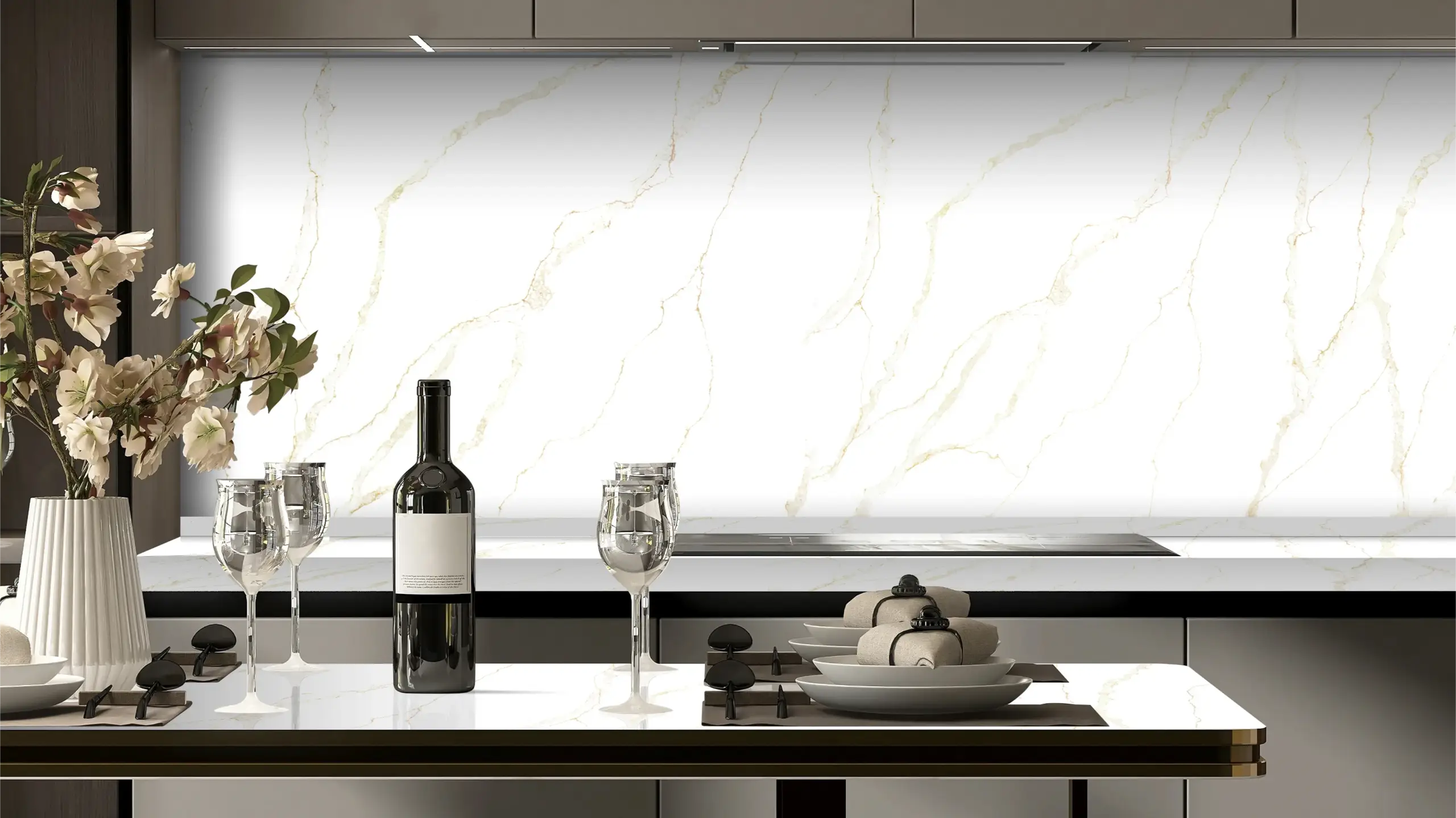
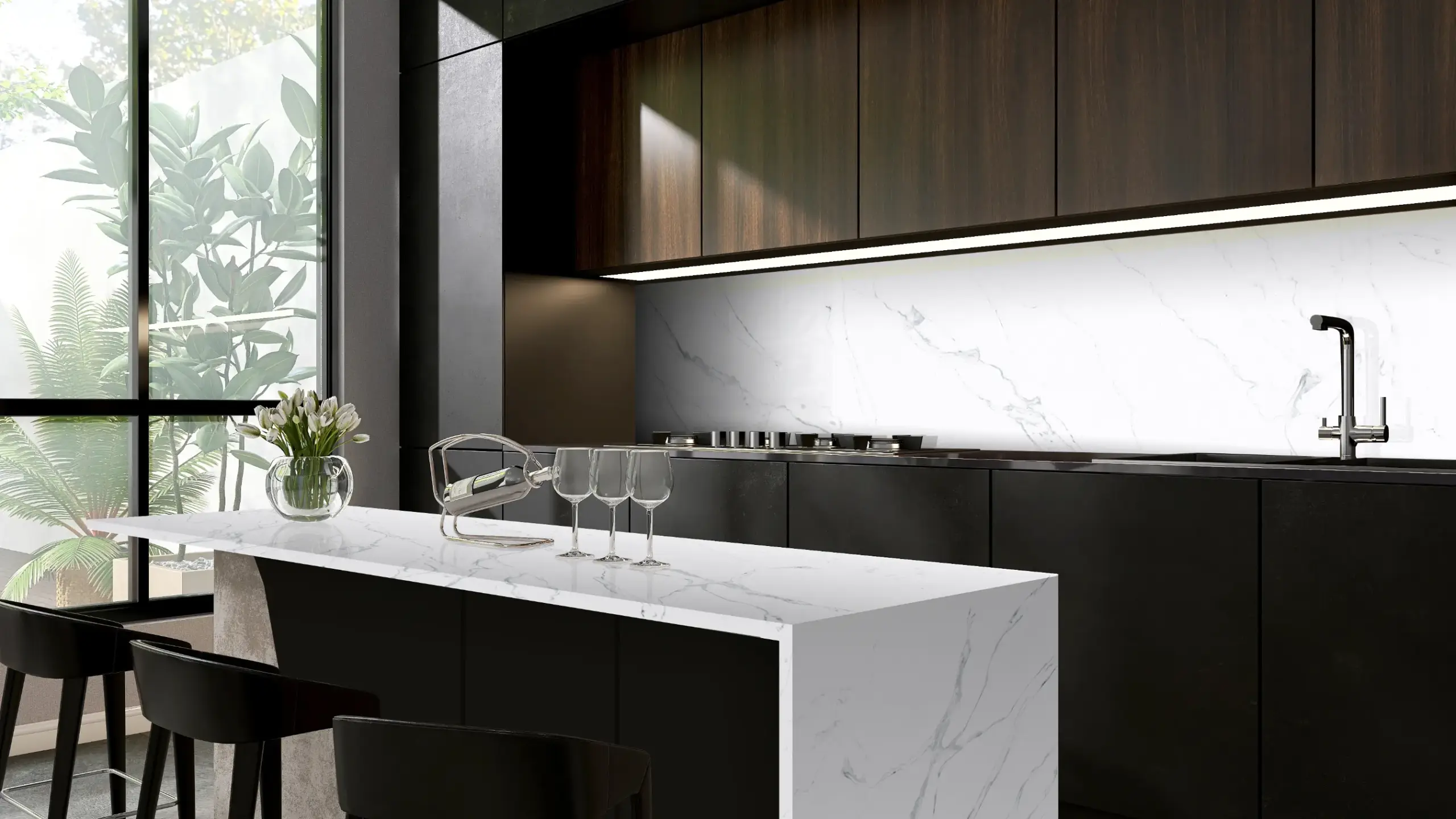
Kitchen Backsplashes
A quartz backsplash removes grout lines entirely — the main source of wall staining and bacterial build-up around a hob. It’s more hygienic and visually cleaner than tiled alternatives.
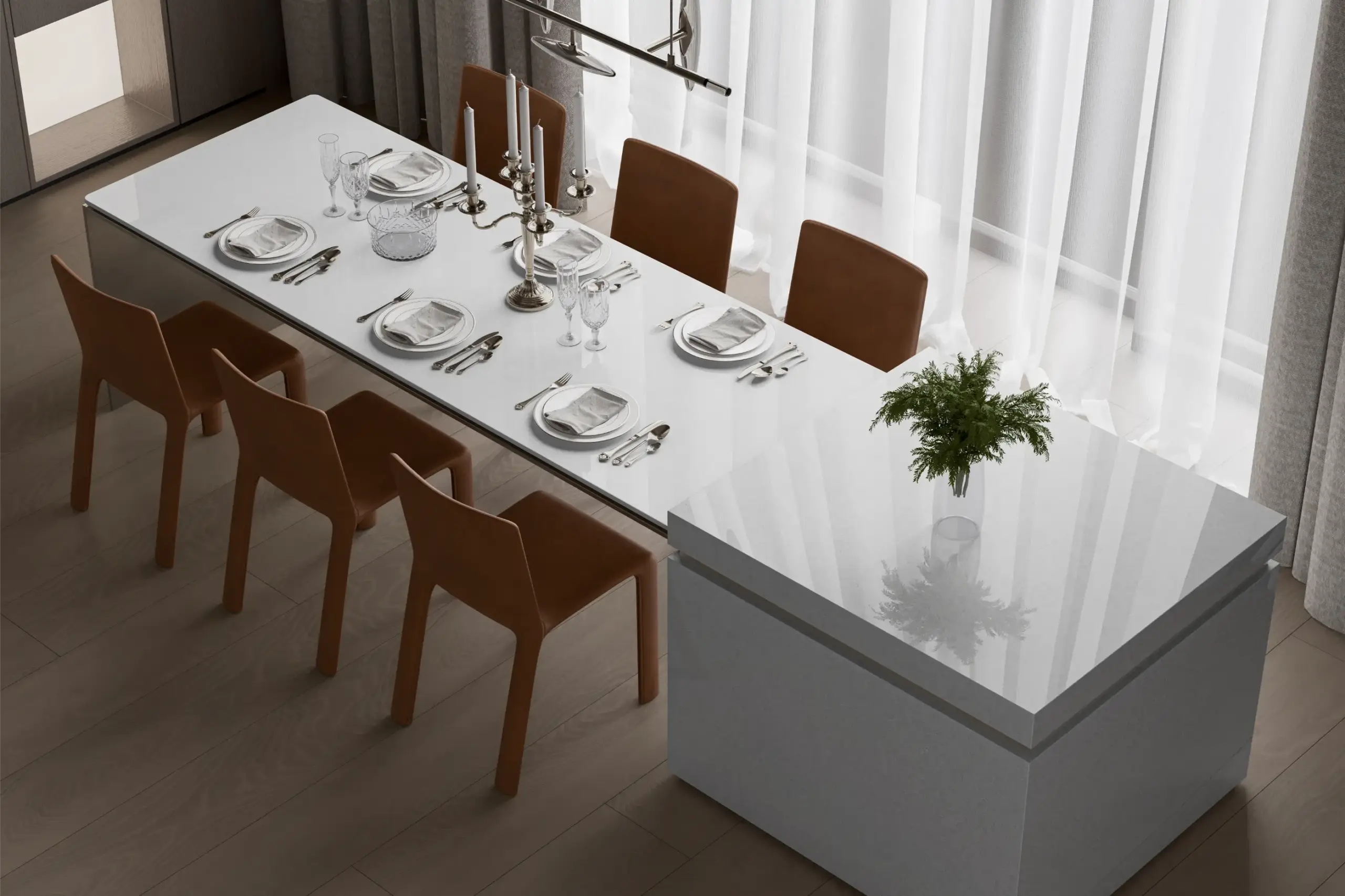
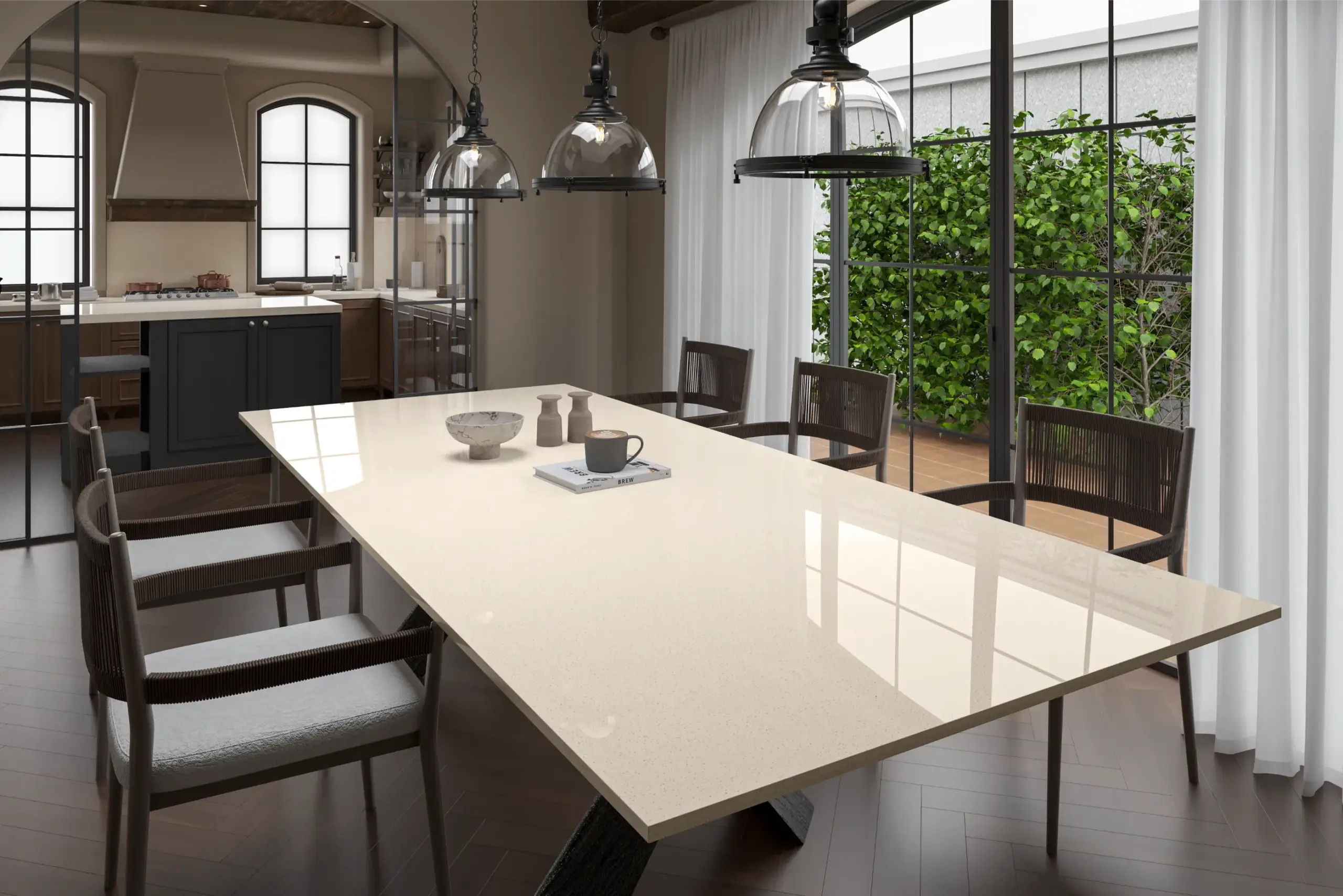
Breakfast Bars & Dining Ledges
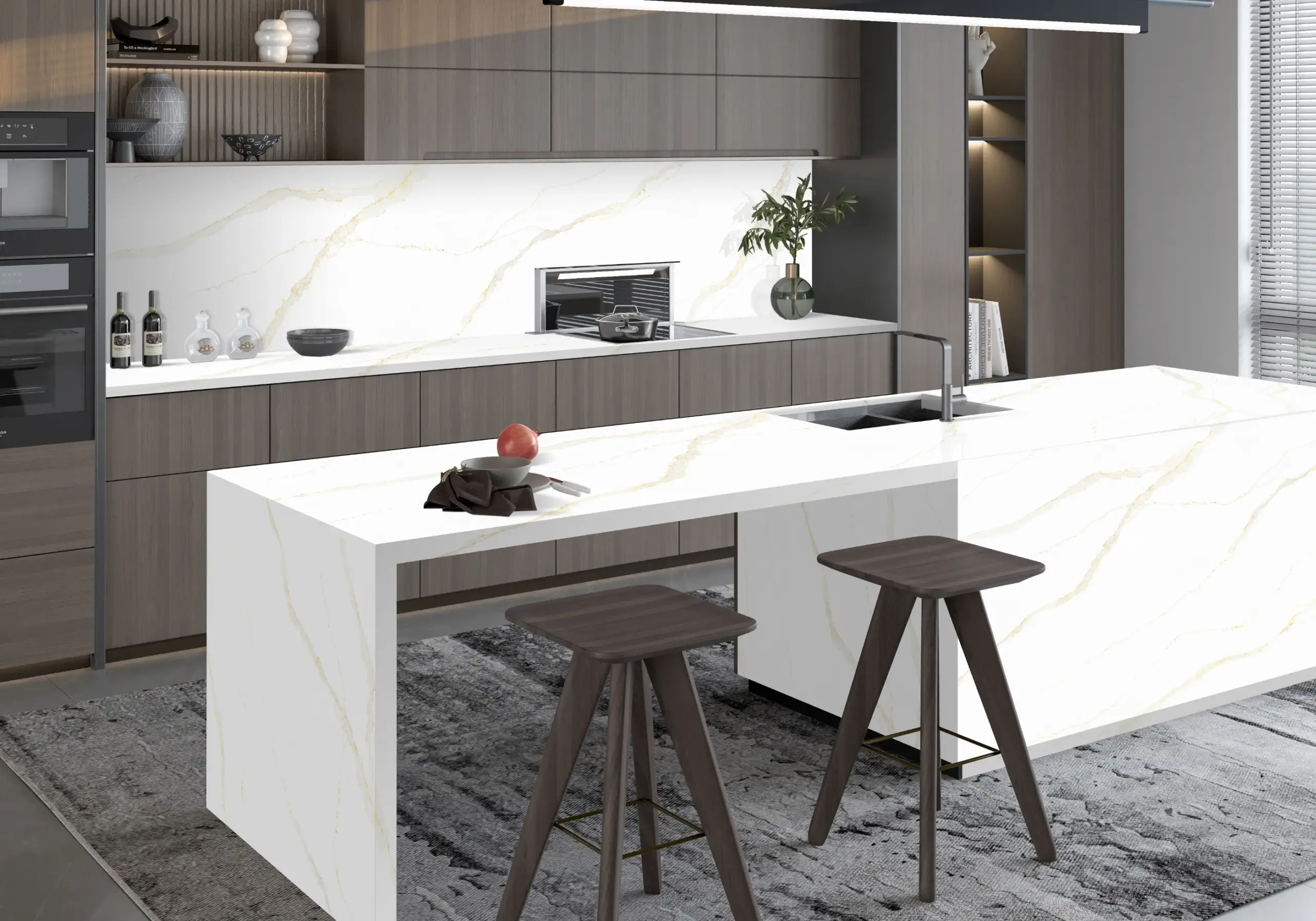
For open-plan kitchens, quartz extends naturally into breakfast bar overhangs and dining ledges, staying structurally sound and visually continuous with the main counter.
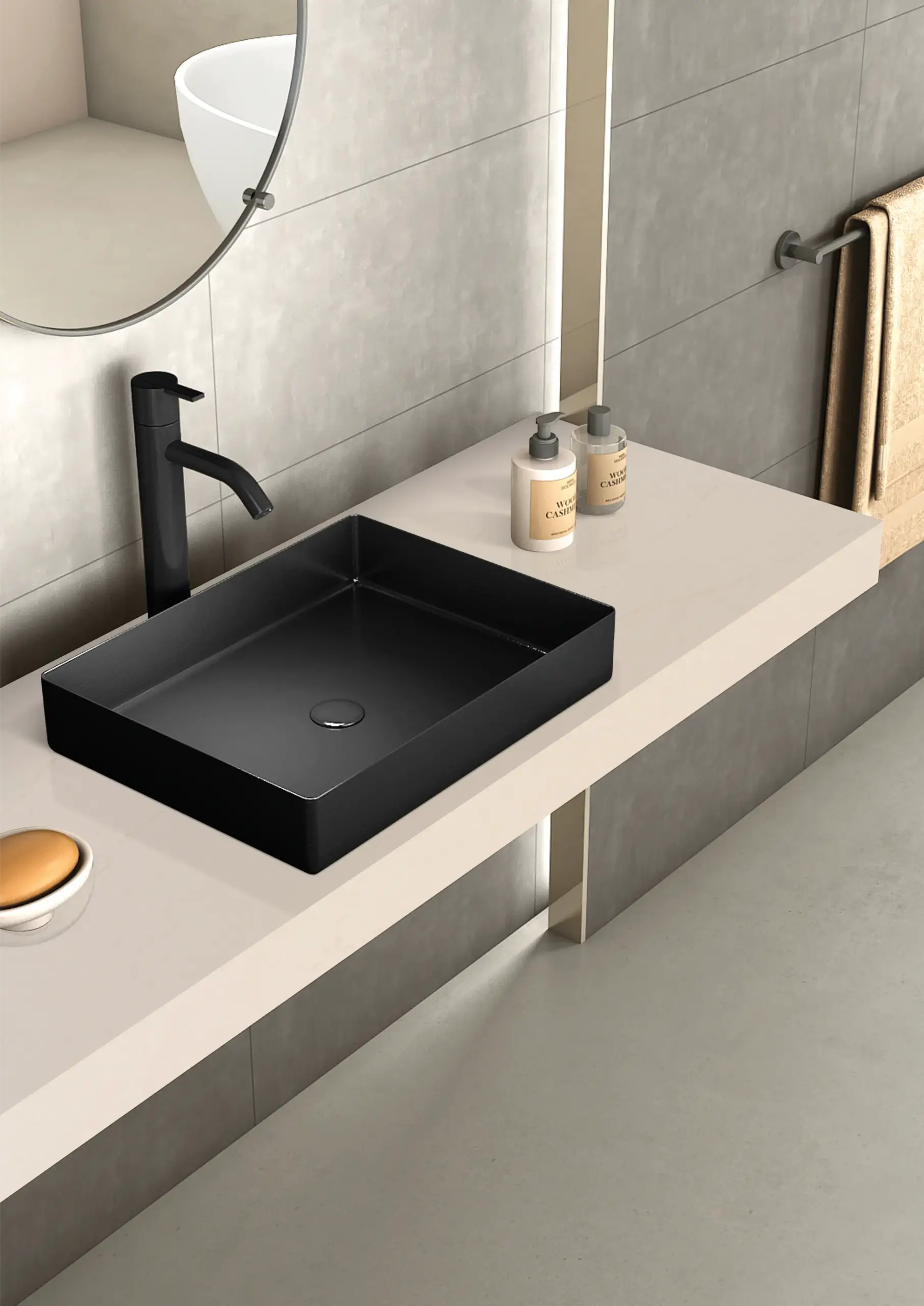
Under-Sink Areas
Constant water exposure makes the non-porous, mould-resistant nature of quartz especially valuable around and under the sink.
Quartz vs Granite vs Marble vs Laminate — Full Comparison
Feature | Quartz (Universal Quartz) | Granite | Marble | Laminate |
Porosity | Non-porous | Porous | Porous | Semi-porous |
Stain resistance | Excellent | Good | Poor | Moderate |
Scratch resistance | Very High (Mohs 7) | High | Low | Low |
Sealing required | Never | Annually | Frequently | Not applicable |
Food safety certification | NSF/ANSI 51 | Not certified | Not certified | Varies |
Slab consistency | Engineered uniform | Variable | Variable | Uniform |
Typical lifespan | 15–25+ years | 10–20 years | 10–15 years | 5–10 years |
Choosing a Kitchen Shade — By Collection
Modular kitchen buyers usually shop by colour and finish first, brand second. Here’s how to think about Universal Quartz’s eight collections specifically for kitchen use — the tonal direction each one leans toward, and the kitchen style it suits best. Exact swatch names and current stock vary by branch; request physical sample chips before finalising, since colour reads differently under kitchen lighting than in a catalogue.
Collection | Tonal Direction | Best Suited Kitchen Style |
Harmony | Clean whites, calm neutrals | Minimalist, Scandinavian-inspired |
Jupiter | Bold marble-look veining | Premium modular, statement islands |
Saturn | Warm neutrals, sandy tones | Wood cabinetry, traditional Indian |
Venus | Soft whites and ivories | Light-filled, airy modern kitchens |
Mercury | Industrial concrete greys | Contemporary, loft-style kitchens |
Mars | Rich earthy browns | Traditional and heritage interiors |
Neptune | Cool blue-grey tones | Coastal, premium modern kitchens |
Uranus | Bold, dramatic darks | Statement kitchens, dark cabinetry |
What Does a Quartz Kitchen Slab Cost in India?
Kitchen quartz pricing depends on four factors, in order of impact: slab thickness (12mm, 18mm, or 20mm), the collection and pattern complexity, the fabrication work involved (cutouts, edge profiles, seams), and your branch location and order volume. Because these variables shift the number significantly project to project, Universal Quartz quotes per project rather than publishing a flat per-square-foot rate — this keeps the number you receive accurate rather than a starting figure that gets revised upward at site measurement.
For budgeting purposes: 20mm is the standard thickness for countertops, 30mm is used for islands and high-load surfaces, and 12–18mm is typical for backsplashes. Your nearest branch can give you a firm quote once slab thickness and area are confirmed.
Why Quartz Outperforms Every Other Kitchen Surface
1. Unmatched Hygiene — NSF Certified Food Contact Safe
Independently verified for direct food contact — essential where wet grinding, raw meat prep, and daily cooking share the same surface.
2. Zero Maintenance, Maximum Longevity
No annual sealing, no etching from acidic foods, no swelling from moisture. A wipe with mild soap and water is the entire maintenance routine, saving real cost and effort over a 10–15 year horizon.
3. Scratch & Impact Resistance
At Mohs 7, quartz resists scoring from knives, utensils, and heavy vessels under normal daily use. (A cutting board still protects your knives, not the counter.)
4. Heat Tolerance
Brief contact with warm vessels is fine; for sustained heat from a pan straight off the burner, a trivet is recommended — standard practice for any surface, natural or engineered.
5. Consistent Aesthetics Across the Kitchen
Countertop, island, and backsplash stay visually cohesive because every slab is engineered to match — something natural stone quarrying cannot guarantee.
6. Design Range
Eight collections span pure whites, warm neutrals, and bold dark tones, so the material adapts to the kitchen design rather than limiting it.
How to Choose the Right Quartz for Your Kitchen
- Step 1 — Define your kitchen style: modern minimalist, traditional Indian, rustic, or industrial. Let the quartz pattern complement your cabinetry and flooring, not compete with it.
- Step 2 — Pick the finish: polished (bright, reflective — best for lighter kitchens), matte/honed (fingerprint-resistant — best for dark or heavy-use kitchens), or leathered (textured, natural-stone look).
- Step 3 — Match to household usage: busy family kitchens do well with mid-tones and matte finishes; showpiece kitchens can carry lighter, more dramatic patterns.
- Step 4 — Request physical samples: colour reads differently under kitchen lighting than in a catalogue or on-screen.
- Step 5 — Plan slab continuity: order countertop and backsplash from the same production batch for exact colour and pattern match.
Installation & Care
Professional Installation
Quartz slabs run roughly 25–30 kg per square foot at 20mm thickness and require professional templating and precision cutting. Universal Quartz works with a trained fabricator and installer network across India.
Daily Care
- Wipe spills immediately with a soft cloth or sponge
- Clean with mild dish soap and warm water
- Use a non-abrasive plastic scraper for dried residue, followed by a damp cloth
What to Avoid
- Concentrated bleach-based cleaners applied directly to the surface
- Abrasive scrubbing pads
- Red-hot pans or pressure cookers placed directly on the surface — use a trivet
- Prolonged exposure to strong alkalis such as drain cleaners or oven degreasers
Why Architects & Designers Across India Specify Universal Quartz
Universal Quartz & Natural Stone Pvt. Ltd. is headquartered in Jaipur, Rajasthan — the centre of India’s stone industry — with 20+ years of manufacturing experience and a pan-India branch network. Architects, interior designers, and builders specify it for residential kitchens, hotel kitchens, restaurant counters, and commercial food-prep environments, backed by a certification stack — ISO 9001:2015, NSF/ANSI 51, GREENGUARD Gold, CE Marking, and LEED/IGBC-ready status — that most quartz manufacturers in India cannot match in full.
Pan-India branches: Jaipur (Head Office), Delhi/NCR, Mumbai, Chandigarh, Tamil Nadu, Gujarat, Nagpur, and UP/Uttarakhand, with export operations active in the United States and other international markets.
Frequently Asked Questions — Quartz Stone for Kitchen
Q1. What is the best quartz stone for a modular kitchen in India?
For modular kitchens, the priority is a non-porous, food-safe surface that matches uniformly across the countertop, island, and backsplash. Universal Quartz’s Harmony and Venus collections suit light modular schemes; Jupiter and Mercury suit bold contemporary modular designs. All eight collections carry NSF/ANSI 51 certification and Mohs 7 scratch resistance.
Q2. How much does a quartz kitchen slab cost in India?
Cost depends on slab thickness, collection, fabrication complexity, and branch location, so Universal Quartz provides project-based quotes rather than a flat listed rate. Contact your nearest branch or call +91 92160 14223 for an accurate quote based on your kitchen’s dimensions and chosen collection.
Q3. Is quartz better than granite for Indian kitchens?
Yes, for most Indian kitchen use cases. Granite is porous and needs annual sealing to resist staining and bacterial penetration; quartz is non-porous and never needs sealing. Quartz also offers batch-consistent colour and carries NSF/ANSI 51 food-safety certification, which granite does not carry by default.
Q4. Which quartz colour works best for a modular kitchen?
White and light-toned quartz (Harmony, Venus) suits bright, minimalist modular kitchens. Grey and concrete tones (Mercury) suit contemporary schemes. Bold veined patterns (Jupiter) work well as a statement island in an otherwise neutral modular layout. Always confirm the shade against a physical sample under your kitchen’s actual lighting.
Q5. Can quartz be used for both countertop and backsplash?
Yes — this is a common premium specification. Ordering both from the same production batch ensures identical colour and pattern, and a quartz backsplash removes grout lines entirely, which is both more hygienic and more visually seamless than tiling.
Q6. Is quartz food-safe for kitchen prep surfaces?
Universal Quartz surfaces carry NSF/ANSI 51 certification, an internationally recognised standard for food-contact safety — independently verified and not universally held across quartz brands in India.
Q7. How long does a quartz kitchen countertop last?
A properly installed and maintained quartz countertop typically lasts 15 to 25 years or more, exceeding laminate (5–10 years) and matching or outperforming natural stone without the ongoing sealing that natural stone requires to reach that lifespan.
Kitchen Gallery