So you’ve decided on quartz for your kitchen countertops. Great choice. But before you get quotes from suppliers or start planning your budget, there’s one question that trips up almost everyone: how many slabs will you actually need?
It sounds like a simple math problem, but there’s more to it than just measuring your counter space. Let’s walk through it step by step.
Why Getting the Quartz Slab Count Right Matters
Ordering too few Quartz slabs means delays while you wait for a matching batch, which isn’t always guaranteed since natural quartz patterns can vary slightly between production runs. Ordering too many means wasted money on material you’ll never use.
Getting this number right the first time saves you both hassle and cost, which is why most manufacturers, including us at Universal Quartz, recommend getting a proper site measurement before finalising your order.
Standard Quartz Slab Sizes
Most quartz slabs in India come in a few standard sizes:
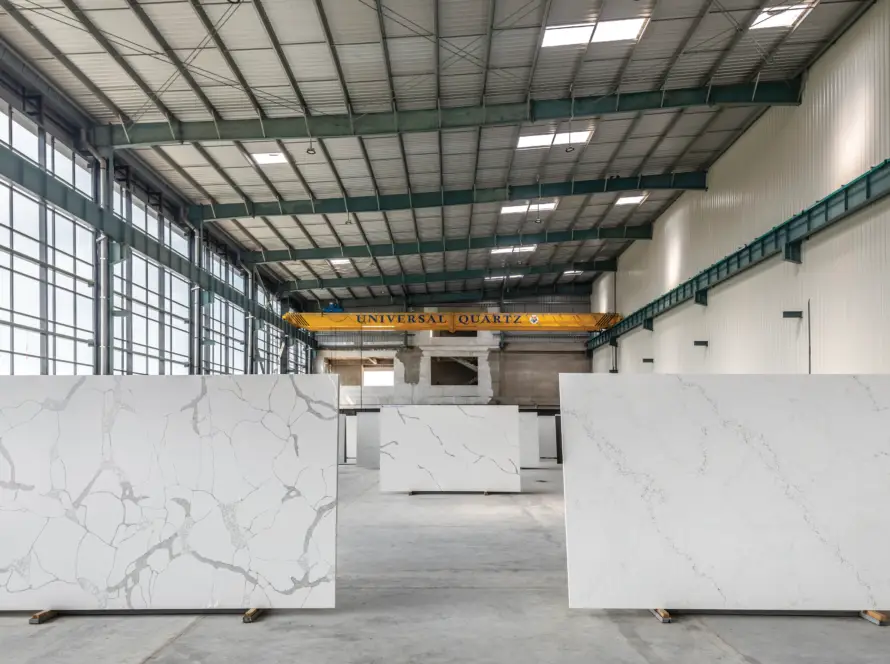
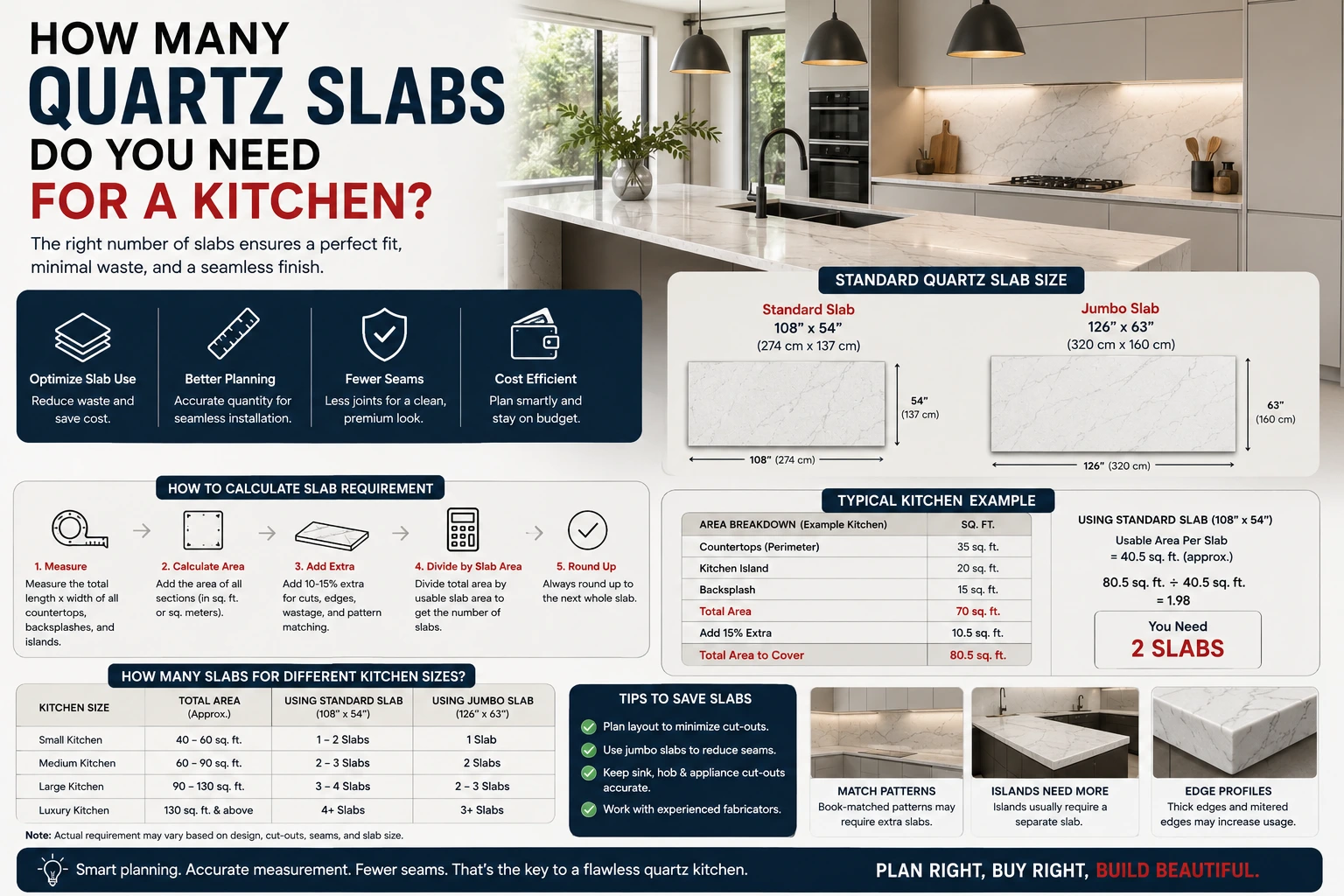
- 3200mm x 1600mm (roughly 10.5 ft x 5.25 ft) — the most common size
- 3000mm x 1400mm (roughly 9.8 ft x 4.6 ft) — slightly smaller, still widely available
- 3200mm x 1800mm — a larger jumbo size, used for bigger islands or fewer joints
A standard slab (3200mm x 1600mm) gives you roughly 55 square feet of usable material, though actual usable area is always a bit less once you account for cutting and edges.
How to Calculate the Area You Need
Here’s the basic process:
- Measure your countertop area. Add up the length and width of every counter section, including the island if you have one.
- Add the backsplash if you’re using quartz for it. Measure the length of the counter edge where the backsplash will go, and multiply by the height (typically 18-24 inches).
- Convert to square feet. Multiply length by width for each section, then add them all together.
- Add a waste allowance. This is the part most people forget. Cutting Quartz slabs for sinks, cooktops, and corners always creates offcuts you can’t use elsewhere.
A Quick Example
Let’s say your kitchen countertop measures 20 feet in total length and 2 feet in depth.
- Total area = 20 x 2 = 40 square feet
- Add a backsplash of the same length at a height of 1.5 feet = 30 square feet
- Total = 70 square feet
Since one standard slab gives you around 55 usable square feet, you’d typically need 2 slabs for this kitchen, with some material left over for smaller cuts or a matching kitchen island panel.
Kitchen Size vs Slab Requirement (Rough Guide)
While every kitchen layout is different, here’s a general estimate to help you plan:
| Kitchen Size | Approx. Countertop Area | Slabs Typically Needed |
| Small (L-shaped, compact) | 25-35 sq ft | 1 slab |
| Medium (U-shaped or with small island) | 40-60 sq ft | 1-2 slabs |
| Large (open kitchen with island) | 65-90 sq ft | 2-3 slabs |
| Very large/commercial kitchen | 100+ sq ft | 3+ slabs |
Keep in mind, these are estimates. An island alone can sometimes need its own dedicated slab if you want a seamless look without visible joints.
Factors That Can Increase the Slab Count
A few things can push your requirement higher than the basic calculation suggests:
Pattern matching. If your quartz has a marble-look veining pattern, cutting pieces to keep the veins flowing naturally across joints can use up more material than a plain, solid-colour slab.
Waterfall edges. If you want that popular waterfall island look, where the countertop wraps down the side to the floor, it eats up a lot of extra slab area.
Sink and cooktop cutouts. These create offcuts that usually can’t be reused elsewhere, so factor in some wastage here.
Seams and joints. Fewer visible seams generally means using bigger sections of a slab, which increases the total slab count needed.
Overhangs and thickness. A thicker countertop or a large overhang for seating may also require more material or additional support pieces.
Tips to Reduce Wastage
- Plan your layout on paper (or ask your fabricator to do a digital layout) before cutting begins
- Choose slab sizes that best match your kitchen dimensions to minimise offcuts
- If budget allows, order a slightly larger Quartz slab size instead of two smaller ones to reduce seams
- Ask your supplier if offcuts can be used for a matching backsplash or small shelf
Why Work With a Manufacturer Directly
Buying straight from a manufacturer like Universal Quartz has a real advantage here: our team can guide you through accurate measurements and slab planning before you commit to an order, so you’re not stuck buying an extra slab “just in case” or, worse, coming up short mid-project. We also help ensure that if you need a second Quartz slab, it’s cut from the same production batch for a consistent colour match.
If you’re not sure how much material your kitchen needs, you can browse our quartz slab collection to see available sizes, or reach out to our team through the contact page for a free measurement-based estimate. And if you’re still comparing manufacturers, our earlier guide on quartz manufacturers in India covers what to look for before you choose one.
Frequently Asked Questions (FAQs)
1. How much does a standard quartz slab cost?
Pricing depends on the design, thickness, and finish you choose. It’s best to get a quote directly from your manufacturer based on your specific requirements.
2. Can I use leftover slab material from my countertop for other areas?
Yes, offcuts are commonly used for backsplashes, small shelves, or bathroom vanity tops, as long as there’s enough usable material left.
3. Do I need extra slabs if I want a waterfall island?
Usually yes. Waterfall edges use significantly more material since the Quartz slab wraps around the sides of the island, so it’s worth mentioning this early when getting your estimate.
4. What happens if I run out of slabs mid-project?
This is exactly why accurate measurement upfront matters. If you do need more material later, ask your manufacturer if they can match it from the same batch to avoid visible colour differences.
5. Is it better to order one large slab or two smaller ones?
A single larger Quartz slab usually means fewer seams and a more seamless look, though it may cost more. Two smaller slabs can be more economical but will have visible joints.
6. How do I know the exact Quartz slab size available from a manufacturer?
Slab sizes can vary slightly between manufacturers. It’s best to confirm exact dimensions directly, which is something our team at Universal Quartz is always happy to help with.
Final Thoughts
Figuring out how many quartz slabs you need doesn’t have to be complicated. Measure your counter area, add a reasonable waste allowance, and factor in any special design elements like waterfalls or heavy pattern matching. When in doubt, a quick conversation with your supplier can save you from ordering too much or too little.
If you’d like help estimating Quartz slabs for your specific kitchen layout, the team at Universal Quartz is happy to walk you through it; just get in touch with your rough measurements to start.