If you’re planning a kitchen countertop, a bathroom vanity, or even a full wall cladding project, one question always comes up sooner or later — what size quartz slab do I actually need? It sounds like a small detail, but slab size can change your budget, your seams, your installation timeline, and even how your finished space looks.
At Universal Quartz, we get this question almost every day from homeowners, architects, and contractors. So let’s break it down in plain, simple language — no confusing technical jargon, just the facts you need to make a smart decision.
Why Quartz Slab Size Even Matters
Quartz slabs aren’t sold like fabric where you can just cut whatever length you want. They come in fixed manufactured sizes, and your fabricator has to work within those dimensions. This affects a few real things:
- Seams — bigger slabs mean fewer joints on your countertop
- Waste — the wrong slab size can mean more offcuts and higher cost
- Look — a single continuous slab looks more premium than multiple pieces joined together
- Budget — bigger slabs (like jumbo sizes) usually cost more per square foot
So before you finalize a design, it genuinely helps to understand the two main categories: standard slabs and jumbo slabs.
Standard Quartz Slab Sizes
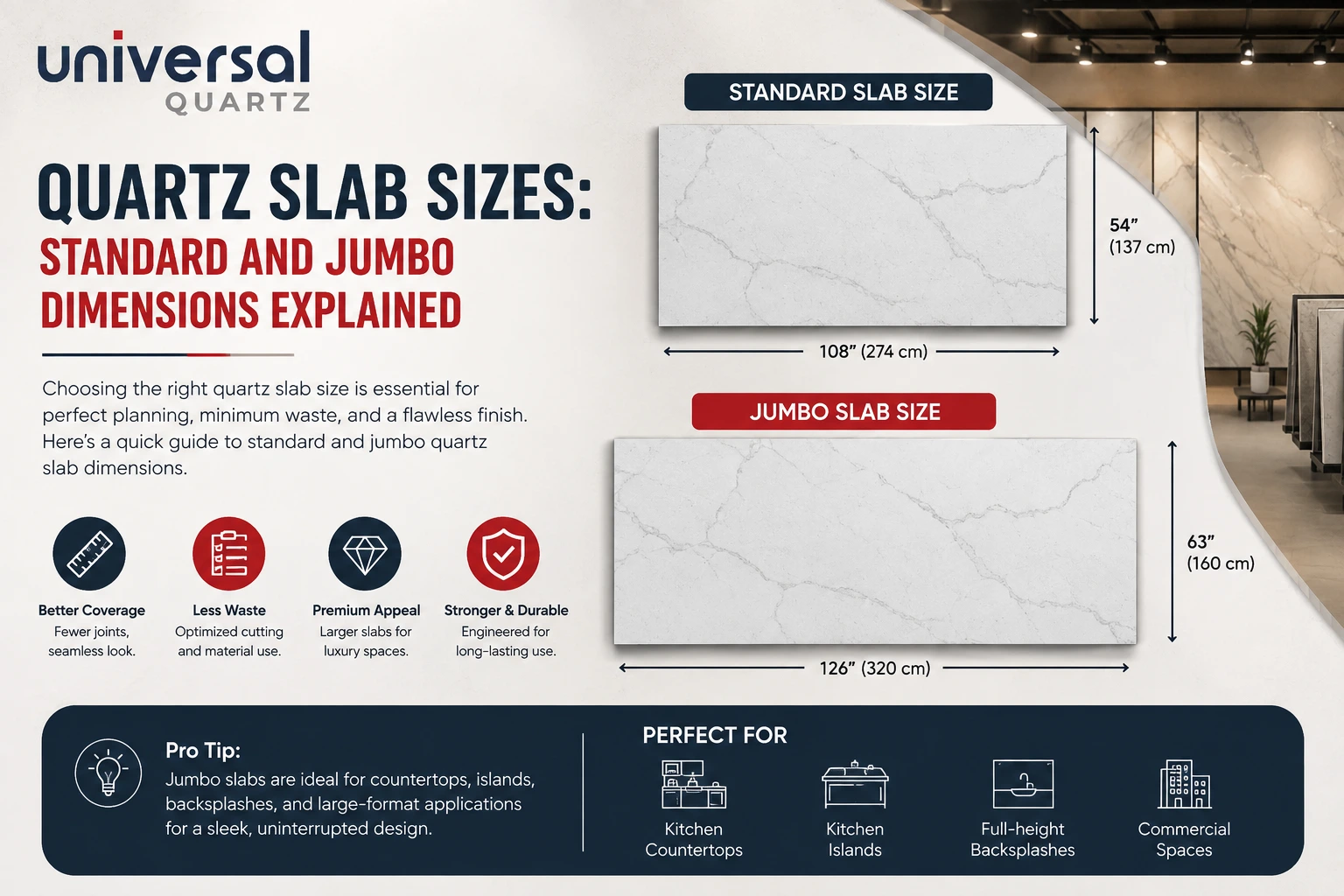
Standard slabs are the most commonly manufactured and most widely available size in the quartz industry. Most manufacturers, including Indian and international brands, produce standard slabs in these typical dimensions:
- Length: Around 120 inches (approximately 3050 mm / 10 feet)
- Width: Around 55 to 65 inches (approximately 1400–1650 mm)
- Thickness: Commonly available in 12mm, 18mm, and 20mm
These are the workhorse sizes used in the vast majority of Indian homes. They’re perfectly suited for:
- Standard kitchen countertops (up to 10 feet in one run)
- Bathroom vanities
- Small to mid-sized islands
- Wall panels and backsplashes
Standard slabs are popular because they’re easier to manufacture, easier to transport, and generally more budget-friendly than jumbo options. If your kitchen counter run is within 9-10 feet, a standard slab will likely cover it in one continuous piece without needing a seam.
Jumbo Quartz Slab Sizes
Jumbo slabs are the larger, premium-format option that has become increasingly popular for modern homes and commercial projects. These are designed for people who want that clean, seamless, luxury look — especially for large kitchen islands or open countertop runs.
Typical jumbo slab dimensions look like this:
- Length: Around 126 to 165 inches (approximately 3200–4200 mm)
- Width: Around 63 to 78 inches (approximately 1600–2000 mm)
- Thickness: Usually available in 15mm, 20mm, and 30mm
Some manufacturers even push jumbo sizes further for special architectural projects, offering slabs beyond 4200mm in length for feature walls or large commercial counters.
Jumbo slabs are ideal for:
- Large kitchen islands without a center seam
- Long, uninterrupted countertop runs
- Waterfall edge countertops (where the slab wraps down the side)
- High-end commercial spaces like hotel lobbies and reception counters
- Full-height wall cladding with minimal joints
Standard vs Jumbo: Quick Comparison
| Feature | Standard Slab | Jumbo Slab |
| Typical Length | Up to ~120 inches | 126–165+ inches |
| Typical Width | 55–65 inches | 63–78 inches |
| Best For | Regular kitchens, vanities | Large islands, waterfall edges |
| Seams Needed | More likely on long counters | Fewer to none |
| Price per sq. ft. | Generally lower | Generally higher |
| Availability | Widely available | Limited by manufacturer |
How Slab Size Affects Your Project
1. Fewer Seams, Better Aesthetics
A seam isn’t just a visual line — it’s a spot where dirt and moisture can collect over time if not sealed properly. Jumbo slabs reduce or eliminate this issue on large surfaces, giving you that smooth, uninterrupted look that high-end kitchens are known for.
2. Waste and Cost Efficiency
Here’s something people don’t think about enough — sometimes a jumbo slab actually reduces waste for large layouts, even though it costs more upfront. Your fabricator can nest the cutting pattern more efficiently on one big slab rather than joining pieces from two standard slabs and wasting offcuts.
3. Transportation and Handling
Bigger isn’t always simpler. Jumbo slabs are heavier and require more careful handling during transport and installation. Not every fabricator or transport team is equipped to move them safely, so it’s worth checking this with your installer beforehand.
4. Thickness Also Plays a Role
Slab size and thickness work together. A 20mm jumbo slab will behave differently during installation than a 12mm standard slab. Thicker slabs are more rigid and support longer unsupported spans (like a waterfall island edge) without extra reinforcement.
Which One Should You Choose?
Honestly, it depends on your specific space:
- If your countertop run is under 10 feet and budget is a priority, standard slabs are more than enough.
- If you’re building a large island, want a seamless waterfall edge, or you simply want that premium continuous look, jumbo slabs are worth the investment.
- For large commercial or architectural projects, jumbo is often the only practical option to avoid too many visible joints.
A good rule of thumb: measure your total countertop length first, add your overhangs and edges, and then check which slab size covers that run with the least number of joins.
Tips Before You Order Quartz Slabs
- Always confirm exact dimensions with your supplier — sizes can vary slightly between manufacturers and even between batches.
- Ask about slab thickness options for your specific application (countertops usually need thicker slabs than wall panels).
- Check slab availability before finalizing your design — jumbo sizes may take longer to source depending on the color and finish you want.
- Factor in cutting and edge profile — some designs (like mitred waterfall edges) need extra slab length beyond just the visible countertop.
- Work with an experienced fabricator who has handled jumbo slabs before, since incorrect handling can cause cracks or breakage.
Final Thoughts
Choosing between standard and jumbo quartz slabs isn’t just about size — it’s about matching the slab to how your space will actually look and function. Standard slabs are practical, cost-effective, and perfect for most homes. Jumbo slabs bring a more luxurious, seamless finish for larger or more ambitious designs.
At Universal Quartz, we help customers pick the right slab size based on their actual room measurements, design goals, and budget — so you’re never stuck with unnecessary seams or costly waste. If you’re unsure which size fits your project, it’s always worth getting a professional measurement done before you order.
Frequently Asked Questions (FAQs)
Q1. What is the standard size of a quartz slab?
A standard quartz slab is typically around 120 inches in length and 55–65 inches in width, with common thickness options of 12mm, 18mm, and 20mm.
Q2. What is a jumbo quartz slab?
A jumbo quartz slab is a larger-format slab, usually ranging from 126 to 165 inches in length and 63 to 78 inches in width. It’s used mainly for large islands, waterfall edges, and seamless countertop designs.
Q3. Why are jumbo quartz slabs more expensive than standard slabs?
Jumbo slabs cost more because they require more raw material, specialized manufacturing equipment, and careful transport and handling. They also allow for fewer seams, which adds to their premium value.
Q4. Can a standard slab cover a large kitchen island?
It depends on the island’s length. If the island is under 10 feet, a standard slab may cover it in one piece. For longer islands, a jumbo slab is usually needed to avoid a visible seam.
Q5. Does slab size affect the thickness options available?
Not directly, but larger slabs are often recommended in thicker options (like 20mm or 30mm) since they offer better structural support for large, unsupported countertop spans.
Q6. How do I know which slab size is right for my project?
Measure your total countertop or wall area first, then consult your fabricator. They’ll recommend whether a standard or jumbo slab minimizes seams and waste for your specific layout.
Q7. Are jumbo slabs harder to install?
Yes, slightly. Due to their size and weight, jumbo slabs require experienced fabricators and proper equipment for safe handling, cutting, and installation to avoid cracks or breakage.
Q8. Does Universal Quartz offer both standard and jumbo slab sizes?
Yes, Universal Quartz offers a range of standard and jumbo quartz slab sizes across multiple colors and thicknesses, helping you find the right fit for both residential and commercial projects.