A beautiful quartz countertop can still feel disconnected from the room if the backsplash and flooring don’t work with it. These three surfaces are the ones your eye moves across constantly in a kitchen or bathroom, so how well they relate to each other has a bigger effect on the finished look than most people expect. This guide explains, in plain language, how to pair your quartz countertop thoughtfully with your backsplash and flooring.
Why These Three Surfaces Need to Work Together
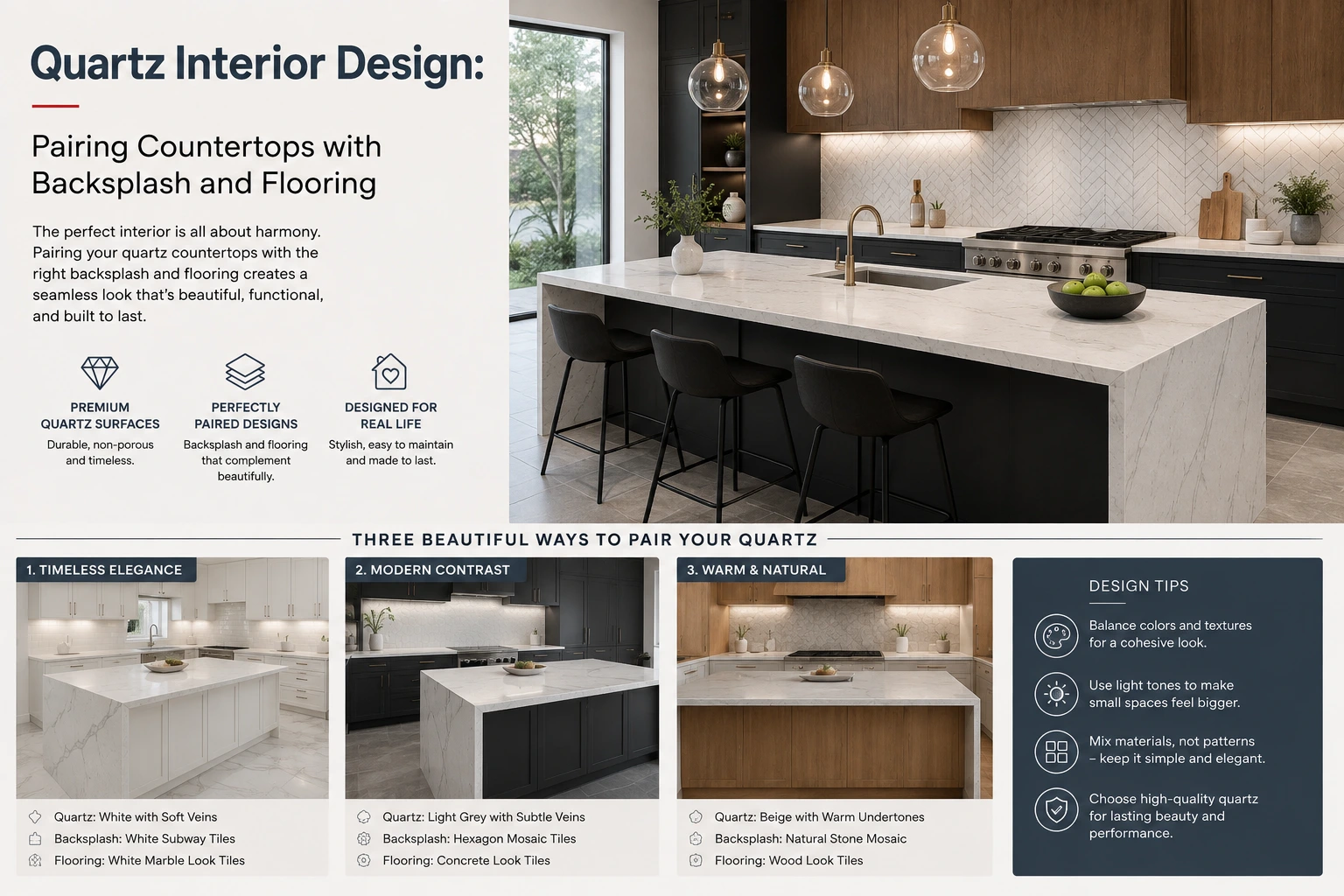
Countertop, backsplash, and flooring aren’t separate decisions made in isolation — they’re the three largest surfaces in the room, and your eye naturally moves between them. When they’re chosen without considering each other, even individually beautiful materials can end up feeling mismatched or visually busy. When they’re chosen together, even simple, affordable materials can look cohesive and intentional.
Approach 1: Matching Countertop and Backsplash
Using the same quartz slab for both the countertop and backsplash creates a seamless, continuous surface from counter to wall. This is a popular approach because it removes a visual break in the room, making the space feel calmer and more unified — especially valuable in smaller kitchens where every visual line matters.
When This Works Best
- Small or narrow kitchens, where reducing visual breaks helps the space feel larger
- Minimalist or modern design styles, where a clean, uninterrupted look is the goal
- Kitchens with bold veining, where continuing the pattern up the wall creates a dramatic, cohesive statement
Approach 2: Contrasting Countertop and Backsplash
Choosing a different material or color for the backsplash — tile, a contrasting quartz tone, or another material entirely — adds visual interest and can highlight architectural details like a range hood or window.
When This Works Best
- Larger kitchens, where a matching wall-to-counter look might feel too uniform or plain
- Traditional or eclectic design styles, where layered textures and materials feel intentional
- Kitchens where the backsplash is meant to be a standalone design feature, such as patterned tile
For more on choosing your countertop color and finish first, see our guide on how to choose the best quartz kitchen countertops.
Pairing Quartz Countertops with Flooring
Flooring covers far more square footage than any countertop or backsplash, so it has an outsized effect on the overall feel of the room, even though it’s easy to treat as an afterthought.
Light Countertops with Light or Warm-Toned Flooring
Light quartz countertops pair well with warm wood flooring or light neutral tile, creating a bright, airy feel throughout the room. This combination works particularly well in smaller or lower-light kitchens.
Dark Countertops with Light Flooring
A dark, moody quartz countertop against lighter flooring creates a grounded, high-contrast look without making the room feel heavy overall, since the floor keeps the space feeling open even as the counters add drama.
Dark Countertops with Dark Flooring
This combination creates a dramatic, cohesive, high-end feel, but works best in kitchens with strong natural light or good artificial lighting, since an all-dark palette can feel closed-in in a dim space.
Matching Undertones, Not Just Shades
Beyond simply choosing “light” or “dark,” pay attention to undertones. A warm-toned quartz countertop paired with cool-grey flooring can feel subtly mismatched, even if both are technically “neutral” colors. Bringing physical samples together in the same room, under your actual lighting, is the most reliable way to check this before committing.
Our guide on the best quartz countertop brands in India for 2026 also covers the range of colors and finishes available if you’re still narrowing down your countertop choice.
A Simple Framework for Pairing All Three
- Choose your countertop first, since it’s usually the hardest material to change later and often has the boldest pattern
- Pick your flooring next, keeping undertones (warm vs. cool) consistent with your countertop
- Choose your backsplash last, since tile and smaller-format materials offer the most flexibility to either match or contrast
- If any one surface has a bold, busy pattern, keep the other two simpler and more neutral to avoid visual competition
- Always view physical samples of all three together, in your actual room lighting, before finalizing
Common Mistakes When Pairing These Surfaces
- Choosing each surface separately, in different showrooms, without bringing samples together
- Matching undertones by eye from memory instead of comparing physical samples side by side
- Choosing three bold, high-contrast materials at once, which can make the whole room feel visually competitive rather than cohesive
- Overlooking how the combination will look under your kitchen’s actual lighting, which can shift color perception significantly from a showroom
A Quick Word on Experience
Getting these pairings right is easier when your countertop manufacturer offers a genuinely wide range of colors and finishes, since that gives you more flexibility to find the right match for your specific flooring and backsplash choices, rather than compromising because of limited stock. A broader product range, developed over years of manufacturing experience, generally makes this whole process smoother.
Frequently Asked Questions
Should my backsplash match my countertop exactly?
Not necessarily. Matching creates a seamless, unified look, especially in smaller kitchens, while a contrasting backsplash adds visual interest and works well in larger spaces. Both are valid design choices.
How do I choose flooring that pairs well with a dark quartz countertop?
Lighter flooring generally balances a dark countertop well, keeping the room from feeling too heavy, while dark flooring paired with dark counters creates a dramatic look best suited to well-lit kitchens.
What is an undertone, and why does it matter?
An undertone is the subtle warm or cool quality beneath a material’s main color. Two “neutral” materials can still clash if one leans warm and the other leans cool, which is why comparing physical samples together matters more than judging colors separately.
Should I choose my countertop, flooring, or backsplash first?
Choosing your countertop first is generally recommended, since it’s the hardest and most expensive surface to change later. Flooring and backsplash can then be selected to complement it.
Can I use the same quartz slab for both countertop and backsplash?
Yes. This is a popular approach that creates a seamless, continuous look from counter to wall, and works especially well in smaller kitchens or with bold veining patterns.
Related Reading
Explore more on choosing and pairing quartz countertops for your space:
How to Choose the Best Quartz Kitchen Countertops
Best Quartz Countertop Brand in India 2026
Quartz Stone Price in India 2026
Final Thoughts
A quartz countertop doesn’t exist in isolation — it’s part of a visual relationship with your backsplash and flooring that shapes how the whole room feels. Whether you choose to match these surfaces for a seamless look or contrast them for visual interest, the key is making the decision deliberately, with real samples compared together under your actual lighting, rather than choosing each surface separately and hoping they work out.