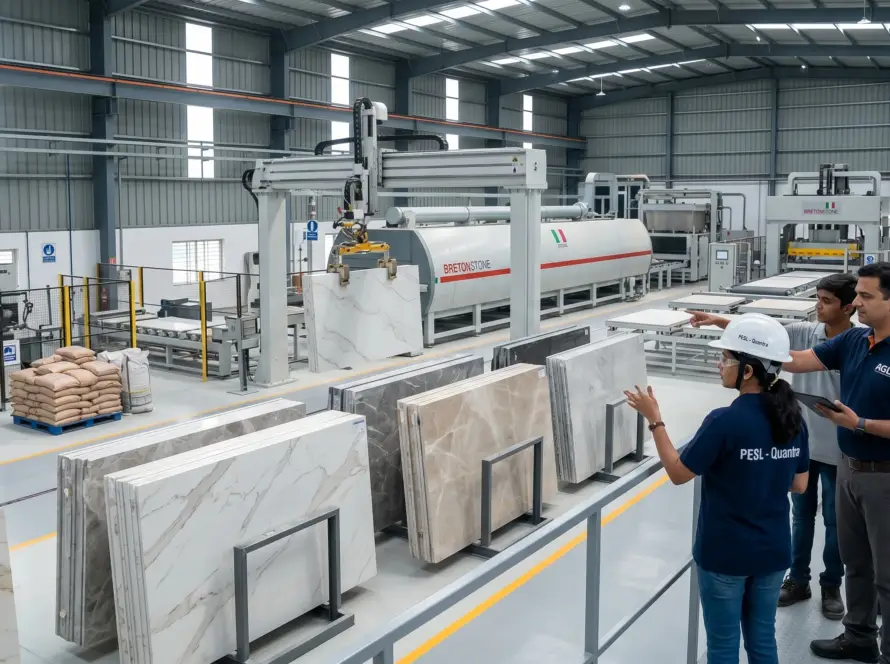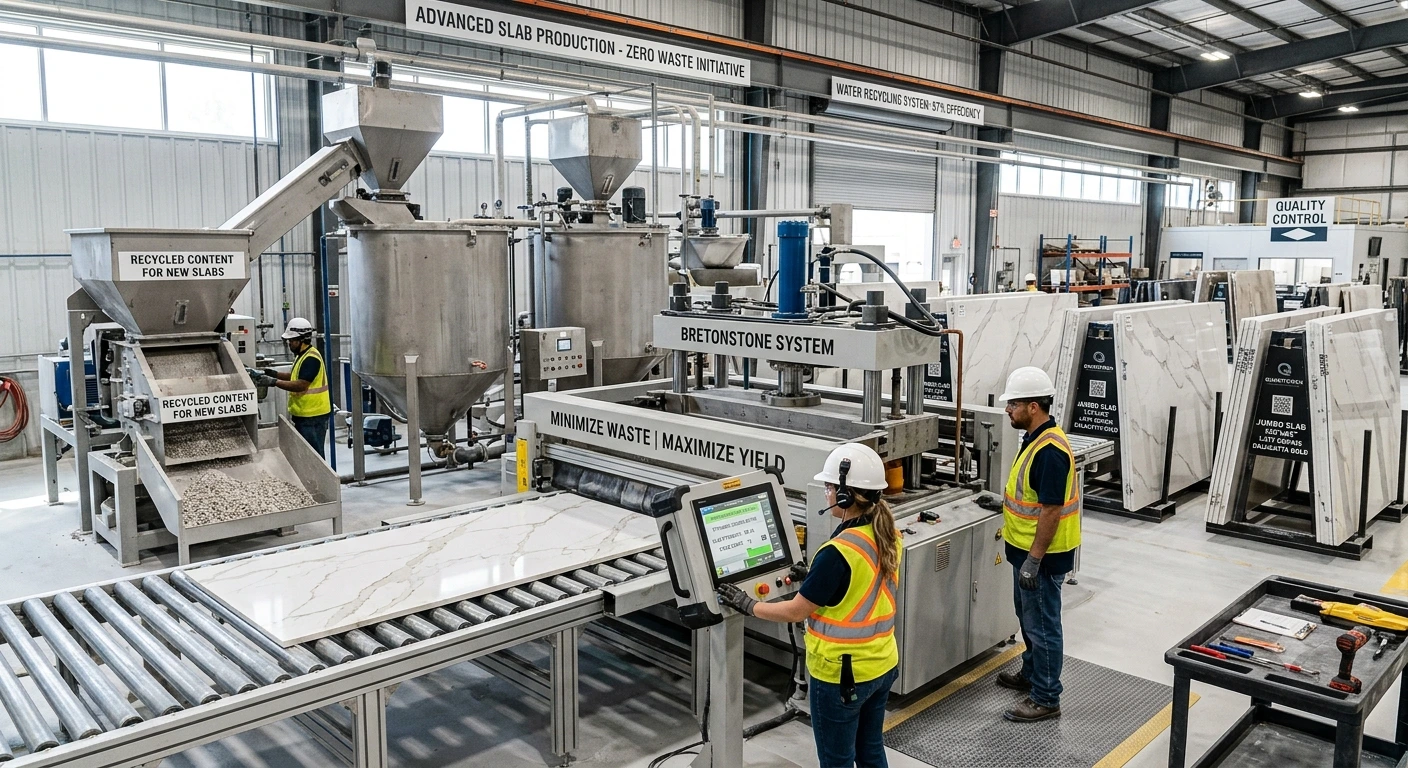
Every quartz slab that gets cut into countertops leaves some material behind. That’s normal — no fabrication process is completely efficient, and a little bit of offcut is unavoidable no matter how good the manufacturer is. But how much material actually gets wasted, and what happens to it afterward, varies a lot more than most homeowners realise. Some manufacturers plan every cut down to the centimetre and find a use for almost everything that’s left over. Others don’t think about it much at all, and simply pass the extra cost of that waste on to the customer without ever explaining why.
This difference matters more than it might seem at first glance, because quartz is not a cheap raw material. It’s manufactured using natural quartz aggregate bound together with resin under heat and pressure, and every square foot that ends up as scrap on the workshop floor is a square foot someone has already paid to produce. In this guide, we’ll walk through how slab waste actually happens during fabrication, what separates a well-run quartz manufacturer from an average one when it comes to managing that waste, and how all of this quietly shapes the price you’re quoted for your project.
Why Slab Waste Matters More Than You Think
When you buy a quartz countertop, you’re not just paying for the finished piece that ends up on your kitchen island or bathroom vanity. You’re paying for the entire slab it was cut from, including every part that didn’t make it into your final countertop. A quartz slab typically arrives at the fabrication workshop as a large rectangular sheet, usually somewhere between 120 and 130 inches long and 60 to 65 inches wide, depending on whether it’s a standard or jumbo size. Your kitchen, on the other hand, is almost never a simple rectangle.
Cutouts for sinks, hobs, cooktops, and electrical points all remove material that frequently can’t be reused for anything meaningful. Corners, curves, and L-shaped or U-shaped counter runs leave irregular gaps around the edges of the slab that are hard to repurpose. If a manufacturer isn’t deliberate about how they plan these cuts before picking up a saw, a surprisingly large amount of usable stone can end up as scrap by the end of the job. And because that stone was never free to begin with, this waste doesn’t just disappear — it shows up somewhere in your final bill, whether it’s itemised separately or simply folded into a higher per-square-foot rate.
Working with a manufacturer that manages this well generally benefits you in more than one way. It usually means a more competitive and honest price for the same scope of work; it means the expensive raw material going into your project is being used sensibly rather than carelessly; and — perhaps most usefully as a signal — it tells you something about how organised and experienced that manufacturer actually is. A workshop that has its wastage under control tends to have its measurements, scheduling, and quality checks under control too.
How Slab Waste Happens During Quartz Fabrication
Waste isn’t a single, simple problem with one fix. It creeps in at several different stages of the fabrication process, and understanding each of these helps explain why some projects generate far more scrap than others, even when the finished countertop looks more or less the same.
1. Shape Mismatch
Countertops are rarely straightforward rectangles. Most kitchens use L-shaped or U-shaped layouts, and many modern designs include curved edges, waterfall sides, or rounded islands. Fitting these irregular shapes onto a rectangular slab always leaves some amount of leftover material around the outer edges, simply because the geometry doesn’t line up perfectly. The more complex and curved your design, the more of this edge material tends to go unused.
2. Cutouts for Sinks, Hobs, and Fixtures
Every sink, cooktop, and electrical outlet cutout removes a solid chunk of stone from the middle of a slab. Some of these removed pieces are large and clean enough to be repurposed for a smaller job elsewhere, such as a vanity top or a sill. Many others are awkward shapes or sizes that simply aren’t useful for much beyond very small repair pieces, and end up as waste.
3. Pattern and Veining Matching
If you want the natural-looking veining on your countertop to flow continuously across a seam — a technique fabricators call book-matching — the person cutting the slab sometimes has to sacrifice extra material just to line the pattern up correctly on both sides of the join. This gives a noticeably better, more seamless final look, which is exactly why many homeowners request it for kitchen islands and large backsplashes. But it does typically mean a bit more waste than a simple straight cut would, unless the layout is planned with real care from the start.
4. Errors and Rework
Measurement mistakes, cutting errors, or accidental damage during handling and transport can turn an otherwise perfectly good piece of stone into unusable waste in an instant. This is the category of wastage that’s most within a manufacturer’s control, and it’s where the real difference between an average workshop and a genuinely skilled one becomes obvious. A single templating error on a large island piece can be an expensive mistake, and how often those mistakes happen says a lot about a manufacturer’s training, equipment, and internal quality checks.
How Top Quartz Manufacturers Reduce Waste
Experienced, well-run manufacturers treat waste reduction as a core part of how they operate, not as an afterthought they get around to occasionally. Here’s what that typically looks like once you go behind the scenes of a workshop that takes this seriously.
Smart Slab Layout and Nesting
Before any cutting begins, a good fabricator plans out exactly where each piece of your countertop will sit on the slab. This planning process is known as nesting. Purpose-built nesting software — or, in smaller workshops, a genuinely experienced layout technician working by eye — arranges all the required pieces the way you’d arrange puzzle pieces, aiming to leave as little unused space as possible between them. This single step usually has the single biggest impact on how much material ends up wasted per project, because it determines how efficiently the raw slab is used before a single cut is even made.
Reusing Offcuts and Smaller Pieces
Not every leftover piece goes straight into the bin. Manufacturers who take waste management seriously keep an organised inventory of offcuts and actively look for ways to use them, rather than letting them pile up unused in a corner of the workshop. Common uses include:
- Bathroom vanity tops, which are usually much smaller than kitchen countertops
- Window sills, thresholds, and small ledges
- Replacement or repair pieces for existing installations
- Sample pieces and display cuts for showrooms
If your project includes any smaller quartz elements alongside your main countertop — a vanity, a sill, a small side table — it’s always worth asking your manufacturer whether these can be cut from existing offcuts instead of a fresh slab. It’s a simple question that can meaningfully reduce your overall cost without any compromise on quality, since the material itself is identical either way.
Batch Planning Across Multiple Orders
Rather than cutting each customer’s order in isolation, larger and more established manufacturers often plan cutting layouts across several orders at once. This means a piece that’s too small or oddly shaped to be useful for one customer’s project might fit perfectly into a completely different customer’s smaller job, instead of being written off as scrap. This kind of batch planning requires more coordination and a certain scale of operation to pull off consistently, which is one reason it tends to be more common among manufacturers with multiple branches and a steady, high volume of orders.
Better Quality Control Upfront
Waste caused by avoidable mistakes is, by definition, the most preventable kind of waste there is. Manufacturers who invest properly in trained fabricators, well-calibrated cutting equipment, and a genuine double-check process before any cut is made tend to have noticeably fewer costly errors on the shop floor. Fewer errors mean less rework, less wasted material, and — just as importantly for you as the customer — fewer surprise delays or unexpected charges appearing later in your project timeline.
How This Affects the Price You Pay
Wastage doesn’t simply vanish once it leaves the cutting table. It either gets absorbed as a cost by the manufacturer, or it gets added, in one form or another, to what you’re quoted. A manufacturer with poor layout planning, weak inventory practices, or a high rate of avoidable cutting errors usually has no choice but to charge more per square foot to remain profitable, because they’re effectively still paying for stone that never made it into any customer’s finished countertop.
This is one of the quieter reasons why two quotes for what looks, on paper, like the exact same project can end up noticeably different in price. It isn’t always about one manufacturer using lower-grade material or cutting corners on quality — sometimes the gap comes down to something far less visible: who is simply running a tighter, more efficient, more experienced fabrication process behind the scenes. A lower price from a well-organised manufacturer can genuinely reflect good operations rather than a compromise on materials, which is exactly why it’s worth looking past the headline number and asking how that number was arrived at.
Questions to Ask Your Manufacturer About Wastage
You don’t need to be a fabrication expert yourself to ask the kind of questions that reveal how seriously a manufacturer takes this. A few direct, simple questions can tell you a great deal:
- How is wastage calculated and billed on my quote?
- Do you reuse offcuts, and can I use them for smaller pieces in my project?
- Do you use layout or nesting planning before cutting begins on a project like mine?
- What happens if there’s a measurement or cutting error on my order — do I get charged again for the replacement piece?
A manufacturer who can answer these clearly, specifically, and without hesitation is usually one that has genuinely thought this through as part of their process, rather than one who’s improvising an answer on the spot. The confidence and detail in the answer often tells you as much as the answer itself.
A Quick Word on Quality
Efficient cutting only matters if the underlying material being cut is good to begin with. If you’d like to understand what actually goes into a quartz slab before it ever reaches the fabrication stage — the raw materials, the resin, and the manufacturing process itself — our guide on what engineered quartz stone is is a good place to start.
And if you’re currently comparing manufacturers for an upcoming project, our roundup of top quartz manufacturers in India covers several other factors worth weighing beyond just the price on the quote.
For a fuller sense of what your project might realistically cost once every factor is accounted for, see our 2026 quartz countertop price guide for India.
Frequently Asked Questions
Does slab wastage always get added to my bill?
Not always as a clearly labelled, separate line item, but it’s almost always factored into the overall per-square-foot price you’re quoted in some way. Manufacturers with efficient, well-planned processes can generally afford to offer more competitive pricing precisely because they’re wasting less material per project, and that saving is passed along in the form of a better rate rather than a visible discount.
Can I request that offcuts from my project be used elsewhere?
You can certainly ask, though offcuts generated from your specific slab are usually kept by the manufacturer for their own inventory — vanities, sills, samples, and similar smaller uses. What you can reasonably ask for instead is whether any of the manufacturer’s existing offcut stock can be used for smaller pieces within your own project, which is a request that can sometimes meaningfully reduce your total cost.
Does book-matching (pattern-matched veining) always create more waste?
It can lead to somewhat more waste than a simple, straight-line cut would, because the fabricator needs to line the natural pattern up precisely on both sides of a seam. That said, an experienced manufacturer plans for this in advance as part of their initial layout, so the additional material used stays fairly minimal while the finished result looks significantly more polished and seamless.
How do I know if a manufacturer has an efficient cutting process?
Ask directly about their layout planning process, whether they use nesting software or rely on an experienced technician, and how they generally handle offcuts once a job is finished. It’s also worth asking to see examples from past projects that involved complex cuts or visible seams — clean, well-matched results in those examples are usually a fairly reliable sign of a genuinely well-planned process behind the scenes.
Does lower wastage mean lower quality?
No, the two are unrelated. Wastage reduction is fundamentally about planning and process efficiency, not about cutting corners on the material itself. A manufacturer can reduce their wastage significantly through better layout and inventory practices while still using exactly the same full-quality, certified quartz for every single piece they produce.