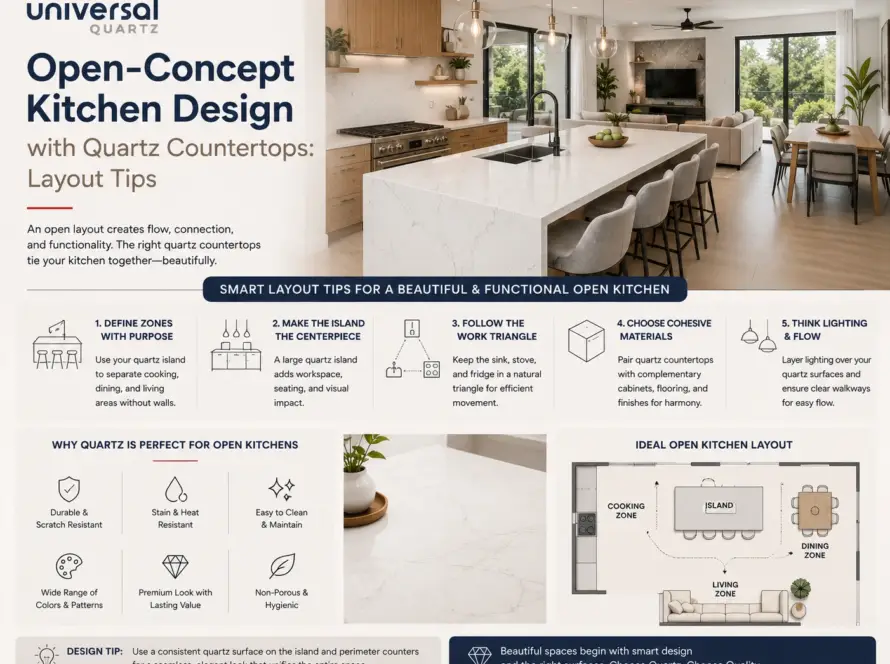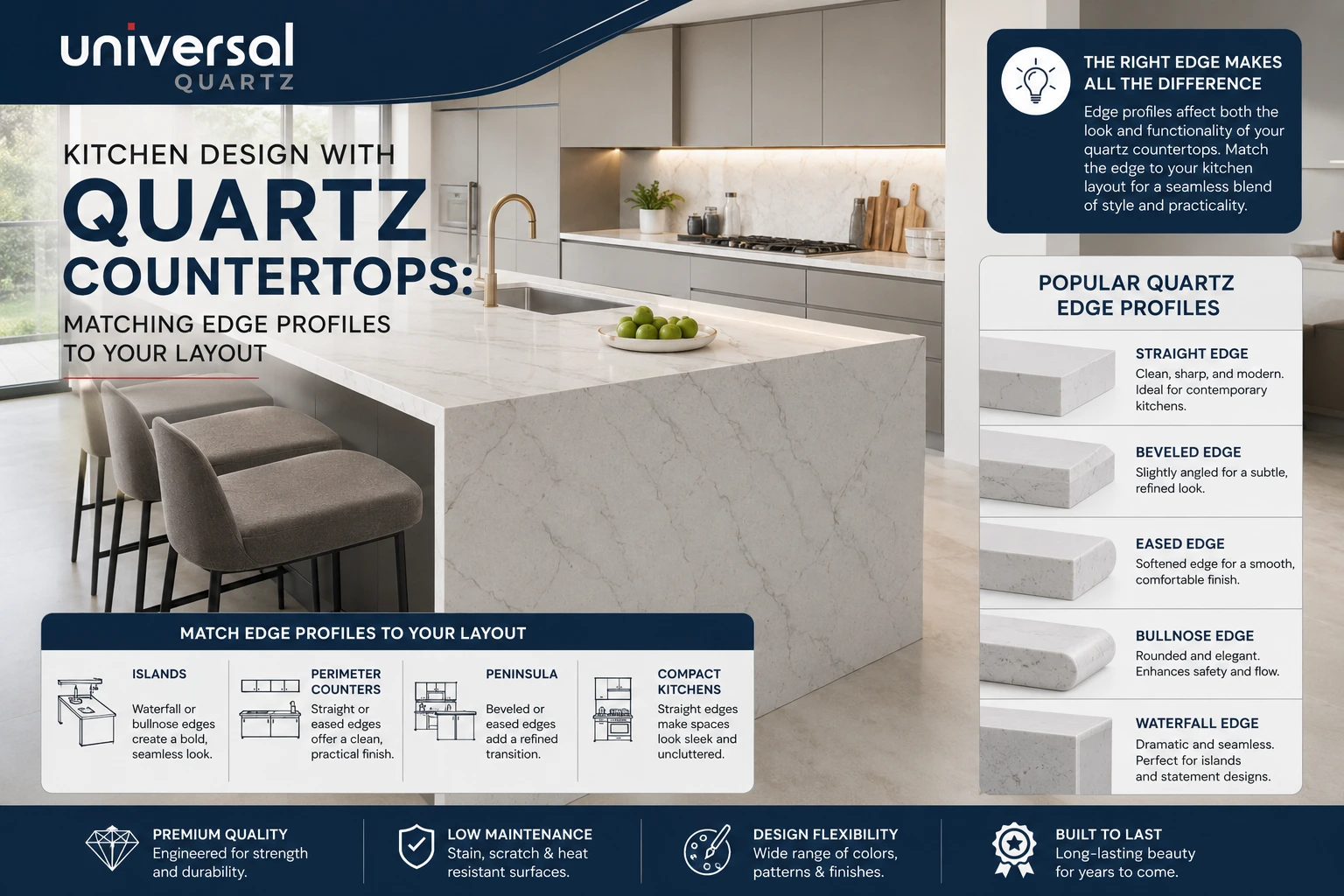
The edge profile you choose should match your kitchen’s layout and traffic pattern, not just its style. Straight (eased) edges suit compact galley and L-shaped kitchens because they take up the least visual space. Bullnose and bevel edges work well in kitchens with children or heavy foot traffic since they remove sharp corners. Mitered or waterfall edges are built for islands, where the goal is a thick, seamless look. Ogee and other decorative edges fit larger, traditional-style kitchens with room to showcase detail. Getting this match wrong is one of the most common — and hardest to reverse — kitchen design mistakes, since an edge profile can’t be changed after fabrication without recutting the slab.
Most homeowners choose a quartz color and finish carefully, then treat the edge profile as an afterthought — something to decide in the fabricator’s showroom in the last five minutes. That’s backwards. The edge profile affects how much usable counter space you have, how safe the counter is around children, how the light hits the slab, and how the whole kitchen reads visually. It also can’t be undone once the slab is cut. This guide walks through the common profiles first, then matches each one to the kitchen layouts where it actually works best.
The Common Quartz Edge Profiles
Straight (Eased) Edge
A flat vertical edge with the sharp top corner very slightly rounded off — just enough to remove the risk of chipping. It’s the most-requested profile in India right now because it’s clean, modern, and the least expensive to fabricate.
Bullnose Edge
A fully rounded edge with no corners at all. It’s the softest-looking profile and the safest around small children, since there’s no hard edge to catch a fall against. The trade-off is that a full bullnose can make a counter look slightly less crisp in a minimalist kitchen.
Bevel Edge
A flat, angled cut along the top edge, usually at 45 degrees. It catches light differently than a straight edge, giving a subtle faceted look without the softness of a bullnose. A good middle ground between modern and traditional.
Ogee Edge
A decorative S-curve profile — part concave, part convex. It’s the most detailed and traditional-looking edge on this list, and the most expensive to fabricate because of the extra shaping work. It fits classic or heavily detailed kitchens far better than minimalist ones.
Mitered (Waterfall) Edge
Two slab pieces joined at a 45-degree angle so the seam is invisible and the edge looks like one continuous thick slab, often 2-4 times the actual slab thickness. This is the profile behind the waterfall-island look, and it’s built specifically for that use case rather than for a standard counter run.
Dupont (Cove) Edge
A rounded groove set slightly below the top surface, giving a stepped, layered look. It’s less common in Indian kitchens but shows up in higher-end commercial and hospitality projects where a distinct, upscale silhouette matters more than cost.
Matching Edge Profiles to Your Kitchen Layout
Galley Kitchens (Narrow, Two-Wall Layout)
Stick with a straight or eased edge. In a narrow run, anything thicker-looking — bullnose, ogee, a built-up mitered edge — visually eats into counter space you don’t have to spare. A slim, straight edge keeps both walls feeling as open as possible.
L-Shaped Kitchens
Straight or bevel edges both work well here. The corner where the two counter runs meet is the detail to watch: a straight edge keeps that corner crisp and geometric, while a bevel softens it slightly without losing definition. Avoid a full bullnose at inside corners — it tends to look bulky rather than soft at that specific joint.
U-Shaped Kitchens
With three counter runs and two corners, U-shaped kitchens can carry slightly more visual weight than a galley or L-shape. A bevel or light bullnose is a reasonable step up from straight if you want some warmth, but keep the profile consistent across all three runs — mixing profiles within one U-shaped run is one of the more common fabrication mistakes we see flagged during site inspections.
Island Kitchens
This is where mitered (waterfall) edges belong. An island is meant to be a visual anchor, and a waterfall edge is the profile that delivers that without needing extra ornamentation. If a full waterfall isn’t in the budget, a simple straight edge on the island reads cleaner than a bullnose or ogee, which can look busy against an already-prominent piece of furniture.
Open-Plan Kitchens (Kitchen Visible from Living/Dining Area)
Because open-plan counters are visible from multiple angles and distances — not just from directly above, the way a closed kitchen counter usually is — a bevel or eased edge tends to look more considered than a plain straight edge, without going as ornamental as an ogee. This is also where edge consistency between the kitchen counter and any peninsula or breakfast bar matters most, since both are in the same sightline.
Small or Compact Kitchens
Straight or eased edges again. Every visual detail in a small kitchen either makes the room feel bigger or smaller, and a thick or ornamental edge profile reads as visual clutter in a space that’s already tight on square footage.
Practical Factors Beyond Layou
A few considerations that apply regardless of which layout you’re working with:
- Households with young children: prioritize bullnose or a heavily eased edge over anything with a defined corner, particularly at counter height where a fall is most likely to make contact.
- Cleaning and maintenance: straight and bevel edges are the easiest to wipe clean in one motion. Ogee and Dupont edges have more grooves where crumbs and liquid can collect, which means more deliberate cleaning at the edge specifically.
- Cost: as a rough rule, straight/eased is the least expensive, bevel and bullnose sit in the middle, and ogee, Dupont, and mitered waterfall edges cost more because of the extra fabrication time and, for waterfall edges, extra slab material.
- Consistency: whatever profile you choose for the main counter, use the same one on any peninsula, breakfast bar, or side counter in the same kitchen — mismatched edge profiles within one kitchen is a common design misstep that’s difficult to spot until the installation is complete.
If you haven’t finalized your overall layout yet, our guide on how to design a quartz kitchen countertop covers layout planning in more depth before you get to edge selection.
For guidance on pairing edge profile decisions with slab color and finish, see how to choose the best quartz kitchen countertop.
Edge profile complexity also affects the final quote — see our quartz countertop pricing guide for how fabrication choices factor into cost.