Few material names cause more confusion on a specification sheet than quartz and quartzite. The similarity in name is not a coincidence — both materials have quartz as their primary mineral component. But beyond that shared origin, they are fundamentally different products: one is a manufactured engineered stone, the other is a natural metamorphic rock. They behave differently, maintain differently, carry different certifications, and serve different purposes in architecture and interior design.
This confusion has real specification consequences. An architect or PMC who specifies ‘quartz’ when they mean ‘quartzite’ — or vice versa — will receive the wrong material, with the wrong maintenance requirements, the wrong certification profile, and potentially the wrong budget. This article provides a clear, technically grounded clarification of the two materials so that specifiers can use the correct terminology with confidence.
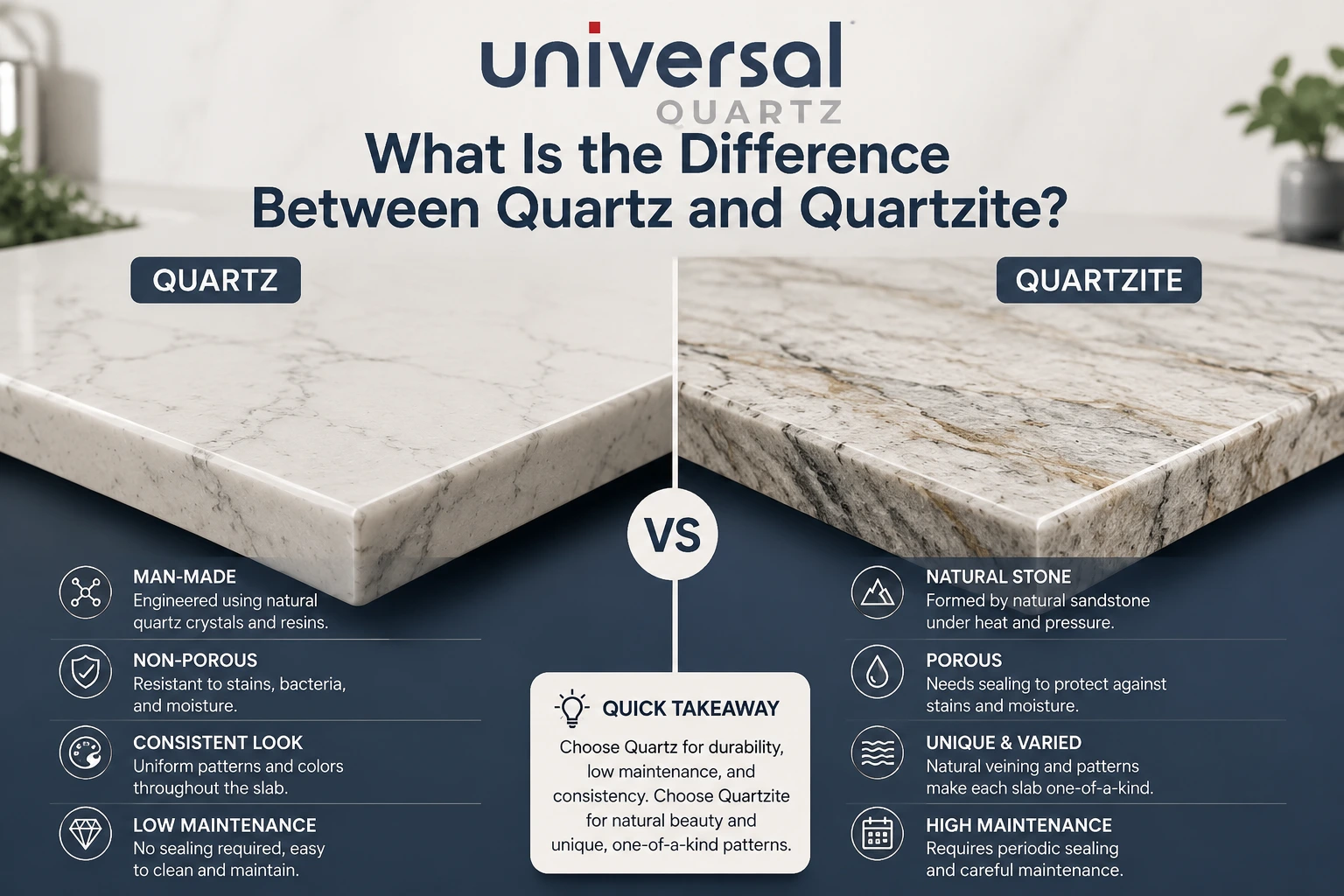
One-Line Clarification: Quartz (engineered quartz) is a factory-manufactured surface material composed of crushed quartz crystal, resins, and pigments. Quartzite is a natural metamorphic rock quarried from the earth. They share a mineral origin but are completely different products in terms of composition, certification, maintenance, and specification behaviour.
What Is Engineered Quartz?
Engineered quartz — the material that most surface suppliers in India and globally sell under brand names as ‘quartz countertops’ or ‘quartz slabs’ — is a manufactured composite material. It is not a natural stone.
The manufacturing process begins with crushed natural quartz crystal, which makes up approximately 90 to 93 per cent of the final slab by weight. This crushed quartz is combined with polymer resin binders and mineral pigments, then compressed under high pressure and cured under controlled heat. The result is a dense, non-porous surface with consistent colour, predictable dimensions, and repeatable physical properties — qualities that natural stone cannot offer by definition.
Universal Quartz’s Christobalite Powder Manufacturing Process
Universal Quartz uses a proprietary Christobalite Powder technology in its manufacturing process. Christobalite is a high-temperature crystalline polymorph of silica, processed at approximately 1,200°C before being incorporated into the quartz matrix. This pre-processing step produces a final slab with an extremely low water absorption rate of 0.02 per cent — near-zero porosity — which is the defining characteristic that enables NSF/ANSI 51 food safety certification and GREENGUARD Gold indoor air quality certification.
Because engineered quartz is a manufactured product, it can be independently tested, certified, and described to precise technical specifications. This is not possible for natural quartzite.
| Key Specification Fact: Because engineered quartz is manufactured under controlled conditions, it can carry internationally recognised third-party certifications including NSF/ANSI 51 (food safety), GREENGUARD Gold (indoor air quality), CE Mark (European construction standard), and ISO 9001:2015 (quality management). Universal Quartz holds all four. Natural quartzite, as a geological material, cannot carry these certifications. |
What Is Quartzite?
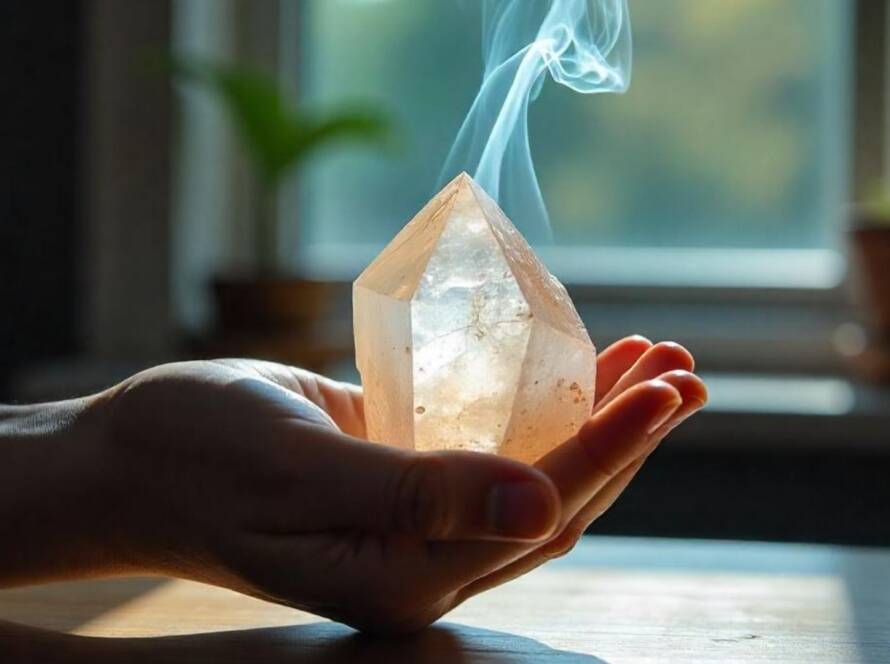
Quartzite is a metamorphic rock. It begins its geological life as sandstone — a sedimentary rock composed primarily of quartz sand grains. Over millions of years, under extreme subterranean heat and pressure, the sandstone recrystallises into quartzite, a hard, dense natural rock with a silica (quartz mineral) content that can exceed 90 per cent in high-grade samples.
Quartzite is quarried directly from geological formations and cut into slabs for use in construction and interior design. Because it is a natural material, no two slabs are identical. The colour, veining, pattern, and even the physical properties of quartzite vary between quarries, between seams within the same quarry, and between individual slabs from the same seam.
Why Quartzite Is Frequently Confused with Quartz
Three factors drive the naming confusion. First, both materials have quartz mineral as their primary component. Second, some suppliers in India and internationally use the term ‘quartzite’ loosely to refer to engineered quartz — an incorrect but commercially driven usage. Third, some natural stones sold as quartzite are actually marble or dolomite with a quartzite-like appearance — a separate but related misrepresentation problem in the natural stone trade.
For specifiers, the safest approach is to ask for the material’s full description: manufactured or natural, composition percentages, water absorption figure, and any available certification documents. These questions immediately clarify which material is being offered.
Field Test Note: A quick field check: pour a small amount of lemon juice on the surface and wait two minutes. Quartzite is generally quartz-dominant and acid-resistant, but low-grade quartzite or misrepresented marble will show an etch mark. Engineered quartz will show no reaction. This is not a certification substitute — it is a rough field qualifier only.
Full Comparison: Engineered Quartz vs Quartzite
The table below covers all properties relevant to architectural specification across kitchens, bathrooms, commercial interiors, and institutional applications. Universal Quartz figures are cited for the engineered quartz column.
| Property | Engineered Quartz | Quartzite (Natural Stone) |
| Composition | 90–93% crushed quartz crystal + polymer resin binders + pigments | Metamorphic natural rock: sandstone transformed by heat and pressure — 90%+ silica content |
| Origin | Factory manufactured under controlled conditions | Quarried directly from natural geological formations |
| Porosity | Non-porous — near-zero water absorption (Universal Quartz: 0.02%) | Porous to semi-porous — requires sealing; varies by quarry source |
| Food Safety Certification | NSF/ANSI 51 certified (Universal Quartz) — independently tested | No food safety certification is available for natural stone |
| Maintenance | Zero sealing required; wipe clean with mild detergent | Re-sealing every 6–18 months depending on use intensity |
| Pattern Consistency | Consistent batch-to-batch; same slab dimensions available | Highly variable — no two slabs are identical; large projects may have batch variation |
| Heat Tolerance | Up to 150°C continuous (Universal Quartz) | Up to 200°C+ — natural rock, no resin binder |
| Scratch Resistance (Mohs) | 6–7 on Mohs scale | 7–8 on Mohs scale — harder surface |
| Stain Resistance | Excellent — non-porous surface repels all common stains | Moderate — sealing required to prevent staining in porous samples |
| Acid Resistance | Excellent — resistant to most kitchen acids | Variable — some quartzites are less acid-resistant than others |
| Certifications Available | NSF/ANSI 51, GREENGUARD Gold, CE Mark, ISO 9001:2015 (Universal Quartz) | None applicable — natural material, not certifiable as a manufactured product |
| LEED / IGBC Credits | Eligible (GREENGUARD Gold, regional material, low-emission) | Eligible for regional material credit only |
| Price Range (India) | ₹200–₹600+ per sq. ft. depending on series and thickness | ₹400–₹2,000+ per sq. ft. depending on grade and origin |
| Pre-fabrication / CNC | Fully compatible — precise CNC machining available | Possible but more complex; natural variation makes precision fitting harder |
| Typical Applications | Kitchen countertops, bathroom vanities, office surfaces, commercial interiors, labs | Kitchen countertops, bathroom, feature walls, flooring (premium residential) |
| Best Suited For | High-use surfaces requiring hygiene certification, consistency, and zero maintenance | Spaces where natural variation and raw stone aesthetic is the design intent |
Why the Certification Difference Matters for Specification
For most specifiers, the comparison between engineered quartz and quartzite eventually comes down to a question of verified performance versus natural beauty. Quartzite is undeniably striking — its natural veining patterns, geological depth of colour, and architectural scale are qualities that engineered stone cannot fully replicate. But certification is not an aesthetic consideration. It is a technical and legal one.
Food Safety in Kitchen Applications
NSF/ANSI 51 certification confirms that a material is safe for surfaces in contact with food. Quartzite, as a natural stone, is porous and unsealed quartzite can harbour bacteria in micro-pores and fissures. More importantly, no natural stone can carry NSF/ANSI 51 certification because certification requires a manufactured product with a fixed, reproducible composition that can be tested under standardised laboratory conditions. For kitchen countertop specification — particularly in commercial kitchens, institutional food facilities, and healthcare environments — NSF/ANSI 51 is a critical differentiator.
Indoor Air Quality in Occupied Spaces
GREENGUARD Gold certification confirms that a material does not emit volatile organic compounds (VOCs) above defined thresholds in occupied indoor environments. This certification is particularly relevant for bedrooms, children’s rooms, healthcare facilities, and educational spaces. Natural quartzite, as a raw stone, does not emit VOCs, but it also cannot carry GREENGUARD Gold certification because the certification applies to manufactured products with defined chemical compositions.
LEED and IGBC Compliance
Both engineered quartz and quartzite can contribute to LEED and IGBC green building credits, primarily through regional material sourcing credits. However, engineered quartz with GREENGUARD Gold certification unlocks additional low-emission material credits that quartzite does not qualify for. For projects targeting LEED Gold or Platinum, this distinction can be decisive at the margin.
Batch Consistency for Large Projects
For high-volume residential developments, commercial fit-outs, or institutional projects specifying the same surface across hundreds of units, batch consistency is a specification requirement, not a preference. Engineered quartz is manufactured to a defined specification with controlled colour and dimensional tolerances. Quartzite from the same quarry can show significant variation between shipments, making it unsuitable for projects where visual consistency across a large number of units is required.
Specifier’s Decision Guide: Which Material to Specify by Application
Use this table as a quick reference for material selection by application type. These recommendations are based on performance requirements, certification availability, and practical specification behaviour — not aesthetics.
| Application / Scenario | Recommended Material & Reason |
| Kitchen countertop — high-use, food prep zone | Engineered Quartz — NSF/ANSI 51 food safety cert, non-porous, zero sealing |
| Bathroom vanity — daily water and product exposure | Engineered Quartz — moisture resistance, no grout lines, consistent sizing |
| Feature wall/accent panel — low-use decorative | Quartzite — natural variation, dramatic veining, architectural statement |
| Commercial kitchen or lab worktop | Engineered Quartz — NSF/ANSI 51 + chemical resistance essential |
| Luxury residential kitchen — premium aesthetic priority | Engineered Quartz for working zones; Quartzite as feature island if budget allows |
| LEED / IGBC project — credits required | Engineered Quartz — GREENGUARD Gold + regional material + low-emission credits |
| Outdoor surface — patio, external cladding | Neither recommended without testing; consult supplier for UV and weathering data |
| High-volume residential/commercial fit-out | Engineered Quartz — batch consistency is essential; quartzite variation is a supply risk |
Frequently Asked Questions
The following questions and answers are structured for FAQPage schema markup. Add each pair via Rank Math’s FAQ block.
| Q: What is the main difference between quartz and quartzite? |
| Quartz (engineered quartz) is a factory-manufactured surface material made of approximately 90 to 93 per cent crushed quartz crystal combined with polymer resins and pigments. Quartzite is a natural metamorphic rock quarried from the earth, formed when sandstone recrystallises under heat and pressure deep underground. They share a mineral origin but are completely different products in terms of composition, porosity, maintenance requirements, and certification availability. |
| Q: Is quartzite better than quartz for kitchen countertops? |
| For functional kitchen countertops — particularly in food preparation zones — engineered quartz is the recommended specification. It is non-porous, requires no sealing, and can carry NSF/ANSI 51 food safety certification, which quartzite cannot. Quartzite is porous to semi-porous, requires regular sealing to maintain hygiene, and is not independently certifiable for food contact safety. Quartzite is better suited for decorative applications where natural aesthetic variation is the priority and food safety certification is not required. |
| Q: Can quartzite be certified as food safe? |
| No. NSF/ANSI 51 food safety certification applies to manufactured products with fixed, reproducible compositions that can be tested under standardised laboratory conditions. Natural quartzite, as a geological material with variable composition, cannot be certified under NSF/ANSI 51. Engineered quartz — specifically brands like Universal Quartz that hold this certification — is the only countertop category that can provide independently verified food contact safety. |
| Q: Is quartzite more durable than engineered quartz? |
| Quartzite scores slightly higher on the Mohs hardness scale (7–8 versus 6–7 for engineered quartz) and has a higher raw heat tolerance due to the absence of resin binders. However, quartzite’s porosity makes it more vulnerable to staining and bacterial ingress without regular sealing, which reduces its practical durability in active kitchen environments. Engineered quartz offers a better overall durability profile for high-use surfaces because its non-porous, sealed surface is permanent. |
| Q: Does quartzite require sealing? |
| Yes. Quartzite is porous to semi-porous depending on its grade and quarry source. All quartzite countertops require sealing before installation and re-sealing every 6 to 18 months depending on use intensity. Engineered quartz does not require sealing at any stage of its life because its non-porous structure is a result of the manufacturing process. |
| Q: How can I tell if a supplier is selling me quartzite when I specified quartz, or vice versa? |
| Ask for the full product description in writing: whether it is manufactured or natural, the composition percentages, the water absorption figure from test data, and any certification documents. A genuine engineered quartz product will have a test-certified water absorption figure below 0.1 per cent and will be able to provide certification documents. A natural quartzite will have a variable water absorption figure and no NSF, GREENGUARD, or CE certification. If a supplier cannot produce these documents, treat the specification as unverified. |
Conclusion
The quartz-quartzite naming confusion is pervasive in the Indian construction and interior design market, and it has real consequences for specification accuracy. Engineered quartz and natural quartzite are not interchangeable — they have different porosity profiles, different maintenance requirements, different certification availability, and different performance characteristics in high-use environments.
For most working surface applications — kitchen countertops, bathroom vanities, commercial interiors, and institutional facilities — engineered quartz provides the better specification outcome: independently certified performance, zero maintenance, batch consistency, and design flexibility. Quartzite earns its place in architecture for its natural beauty and geological character, but in surfaces that require verified hygiene and certified performance, the specification case for engineered quartz is clear.
Universal Quartz holds NSF/ANSI 51, GREENGUARD Gold, CE Mark, and ISO 9001:2015 certifications — the complete certification stack for specification-grade surfaces in residential, commercial, healthcare, and green building projects. Download the Universal Quartz Specification Guide to see the full technical data for every product series.