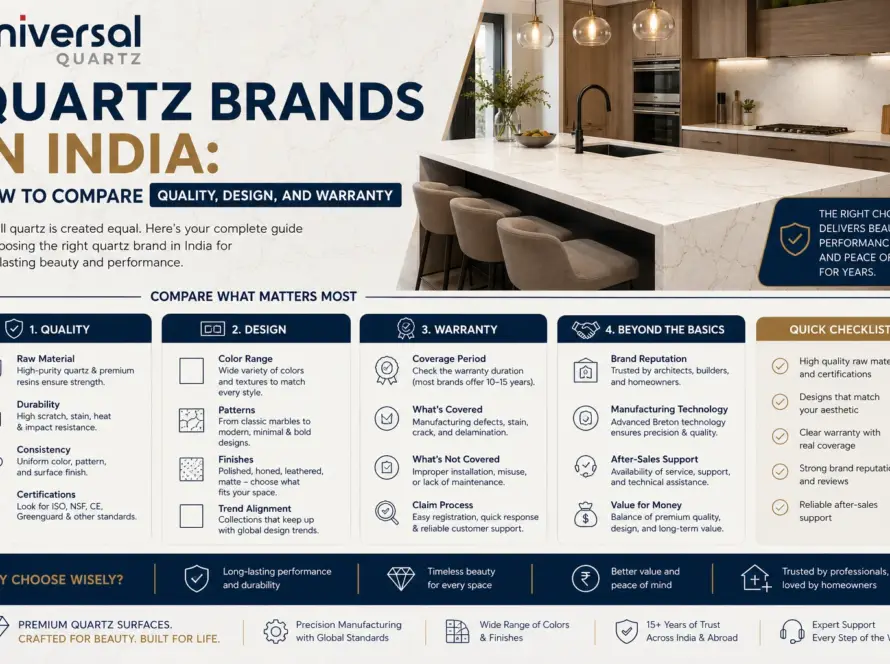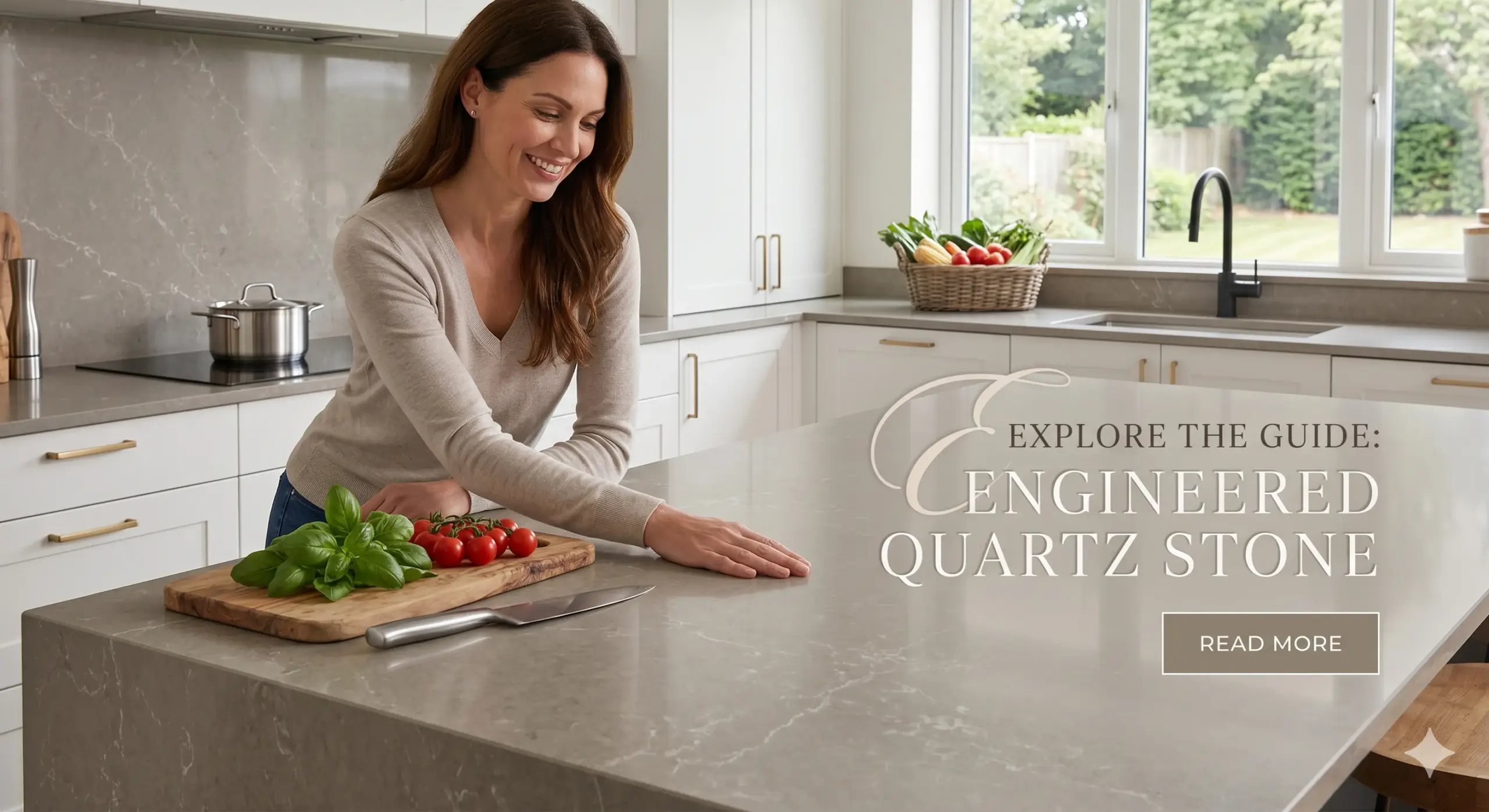
If you are renovating your kitchen, selecting a bathroom vanity, or designing a commercial workspace, there is a strong chance you have come across the term ‘engineered quartz stone’. But what exactly is it, how is it made, and is it genuinely better than granite or marble? This guide answers every question a homeowner or designer needs before making a surface decision.
Universal Quartz has been manufacturing engineered quartz surfaces for over 20 years from our facility in Jaipur, Rajasthan. Everything in this guide is grounded in real manufacturing knowledge and verified by our certified engineering team.
1. What is engineered quartz stone?
Engineered quartz stone — also called quartz surface, quartz slab, or simply ‘quartz’ in the design industry — is a composite material created by combining crushed natural quartz crystals with a small percentage of polymer resin binders and colour pigments. The resulting material is then compressed under vacuum and cured under heat to produce a dense, hard, non-porous slab.
The key distinction from natural stone is that engineered quartz is manufactured to a precise and consistent specification. Every slab from the same batch looks virtually identical, whereas natural granite or marble will always carry natural variation and veining that can be unpredictable.
What is engineered quartz made of
| Component | Proportion | Purpose |
| Ground quartz crystals | 93–95% | Hardness, density, scratch resistance |
| Polymer resin binders | 4–6% | Bonding, flexibility, non-porosity |
| Colour pigments & additives | <1% | Aesthetic design and UV stability |
| Christobalite powder (in UQ slabs) | Trace | Enhanced surface density and strength |
2. How is engineered quartz made?
The manufacturing process is what gives engineered quartz its superior performance characteristics. At Universal Quartz, we follow a precisely controlled, multi-stage production process:
- Raw quartz crystals are sourced, cleaned, and ground to specific particle sizes for optimal packing density.
- Ground quartz is blended with polymer resins, pigments, and any performance-enhancing additives in precise ratios.
- The mixture is poured into moulds and compressed under vacuum at high pressure to eliminate air pockets — this is what makes quartz non-porous.
- Slabs are cured in a kiln at controlled temperatures to complete the polymer bonding process.
- Finished slabs are calibrated, polished, and quality-inspected before packaging.
The vacuum compaction step is critical. It is what distinguishes quartz from other engineered surfaces and from natural stone — no pores means no bacterial penetration, no staining from liquids, and no need for periodic sealing.
3. Key benefits of engineered quartz stone
- Non-porous: Non-porous surface — resistant to bacteria, mould, and moisture. No sealing required.
- Scratch-resistant: Quartz rates 7 on the Mohs hardness scale, harder than most kitchen tools.
- Consistent: Consistent appearance — manufactured to a uniform standard, ideal for large-format installations.
- Stain-resistant: Stain-resistant — does not absorb wine, oil, coffee, turmeric, or hard water minerals.
- Low maintenance: Low maintenance — clean with mild soap and water; no specialist products needed.
- Design versatility: Design versatility — available in hundreds of colours, finishes, and vein patterns.
- Certified safe: Certified safe — Universal Quartz slabs carry ISO, CE, GREENGUARD, and NSF certifications.
4. Engineered quartz vs natural stone: at a glance
| Feature | Engineered Quartz | Granite | Marble |
| Non-porous | Yes | No (requires sealing) | No (requires sealing) |
| Consistent pattern | Yes | No | No |
| Sealing required | Never | Every 1–2 years | Every 6–12 months |
| Scratch resistance | Very High | High | Medium |
| Stain resistance | Excellent | Good (sealed) | Poor |
| Maintenance effort | Minimal | Moderate | High |
| Indian climate suited | Excellent | Good | HighThe |
5. Where is engineered quartz used?
Engineered quartz is one of the most versatile surface materials available. Universal Quartz slabs are used across a wide range of residential and commercial applications across India and internationally:
- Kitchen countertops and islands — the most common application, valued for hygiene and durability.
- Bathroom vanity tops and shower surrounds — non-porous surface handles constant moisture exposure.
- Office workstations and conference table tops — professional aesthetic with minimal upkeep.
- Reception desks and hotel lobbies — large-format slabs create a striking first impression.
- Wall cladding and feature panels — polished or matte finishes add texture to interiors.
- Pre-fabricated modular surfaces — Universal Quartz offers pre-fab solutions for faster site installation.
6. Why engineered quartz is ideal for Indian homes
India’s climate and lifestyle present specific demands on interior surfaces that engineered quartz is exceptionally well-suited to meet:
- High humidity in coastal cities like Mumbai, Chennai, and Kochi — quartz will not absorb moisture or warp.
- Hard water is common across Delhi NCR, Rajasthan, and Gujarat — mineral deposits do not etch quartz the way they do marble.
- Turmeric, masala, and cooking oil spills in Indian kitchens — quartz’s non-porous surface prevents permanent staining.
- Temperature fluctuations across India’s diverse climates — engineered quartz performs consistently in both humid and dry conditions.
- Growing demand in metro renovation markets — Delhi NCR, Mumbai, Bangalore, Hyderabad, and Pune leads quartz adoption among designers.
Frequently asked questions
Is engineered quartz the same as quartzite?
No. Engineered quartz is a manufactured composite containing 93–95% ground quartz crystals bonded with resin. Quartzite is a natural metamorphic rock formed when sandstone is exposed to heat and pressure. They are entirely different materials, though both contain quartz minerals.
Does engineered quartz need to be sealed?
No. Because engineered quartz is non-porous, it never needs sealing. This is one of its primary advantages over natural granite and marble, which require re-sealing every one to two years to maintain stain resistance.
Can quartz countertops handle hot pots and pans?
Engineered quartz can tolerate brief exposure to moderate heat, but prolonged direct contact with very hot cookware (above 150°C) can cause thermal shock or discolouration of the resin binders. It is recommended to always use trivets or heat pads under hot vessels.
How much does engineered quartz cost in India?
Engineered quartz prices in India typically range from ₹250 to ₹600 per square foot, depending on the series, finish, and slab thickness. Universal Quartz offers multiple product series — from the premium Harmony range to the versatile Jupiter and Venus collections — at different price points. Contact our nearest branch for a current quote.
Is Universal Quartz certified safe for kitchen use?
Yes. Universal Quartz slabs carry ISO certification, CE marking, GREENGUARD Gold certification for indoor air quality, and NSF certification — all internationally recognised safety and quality standards. These certifications confirm our surfaces are safe for food-contact environments.
How do I clean engineered quartz?
Regular cleaning requires only a soft cloth, mild dish soap, and warm water. For dried spills, use a non-abrasive plastic scraper followed by a surface cleaner. Avoid bleach, abrasive powders, and acid-based cleaners as these can dull the resin binders over time.
Ready to choose your quartz surface?
Universal Quartz offers 8 premium product series — Harmony, Jupiter, Saturn, Venus, Mercury, Mars, Neptune, and Uranus — each inspired by the cosmos and crafted for Indian and international interiors. Visit universalquartz.in to download our catalogue, request a sample, or speak with a design consultant at our nearest branch.