“Engineered stone” sounds technical, but the idea behind it is fairly simple once you break it down. This guide explains, in plain language, what engineered stone actually is, the science behind how it’s made, and why that science is what gives quartz countertops their strength, consistency, and low-maintenance reputation.
What “Engineered Stone” Actually Means
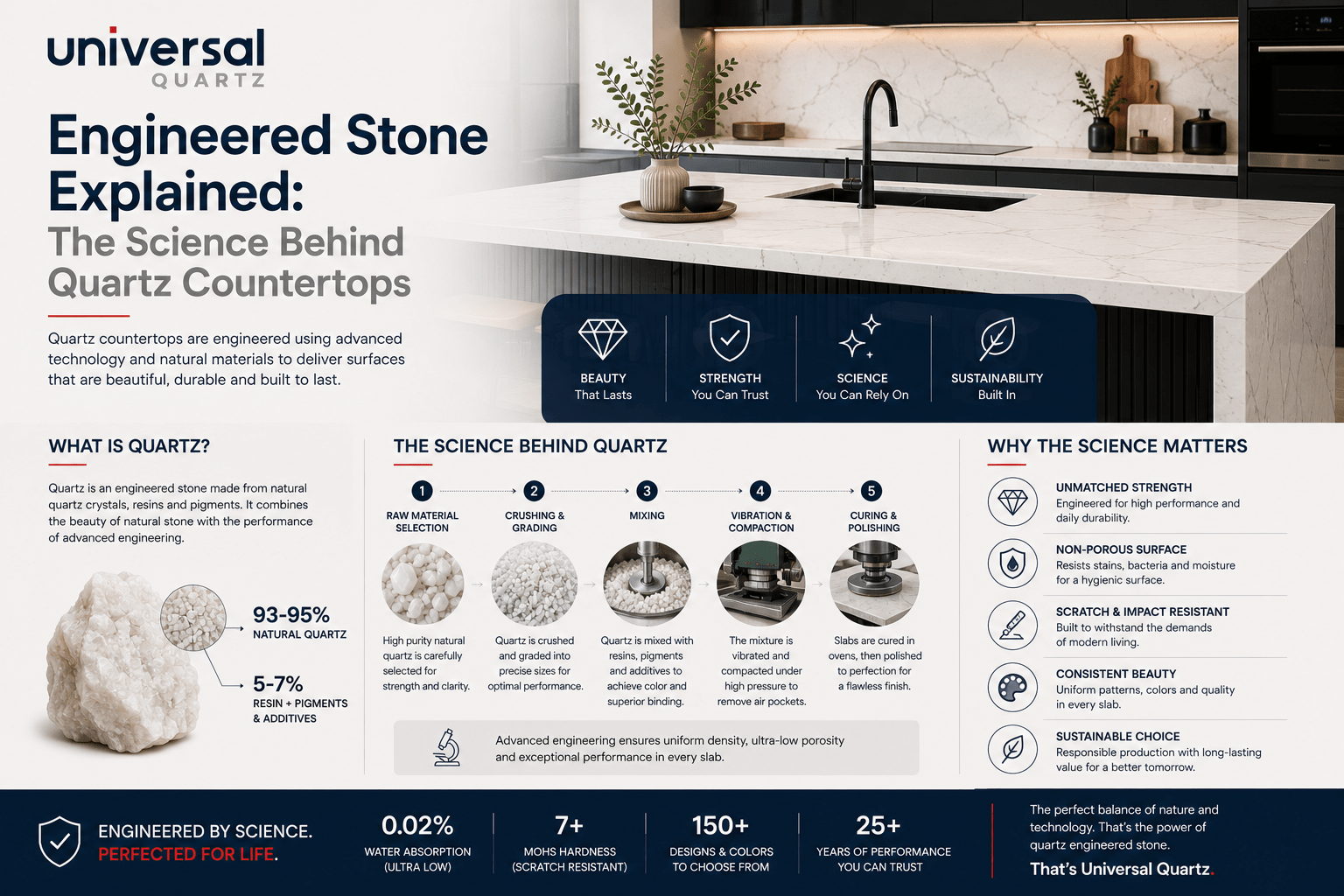
Engineered stone is a man-made material created by combining crushed natural minerals with a binding agent, rather than being cut directly from a single block of stone found in nature. In the case of quartz countertops, that natural mineral is quartz — one of the hardest and most abundant minerals on earth — combined with polymer resin and pigments.
This is the key difference from natural stone like granite or marble: natural stone is quarried and cut, meaning every slab is exactly what nature produced. Engineered stone is manufactured, meaning a company controls the mix, the strength, and the appearance.
The Science Behind the Strength
Why Quartz Mineral Is the Foundation
Quartz is one of the hardest naturally occurring minerals, ranking 7 on the Mohs hardness scale (a standard scale used to measure mineral hardness, where diamond sits at 10). This natural hardness is a big part of why engineered quartz countertops resist everyday scratching so well — the finished slab inherits much of the raw mineral’s hardness.
The Role of Resin
Resin acts as the binding agent that holds the crushed quartz particles together. It fills the tiny gaps between quartz particles, which is what makes the finished surface non-porous — essentially eliminating the microscopic holes that allow liquid to seep into natural, porous stone.
Why Compaction Is the Most Critical Step
The quartz-resin mixture is compacted under intense vacuum and vibration, a process that removes trapped air and packs the particles as tightly as possible. This step, sometimes enhanced using technology like Christobalite Powder-based compaction, is what ultimately determines the density of the slab. A denser slab is generally stronger, more resistant to micro-cracking, and more color-consistent than a loosely compacted one.
Curing and Molecular Bonding
After compaction, heat is used to cure the resin, triggering a chemical process that hardens it into a solid, stable structure. Proper curing temperature and timing affect how strong and stable the final bond between the quartz particles and resin actually is.
Why This Science Translates Into Real Benefits
- Hardness: The high quartz mineral content, combined with tight compaction, gives the surface strong resistance to everyday scratching
- Non-porosity: The resin filling microscopic gaps is what allows quartz to resist staining without ever needing to be sealed
- Consistency: Because the mix, color, and process are controlled by the manufacturer, each slab from a well-run factory looks predictably similar to the sample
- Design flexibility: Since color comes from added pigments rather than only what nature provides, manufacturers can create colors and patterns that don’t exist in natural stone
To see how this manufacturing science plays out across the full production process, our guide on engineered quartz in India covers it step by step.
Engineered Stone vs. Natural Stone: The Core Scientific Difference
Formation
Natural stone forms over millions of years underground and is quarried in its existing state. Engineered stone is manufactured in a controlled factory environment in a matter of hours or days.
Porosity
Natural stone contains microscopic pores, which is why it needs sealing to resist stains. Engineered quartz is designed to be non-porous from the manufacturing process itself, so sealing isn’t necessary.
Consistency
Every piece of natural stone is unique, with no two slabs identical. Engineered stone can be produced with a controlled, repeatable pattern and color, which is why quartz slabs from the same batch look very similar to each other.
Composition Control
With natural stone, you get whatever minerals nature included. With engineered stone, the manufacturer controls the exact ratio of quartz, resin, and pigment, which is part of what allows for consistent quality standards and certifications.
A Quick Word on Experience
The science behind engineered stone only translates into real-world quality when it’s applied correctly and consistently, batch after batch. This is where manufacturing experience matters — a company that has spent years refining its compaction and curing process is more likely to produce consistently dense, well-bonded slabs than a newer operation still working out the details. Certifications like ISO 9001:2015 exist specifically to verify that this kind of process consistency is actually being maintained.
For more on how to evaluate that consistency in a manufacturer, see our guide on the best quartz countertop brands in India for 2026.
Frequently Asked Questions
Is engineered stone the same as quartz?
In the context of countertops, yes — “engineered stone” and “engineered quartz” are generally used to describe the same type of manufactured surface made from crushed quartz mineral bound with resin.
Why is engineered quartz harder than some natural stones?
The quartz mineral itself is very hard, ranking 7 on the Mohs hardness scale. Combined with tight compaction during manufacturing, this gives engineered quartz strong resistance to everyday scratching.
Why doesn’t engineered quartz need to be sealed?
The resin used in manufacturing fills the microscopic gaps between quartz particles, making the surface non-porous. This means there are no tiny holes for liquid to soak into, unlike natural, porous stone.
Does the manufacturing process affect the final quality of quartz?
Yes, significantly. The compaction and curing steps determine the slab’s density, strength, and consistency, which is why manufacturing quality varies noticeably between different quartz producers.
Can engineered stone look like natural stone?
Yes. Manufacturers can create marble-look veining and other natural-looking patterns using pigments and design techniques during production, while still keeping the practical benefits of an engineered, non-porous surface.
Related Reading
Explore more on the science, manufacturing, and selection of quartz countertops:
Best Quartz Countertop Brand in India 2026
How to Choose the Best Quartz Kitchen Countertops
Final Thoughts
Engineered stone isn’t complicated once you understand the basic science: hard natural quartz mineral, bound tightly with resin, compacted to remove air, and cured into a dense, non-porous slab. That process is exactly why quartz countertops offer the durability, consistency, and low maintenance that natural stone often can’t match. Understanding the science also makes it easier to spot the difference between a well-manufactured slab and a lower-quality one — the details of the process are what separate the two.