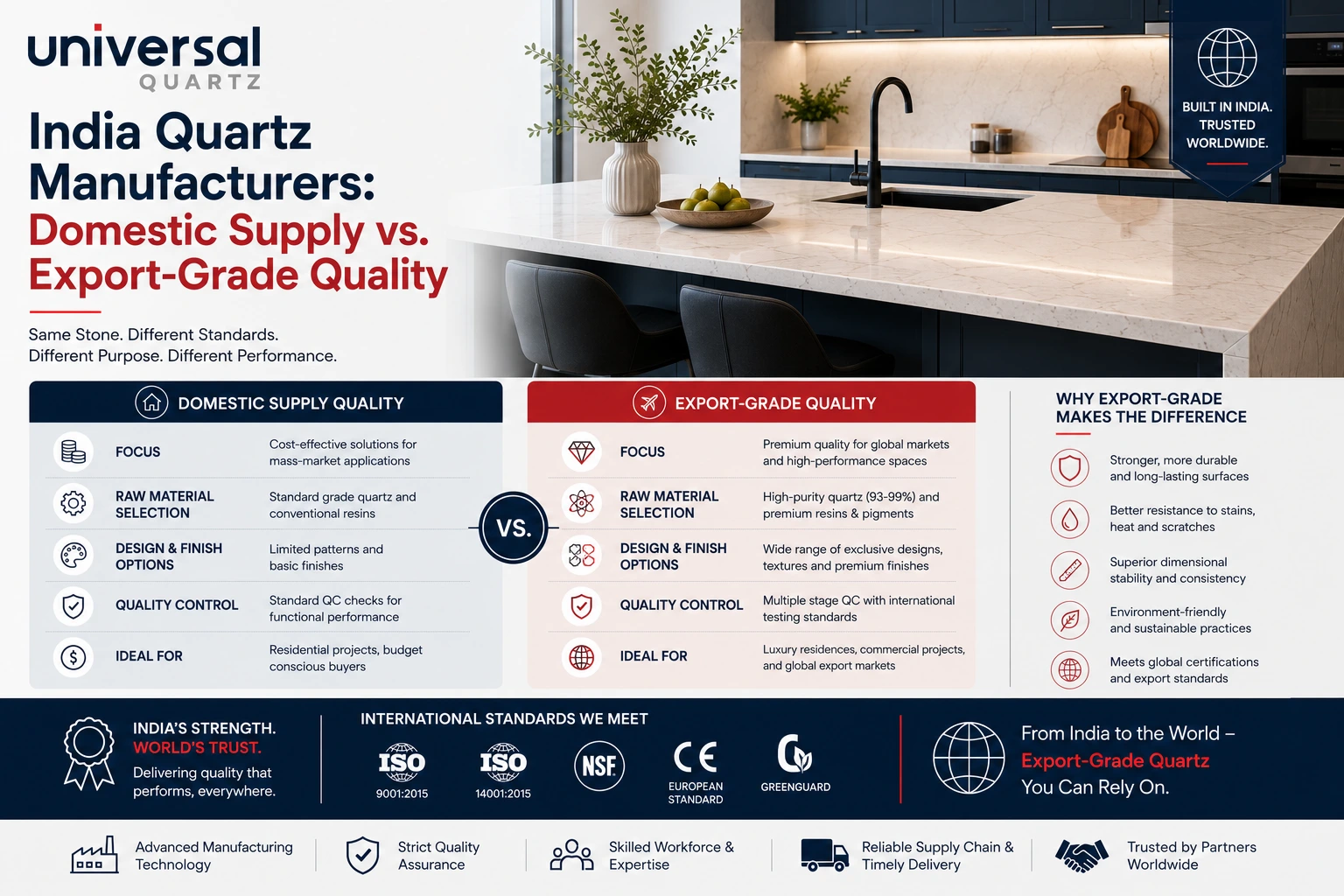
There’s a common assumption that anything made for export is automatically better than what’s sold domestically. With quartz manufacturing in India, the real picture is more nuanced than that. This guide explains, in plain language, what actually separates domestic supply from export-grade quality, and how to make sure you’re getting the right standard for your project, wherever you’re buying from.
Why This Question Even Comes Up
International markets like the United States and the European Union often require stricter documentation, testing, and certification before a product can be sold there. This has led to a widespread assumption that “export-grade” automatically means better material. In some cases, that’s true. But in a well-run factory, it’s less about two different quality tiers and more about which paperwork and certification requirements apply to a given shipment.
What Actually Differs Between Domestic and Export Supply
1. Certification and Documentation Requirements
Export markets typically require specific certifications — like a CE Mark for Europe, or compliance with country-specific building and safety codes for the US — along with detailed documentation and testing records. Domestic sales in India may not legally require the same paperwork, even if the underlying slab quality is identical.
2. Quality Control Consistency
In a well-managed factory, the same production line and quality-control process typically produces both domestic and export slabs. The manufacturing technology, compaction process, and raw material sourcing usually don’t change based on where the slab is headed — what changes is the documentation and testing required to prove it.
3. Batch Selection and Inspection Rigor
Some manufacturers do apply more rigorous batch inspection specifically for export shipments, since a single non-compliant shipment can affect an international client relationship or trigger regulatory issues. This is where a genuine quality gap can appear if a manufacturer treats export inspection as a separate, stricter process rather than a baseline standard applied to everything.
4. Packaging and Handling Standards
Export shipments often require more robust packaging and handling protocols to survive long-distance shipping, which can indirectly reflect a manufacturer’s overall operational discipline, even if it doesn’t change the slab material itself.
How to Make Sure You’re Getting Export-Level Quality Domestically
- Ask whether the manufacturer applies the same quality-control process to all production, regardless of destination
- Request the same certifications you’d expect on an export shipment — ISO 9001:2015, NSF/ANSI 51, GREENGUARD Gold — even for a domestic purchase
- Ask directly whether the slab you’re buying comes from the same production line and batch standards used for export orders
- Choose manufacturers who are transparent about maintaining one consistent quality standard, rather than implying two separate tiers
- Ask to see a full slab and, where possible, batch documentation, not just a small sample chip
For more on evaluating a manufacturer’s overall quality standards, see our guide on the best quartz countertop brands in India for 2026.
Why a Genuine Export Track Record Is Still a Good Signal
Even though domestic and export slabs can come from the same production standard, a manufacturer’s export track record is still worth paying attention to. Consistently meeting the documentation, testing, and compliance demands of international markets over time suggests a level of operational discipline that tends to carry over into everything the factory produces — not proof by itself, but a meaningful, verifiable signal.
To understand how manufacturing consistency is achieved in practice, see our guide on engineered quartz in India.
Red Flags Worth Watching For
- A manufacturer openly admits domestic-market slabs are made to a lower standard than export slabs
- Certifications are only available for export documentation and can’t be provided for a domestic purchase
- Vague or inconsistent answers about whether production lines differ by destination
- Reluctance to let you inspect a full slab or provide batch-level documentation
A Quick Word on Experience
The manufacturers most likely to maintain one consistent quality standard across domestic and export supply are generally the ones with the longest track record and the broadest range of current certifications. A long operating history combined with active exports usually means the factory has already built the systems needed to maintain consistent quality at scale — across every order, not just the ones headed overseas.
Frequently Asked Questions
Is export-grade quartz always better than domestic supply?
Not necessarily. In a well-run factory, the underlying manufacturing process is often the same for both. The real difference is usually in documentation, certification, and inspection rigor rather than the material itself.
Why do export markets require more certifications?
International markets like the US and EU have their own regulatory and safety requirements, so manufacturers must provide specific certifications and testing documentation to sell there, regardless of underlying slab quality.
How can I get export-quality quartz without importing it?
Ask your domestic manufacturer whether their domestic products come from the same production line and quality standard as their export orders, and request the same certifications you’d expect on an export shipment.
Does a manufacturer’s export track record matter if I’m buying domestically?
Yes, indirectly. A consistent export track record suggests the manufacturer has systems in place to maintain quality standards reliably, which is a good sign for their domestic products as well.
What should I ask a manufacturer to confirm consistent quality?
Ask if all production follows the same quality-control process regardless of destination, and request certification documents and batch information for the specific slab you’re buying.
Related Reading
Explore more on evaluating quartz manufacturers and understanding certifications:
Best Quartz Countertop Brand in India 2026
Top 5 Quartz Stone Manufacturers in India
Final Thoughts
“Export-grade” isn’t automatically a different, superior material — in a well-run factory, it usually reflects stricter documentation and inspection rather than a fundamentally different slab. The real question to ask any India-based quartz manufacturer isn’t whether their export quality is good, but whether they apply that same standard consistently to everything they produce, domestic orders included. A manufacturer confident in their process should have no problem answering that directly.