Most people shopping for a countertop never see how it’s actually made. They see the finished slab in a showroom, pick a color, and move on. But the manufacturing process behind that slab has a direct effect on how it looks, how long it lasts, and how safe it is to use in your kitchen — which is exactly why it’s worth understanding, even in simple terms.
This guide walks through, step by step, how quartz countertops are actually manufactured, and explains why each part of the process matters for the slab that eventually ends up in your home.
What Kitchen Quartz Stone Actually Is
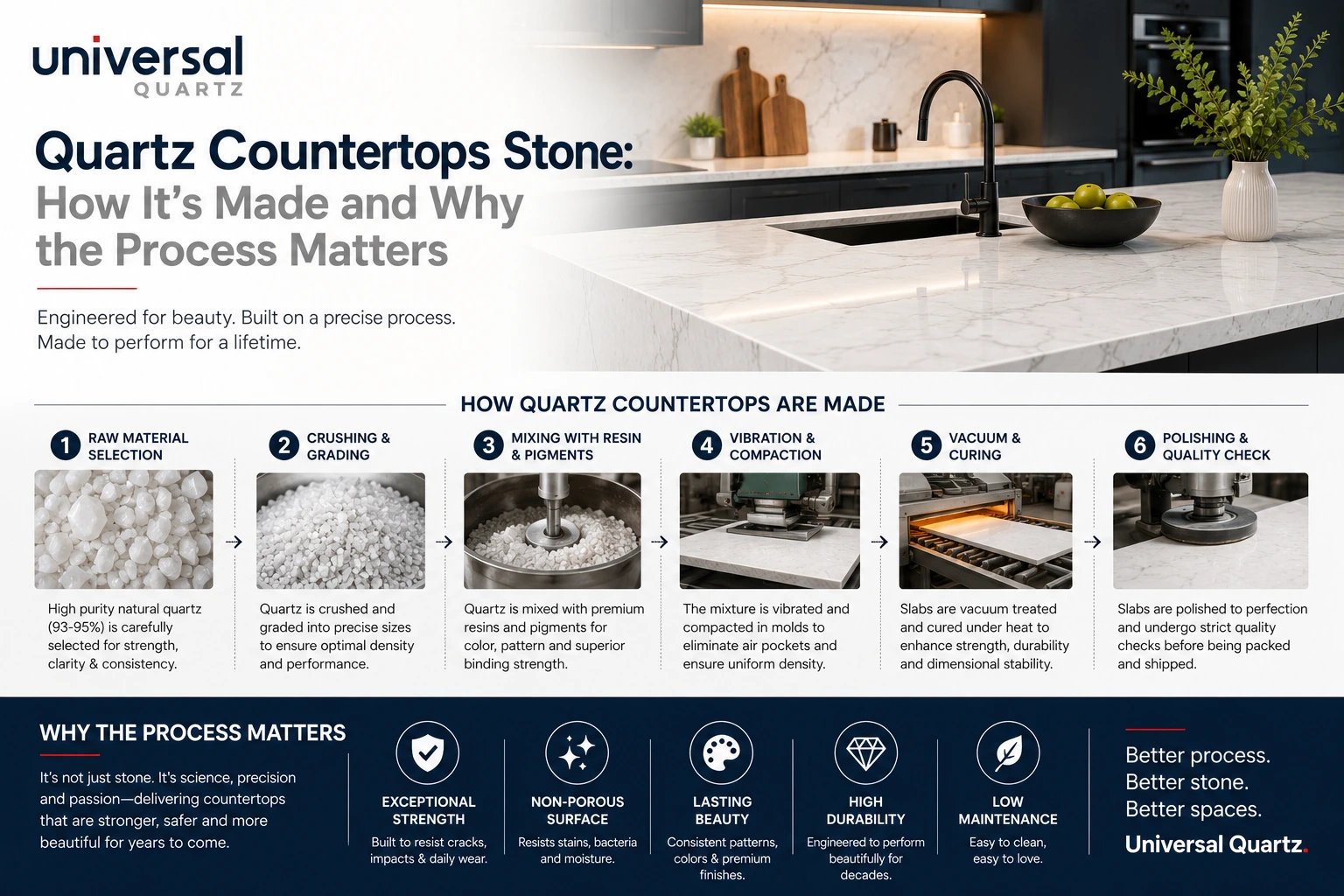
Quartz countertops, also called engineered quartz, are not cut from the earth the way granite or marble are. Instead, they are manufactured in a factory by combining crushed natural quartz mineral with resin (a type of binding material) and pigments, then compressing that mixture into a solid slab. Most quartz slabs are made up of roughly 90 to 95 percent natural quartz, with the rest being resin and coloring.
This engineered approach is exactly why quartz can offer a level of consistency that natural stone can’t — the manufacturer controls the mix, the color, and the pattern, rather than relying entirely on what nature happened to produce underground.
The Manufacturing Process, Step by Step
Step 1: Sourcing and Crushing the Quartz
The process starts with natural quartz mineral, which is crushed into small particles or fine powder. The size and quality of these particles affects the final look and strength of the slab — finer, more consistent particles generally produce a denser, more uniform surface.
Step 2: Mixing With Resin and Pigment
The crushed quartz is then mixed with polymer resin, which acts as the binding agent holding everything together, along with pigments for color. This is also the stage where design elements like veining or flecks are introduced, depending on the pattern being produced.
Step 3: Pressing and Compaction
This is one of the most important steps in the entire process. The quartz-resin mixture is placed into molds and compacted under intense vacuum and vibration, a method often called vacuum vibro-compression. This process removes air bubbles and packs the material tightly together, which is what gives the finished slab its strength and its non-porous surface.
Some manufacturers use advanced compaction methods, such as Christobalite Powder technology, which is designed to produce an even denser, more uniform slab compared to standard compaction alone. The tighter and more even this compaction is, the less likely the slab is to develop weak points over time.
Step 4: Curing
After pressing, the slab is cured, usually using heat, to harden the resin and lock the slab into its final solid form. Proper curing time and temperature matter — a slab that is cured too quickly or unevenly can end up with inconsistent strength across the surface.
Step 5: Cutting and Calibrating
Once cured, the large block is cut into slabs of a specific thickness — typically 12mm, 18mm, or 20mm. The slabs are then calibrated, meaning they’re processed to a precise, consistent thickness across the entire surface.
Step 6: Polishing or Finishing
Depending on the desired final look, the slab is polished, honed, or given a textured finish. This step determines whether the countertop will have a glossy, matte, or leathered surface once installed.
Step 7: Quality Inspection
Before a slab leaves the factory, it should go through quality checks for consistency, surface defects, and structural integrity. This is also the stage where a manufacturer’s certifications and quality standards — like ISO 9001:2015 — come into play, since these certifications require documented, repeatable quality-control processes.
Why the Manufacturing Process Matters to You as a Buyer
It’s easy to assume all quartz slabs are basically the same once they’re polished and sitting in a showroom. In reality, the manufacturing process behind a slab affects several things you’ll notice long after installation:
- Durability: Slabs made with better compaction technology are generally more resistant to micro-cracking and chipping over years of daily use
- Consistency: A well-controlled process means the slab in your kitchen will closely match the sample you picked in the showroom
- Stain resistance: Proper compaction reduces porosity, which is what allows quartz to resist stains without sealing
- Color stability: Quality pigment mixing and curing affect whether the color stays consistent over time, or fades and shifts with age and light exposure
- Safety: A properly manufactured slab, tested and certified, is less likely to release unwanted chemicals into your kitchen air over time
If you want to understand how this manufacturing quality connects to pricing, our guide to quartz stone prices in India for 2026 breaks down what you’re actually paying for beyond just the slab itself.
Questions Worth Asking a Manufacturer About Their Process
- What compaction technology do you use, and how does it affect slab density?
- How is color consistency controlled from batch to batch?
- What quality checks happen before a slab leaves the factory?
- Can you provide documentation for your certifications, such as ISO 9001:2015 or NSF/ANSI 51?
- How long has your factory been producing quartz using this process?
A manufacturer confident in their process should be able to answer these clearly, without vague or evasive responses.
A Quick Word on Experience
Manufacturing quartz well is a genuinely technical process, and it takes years of refinement to get consistently right. Manufacturers with a long track record and export experience have typically been tested by a wider range of demanding markets and quality audits than newer or smaller producers, which is one of the simplest, most reliable signals that their process has been proven over time — not just described in marketing material.
To see how manufacturing quality factors into overall brand comparisons, take a look at our overview of the best quartz countertop brands in India for 2026.
Frequently Asked Questions
What is quartz countertop stone actually made of?
Quartz countertops are made from roughly 90 to 95 percent natural crushed quartz mineral, combined with polymer resin as a binder and pigments for color, then compacted and cured into a solid slab.
Why does the manufacturing process affect durability?
The compaction process removes air bubbles and packs the material tightly, which directly affects how resistant the slab is to cracking, chipping, and staining over time. Better compaction generally means a stronger, more durable slab.
What is vacuum vibro-compression?
It’s a manufacturing method where the quartz-resin mixture is compacted under vacuum and vibration to remove air pockets and create a dense, uniform slab, which improves strength and reduces porosity.
Does the manufacturing process affect color consistency?
Yes. Well-controlled pigment mixing and curing during manufacturing help ensure the color and pattern stay consistent across the slab and match what you saw in the showroom sample.
How can I tell if a quartz manufacturer uses a quality process?
Ask about their compaction technology, quality inspection steps, and certifications such as ISO 9001:2015. A manufacturer with nothing to hide will be able to explain their process clearly and provide certification documents.
Related Reading
Explore more on quartz manufacturing, pricing, and brand comparisons in India: