The Indian kitchen is unlike any other in the world. It’s the heart of the home — a place of daily ritual, weekend feasts, festive preparation, and quiet morning chai. It also happens to be one of the most demanding cooking environments on the planet: high-heat tadkas, turmeric-heavy curries, pressure cookers going off like clockwork, and oily splatter that travels farther than you’d think.
That’s why designing an Indian modular kitchen isn’t just about aesthetics. It’s about building a space that can survive real Indian cooking — and still look stunning five years from now.
In 2026, quartz has firmly established itself as the surface of choice for discerning Indian homeowners. And for good reason. But choosing quartz is just the beginning. The real magic lies in how you design the entire kitchen around it.
This guide walks you through everything — from layout planning to slab selection, from colour pairing to maintenance myths — so you can design the perfect Indian modular kitchen with quartz surfaces.
Why Quartz Is the Right Choice for Indian Kitchens in 2026
Before we dive into design, let’s quickly address why quartz has overtaken granite, marble, and laminates as the preferred surface material for modern Indian kitchens.
Non-Porous = Hygienic
Indian cooking involves a lot of liquids — coconut milk, tamarind water, oil, and haldi (turmeric). Natural stone like granite and marble is porous, meaning these liquids seep in over time, causing stains and harbouring bacteria. Quartz, being engineered (93–94% crushed stone bound with resins), is non-porous. Nothing penetrates the surface.
Haldi-Proof (Mostly)
Turmeric is notorious for staining. While no surface is 100% haldi-proof under prolonged exposure, modern quartz slabs — especially those from brands like Kalinga Stone, Caesarstone India, Silestone, and Quantra — are significantly more resistant than granite or marble when wiped promptly.
Heat Resistance — With Caveats
Quartz can handle moderate heat but is not recommended for direct, prolonged exposure to very high temperatures (above 150°C). Always use trivets or heat pads beneath hot pressure cookers and tawas. The good news: Indian cooking rarely involves leaving a scorching vessel on the counter for extended periods.
Low Maintenance
No sealing. No annual polishing. A daily wipe-down with a damp cloth is all it takes. For a busy Indian household, this is a massive practical advantage over marble.
Aesthetic Versatility
Modern quartz comes in hundreds of finishes — matte, polished, leathered, veined — making it compatible with everything from sleek contemporary kitchens to warm, traditional designs.
Step 1: Choose the Right Kitchen Layout for Indian Cooking
The foundation of a well-designed modular kitchen is the layout. Indian cooking involves multiple burners running simultaneously, heavy vessels, and constant movement. Your layout must support this workflow.
The Parallel (Double) Kitchen — Best for Serious Indian Cooking
Two counters facing each other, typically 900mm–1050mm apart. This is the gold standard for Indian cooking. You get dedicated prep zones on one side and a cooking zone on the other, with easy movement between them. Ideal for homes where cooking is a daily, high-intensity activity.
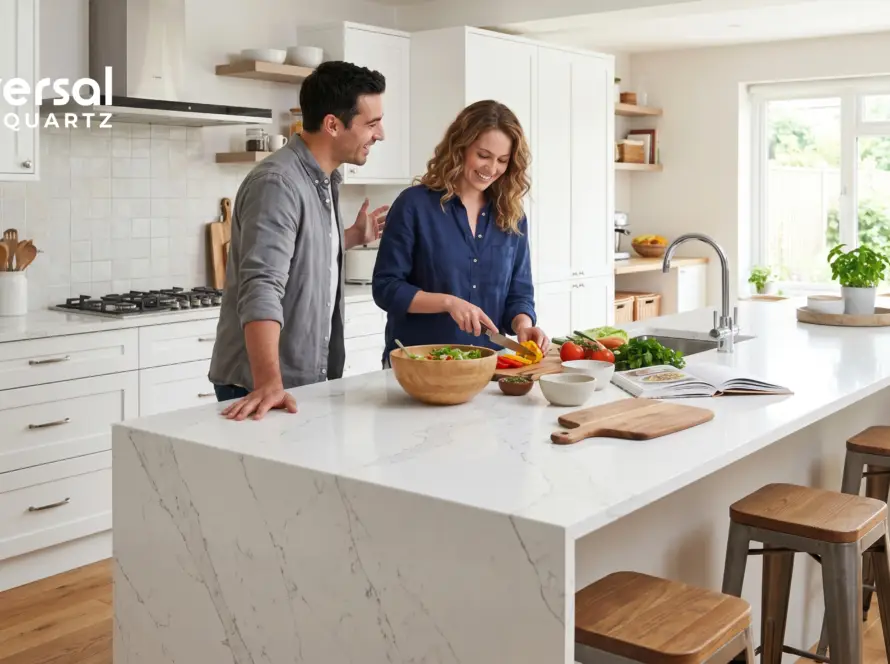
Quartz application: Use a waterfall-edge quartz counter on the prep side for a dramatic visual statement. Keep the cooking-side counter slightly thicker (20mm+) to withstand heavier use.
The L-Shaped Kitchen — Best for Mid-Sized Indian Homes
An L-shaped layout works beautifully for kitchens between 120 and 180 sq ft. One arm holds the cooking range and prep counter; the other arm becomes a utility zone — dishwashing, storage, or a breakfast counter.
Quartz application: A continuous quartz slab connecting both arms creates a seamless, high-end look while eliminating grout lines where grime can accumulate.
The U-Shaped Kitchen — Best for Spacious Kitchens
Three walls of counters and storage. Maximum workspace, maximum storage. If you have the square footage, this layout handles even the most elaborate Indian cooking with ease.
Quartz application: Consider using two quartz colours — a neutral base tone on lower counters and a feature quartz (veined or bold) on one accent wall or island to prevent visual monotony.
The Straight (Single Wall) Kitchen — For Compact Apartments
One wall of cabinets and counters. Common in urban apartments and studio flats. Works for lighter Indian cooking.
Quartz application: Use a full-height quartz backsplash (matching or complementary) to make the single wall feel expansive and luxurious.
Plan the Work Triangle (Indian Version)
The classic kitchen work triangle connects the refrigerator, sink, and stove. In an Indian context, you need to extend this concept to include:
- Masala/spice prep zone — close to the stove
- Chopping/cutting zone — with sufficient quartz counter depth (minimum 600mm)
- Wet/sink zone — with a drainage-friendly quartz or stainless-steel insert
- Hot vessel landing zone — a dedicated spot near the stove where hot vessels can be placed, ideally with a heatproof quartz insert or trivet built in
Pro Tip for 2026: Many modular kitchen designers now build in a tadka station — a small, dedicated section of the counter right beside the gas hob with a slightly raised lip on three sides to catch oil splatter. If your kitchen vendor doesn’t offer this, a 4–6 inch quartz upstand achieves the same effect.
Select Your Quartz Slab
This is where most homeowners spend the most time — and rightly so. Your quartz slab defines the look of the entire kitchen.
Thickness Matters
- 12mm: For cabinet shutters and vertical surfaces. Not recommended for countertops.
- 18mm: Suitable for lighter-use counters in apartments.
- 20mm: The most popular for Indian modular kitchens — strong, practical, visually substantial.
- 30mm: Premium, heavy, creates a bold visual impact. Excellent for islands and breakfast counters.
Finish Types for Indian Kitchens
| Finish | Look | Practical for India? |
| Polished/Gloss | Reflective, sleek | Shows fingerprints and water marks more; wipes clean easily |
| Matte/Honed | Soft, understated | Hides smudges; very popular in 2026 |
| Leathered | Textured, organic | Unique look; slightly harder to clean deep textures |
| Suede | Between matte and textured | Excellent for Indian kitchens — balance of beauty and practicality |
For Indian kitchens specifically, matte and suede finishes are recommended in 2026. They hide the inevitable daily splash and fingerprint marks far better than high-gloss.
Colour Palettes That Work for Indian Kitchens in 2026
Warm Neutrals (Most Popular)
- Cream, beige, warm white — timeless, brightens dark kitchens, pairs with warm wood cabinets
Greige and Taupe Tones
- Sophisticated and forgiving — doesn’t show masala stains the way stark white does
Charcoal and Deep Grey
- Dramatic, contemporary — pairs beautifully with brass or gold hardware
Veined Whites (Calacatta-style)
- The aspirational choice — creates a marble look with quartz practicality
What to Avoid:
- Stark bright white in kitchens that see daily Indian cooking — turmeric is unforgiving on pure white surfaces even with quartz. Opt for off-white or warm white instead.
- Very dark surfaces near the cooking zone — they show light-coloured masala dust and flour constantly.
Design Your Quartz Backsplash
In 2026, the full-height quartz backsplash — from counter to upper cabinet — has replaced the tiled backsplash in premium Indian kitchen designs. Here’s why it works so well:
- No grout lines to trap masala, oil, and moisture
- Seamless look that elevates the entire kitchen
- Easy to wipe — a damp cloth removes everything
- Visual continuity when the same slab is used for the counter and backsplash
Backsplash Height Options
- 4-inch upstand (the minimum): Protects the wall directly behind the counter from splatter. Budget-friendly.
- Window-height backsplash: Up to the base of the upper cabinet. The most common choice.
- Full-height slab backsplash: From the counter all the way to the ceiling or top of upper cabinets. Maximum drama and practicality.
For Indian cooking, we recommend a minimum of a window-height backsplash behind the cooking range. The area behind a gas stove in an Indian kitchen accumulates oil and masala splatter faster than anywhere else — easy-to-clean quartz here pays for itself in 6 months.
Pair Your Cabinet Finish with Quartz
The quartz and cabinet combination defines the kitchen’s personality. Here are the pairings that are trending and timeless in 2026:
Warm Wood + Warm White Quartz
The most popular combination in Indian homes in 2026. Natural wood veneer or wood-finish laminates paired with a warm white or cream quartz create an inviting, premium look that feels both contemporary and rooted.
Sage Green / Olive Cabinets + Off-White or Grey Quartz
The 2026 “kitchen of the year” aesthetic. Muted greens give warmth without the starkness of grey, and pair beautifully with quartz in warm off-whites, creams, or even veined white slabs.
Navy Blue / Deep Teal + White Veined Quartz
Bold, sophisticated, and increasingly popular in urban Indian apartments. Navy lower cabinets with white upper cabinets and a white veined quartz create a Hamptons-meets-Mumbai aesthetic.
All White + Calacatta Quartz
Timeless luxury. Demands good lighting and a household that’s willing to stay on top of cleaning — but the results are spectacular.
Charcoal Grey Cabinets + Gold-Veined Quartz
For those who want a deeply dramatic kitchen. Pairs best with gold or brass hardware.
Hardware, Sink, and Faucet Considerations
The hardware you choose frames your quartz surfaces. Get this right.
Hardware Finishes in 2026
- Brushed gold / Antique brass: The dominant hardware trend in Indian modular kitchens — warm, rich, works with virtually every quartz colour
- Matte black: Sleek and architectural; pairs well with grey and white quartz
- Satin nickel/chrome: Classic, never goes wrong, budget-friendly
- Avoid: Bright chrome in high-Indian-cooking kitchens — it shows water spots from hard water (a real issue in most Indian cities) constantly
Sink Choices
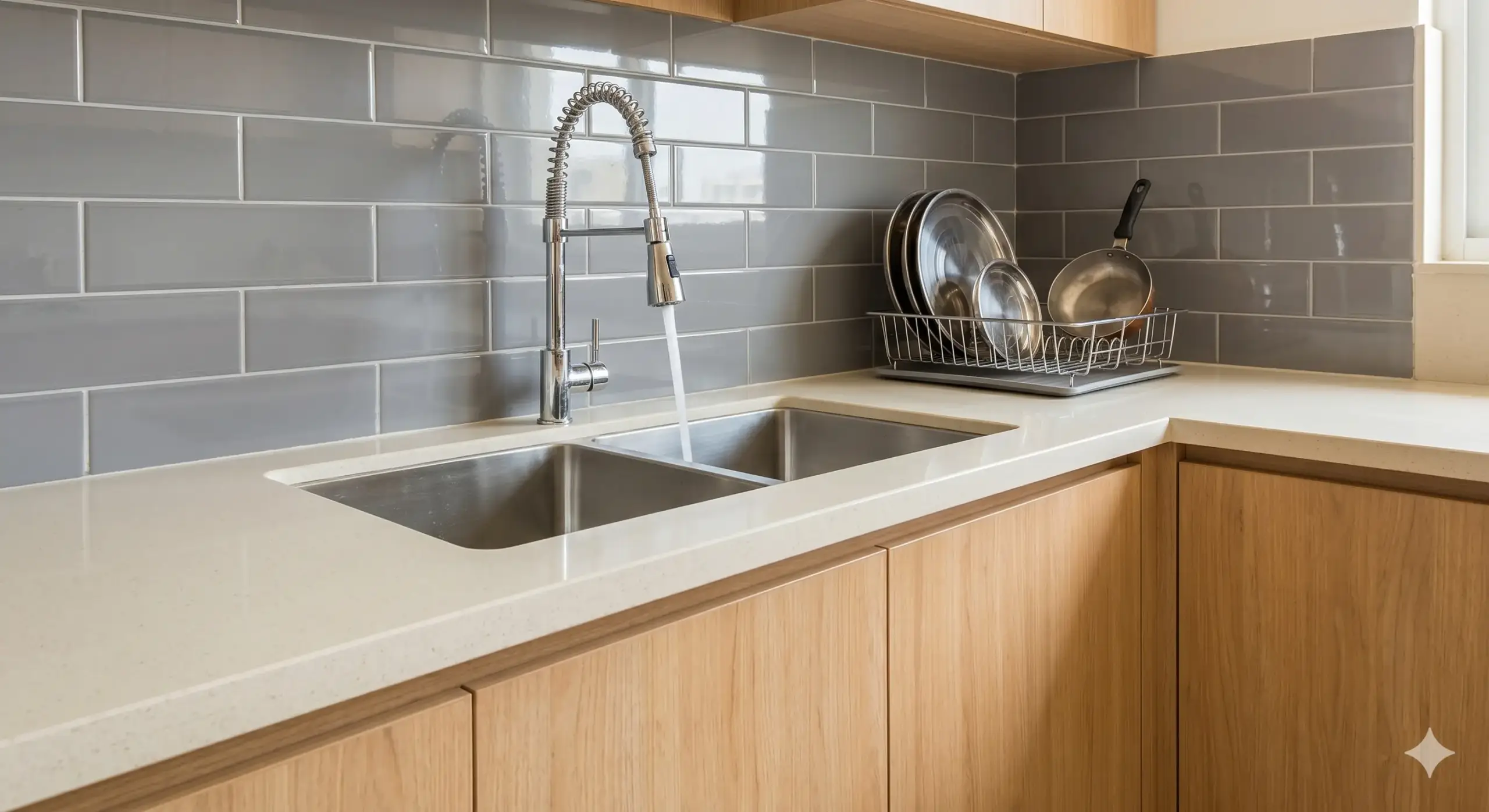
- Undermount stainless steel: The practical favourite for Indian kitchens. Seamlessly integrated with quartz, easy to sweep debris directly into the sink, and hygienic.
- Quartz composite sink: Matches the counter perfectly, is very hygienic, and is growing in popularity
- Avoid drop-in sinks: The rim collects food debris and grime — a nightmare in Indian cooking environments
Faucet
Invest in a quality faucet — this is one of the most-used elements in any kitchen. For Indian kitchens, a pull-out or pull-down faucet is highly recommended because washing large vessels, greens, and fruits is a daily activity.
Storage Design for Indian Kitchens
Indian kitchens require significantly more storage than Western kitchens — dal, rice, atta, poha, chivda, a dozen masala dabbas, pressure cookers of varying sizes, kadais, and more.
Must-Have Storage Features
Deep Drawers (600mm+): For storing heavy vessels like pressure cookers, kadais, and stock pots. Far more accessible than traditional shelves.
Pull-Out Masala Unit / Spice Drawer: A dedicated, tiered pull-out unit near the stove for masala dabbas is a game-changer. No more rummaging through shelves mid-cooking.
Corner Units: L-shaped kitchens waste enormous amounts of corner space. Magic corners, carousel units, or Le-mans units reclaim that space.
Tall Unit for Pantry Storage: If your kitchen has the wall space, a floor-to-ceiling tall unit provides deep pantry storage for dry goods, grains, and appliances.
Appliance Garage: A dedicated cabinet for countertop appliances (mixer-grinder, microwave, OTG, air fryer) keeps the quartz counter clutter-free — which is especially important since your beautiful quartz should be showcased, not buried under appliances.
Lighting Your Quartz Kitchen
Lighting is the most underinvested element in most Indian kitchen designs. In 2026, smart kitchen lighting is no longer a luxury.
Essential Lighting Layers
Under-Cabinet Task Lighting (Non-Negotiable) LED strips under upper cabinets illuminate the quartz counter directly — making food prep safer, easier, and dramatically more beautiful. The light playing off a polished or veined quartz slab at night is genuinely stunning. Choose warm white (2700K–3000K) for Indian kitchens — it flatters food and creates a warm ambiance.
Ceiling Downlights Recessed LED downlights provide even ambient illumination. Place one directly over the sink and one or two over the main prep counter.
Pendant Lights Over Island/Breakfast Counter If your kitchen has a quartz island or breakfast counter, pendant lights are both functional and a strong design statement. Rattan, brass, or matte black pendants are all popular in 2026 Indian kitchen designs.Avoid: A single ceiling tube light in the centre of the kitchen — the most common lighting mistake in Indian homes. It creates shadows exactly where you’re working.
Ventilation — The Most Important (and Most Ignored) Element
No kitchen design guide for India is complete without a serious conversation about ventilation. Indian cooking produces enormous amounts of oil vapour, smoke, and moisture. A poorly ventilated kitchen destroys surfaces — including your quartz — over time, and creates health issues.
Chimney Sizing
- Straight/I-shaped hob: Chimney should be at least as wide as the hob, ideally wider (60cm hob → 60cm or 90cm chimney)
- Suction capacity for Indian cooking: Minimum 1000 m³/hour for regular Indian cooking; 1200–1500 m³/hour for heavy cooking
Ducted vs. Recirculating
Always opt for ducted (exhaust to outside) if possible. Recirculating chimneys filter and recirculate air — they manage odour reasonably but don’t remove moisture or heat. In Indian cooking contexts, ducted is significantly superior.
Window Placement
If your kitchen has a window, position your prep counter near it for natural light and cross-ventilation during light cooking.
The Finishing Touches That Define a Premium Indian Kitchen
Edge Profiles for Quartz
The edge profile of your quartz counter is a small detail with a big visual impact.
- Straight/Square Edge: Clean, modern, most popular in 2026 — great for contemporary Indian kitchens
- Bevelled Edge: Slight angle at the top — adds detail without fuss
- Bullnose/Rounded Edge: Softer, family-friendly — ideal for homes with children
- Waterfall Edge: Quartz continues down the side of the island to the floor — the ultimate luxury statement
- Ogee Edge: More ornate, suits traditional or classic kitchen styles
Quartz Island vs. Breakfast Counter
If space allows, a quartz-topped island or breakfast counter transforms the kitchen into a social space. In 2026, the kitchen island has become central to Indian home design — it’s where chai happens, where kids do homework, where informal meals are eaten.
Recommended island counter height: 900mm (same as standard counter) for a working island; 1050–1100mm for a breakfast bar with bar stools.
Flooring to Complement Quartz
- Large format tiles (800x800mm or 600x1200mm): Fewer grout lines, easier cleaning — pairs beautifully with quartz counters
- Matte porcelain: Safe, non-slip, low maintenance — ideal for Indian kitchens
- Avoid: High-gloss floor tiles in the kitchen — extremely slippery when wet and show every footprint
Common Mistakes to Avoid in Indian Modular Kitchen Design
1. Choosing the wrong quartz colour for your cooking style If you cook heavy Indian meals daily, avoid pure white or very pale quartz. Choose warm whites, creams, or grey-toned neutrals.
2. Inadequate counter depth. Standard Indian modular kitchens often come with 500mm deep counters. Insist on 600mm depth — the extra 100mm transforms usability enormously.
3. Ignoring the backsplash behind the gas hob. This is the single most abuse-prone surface in any Indian kitchen. A full-height quartz backsplash here is worth every rupee.
4. Overloading the counter, Quartz is beautiful — show it off. Build enough storage (especially appliance garages and drawer systems) so your counter remains a showcase surface, not a storage shelf.
5. Skimping on the chimney. The most common post-renovation regret in Indian kitchens. Invest in a high-quality, adequately sized chimney. Your quartz (and your lungs) will thank you.
6. Not visiting slab samples in natural light. Quartz looks different under showroom LED lighting versus natural light. Always take a large sample home before finalising.
Quartz Maintenance for Indian Kitchens: The Real Rules
Quartz is low-maintenance, not no-maintenance. Here’s what actually works:
Daily: Wipe with a damp microfibre cloth. For oily residue (common after tadka), use a drop of dish soap.
Weekly: A quartz-safe cleaner (pH neutral) for a deeper clean.
Immediately: Wipe turmeric, red chilli, and beetroot spills the moment they occur. These won’t penetrate quartz but can leave temporary discolouration if left for hours.
Never use: Bleach, strong acids (vinegar-based cleaners), harsh abrasives, or steel wool on quartz. These degrade the resin binders and damage the surface permanently.
Heat protection: Always use trivets. While quartz is heat-resistant, repeated thermal shock weakens the resin binding over time.
Budget Guide: Indian Modular Kitchen with Quartz Surfaces (2026)
| Category | Budget Range (INR) | What You Get |
| Basic Modular + Standard Quartz | ₹3–5 lakh | Basic modular units, Indian quartz brands (Quantra, etc.), straight edge, standard chimney |
| Mid-Range | ₹6–12 lakh | Better hardware, imported quartz or premium Indian quartz, soft-close fittings, decent chimney |
| Premium | ₹13–25 lakh | Handleless design, Caesarstone/Silestone/Kalinga Stone quartz, premium chimney, custom storage solutions |
| Luxury | ₹25 lakh+ | Bespoke design, premium imported slabs, waterfall edges, smart appliances, custom islands |
Note: Prices vary significantly by city, vendor, and scope. Get at least three detailed quotes.
Top Quartz Brands Available in India in 2026
- Universal Quartz- —Universal Quartz is a leading manufacturer of premium engineered quartz surfaces, combining over 30 years of industry expertise with innovative design and advanced technology. Their quartz slabs are crafted for exceptional durability, stain resistance, and timeless aesthetics, making them ideal for kitchens, bathrooms, countertops, and commercial spaces. With a wide range of modern designs and a strong global presence, Universal Quartz delivers surfaces that elevate every interior with style and performance.
- Kalinga Stone — Indian brand, excellent quality-price ratio, wide range of colours
- Quantra by Pokarna — India’s largest quartz manufacturer, reliable and widely available
- Caesarstone India — Premium international brand, excellent consistency
- Silestone (by Cosentino) — Premium, excellent stain resistance, good range
- Quartz Master / Astroquartz — Mid-range options with decent performance
- Compac — Growing presence in the premium Indian market
Conclusion: Design for How You Actually Cook
The perfect Indian modular kitchen isn’t the one that looks best in photographs. It’s the one that works effortlessly for the way your family actually cooks — every single day.
Quartz surfaces give you the beauty and the durability to build a kitchen that can handle everything Indian cooking demands while still looking like something out of an interior design magazine. But the surfaces are only one part of the equation. The layout, lighting, ventilation, storage, and hardware all have to work together.
Take your time with the planning. Visit multiple vendors. Bring home quartz samples. Stand in the kitchen with the samples in natural light. Think about your daily cooking routine — where you stand, what you reach for first, what annoys you in your current kitchen.
Design for the kitchen you actually use, not just the kitchen you want to photograph.
That’s the perfect Indian modular kitchen — and in 2026, with the incredible range of quartz options available, it’s more achievable than ever.