Designing a quartz kitchen countertop involves more than picking a colour from a catalogue. From accurate measurements to edge profiles to sink cutout placement — every decision affects both the final look and the long-term performance of your surface. Get it right, and your countertop will look stunning and perform flawlessly for decades. Get it wrong, and you will face costly rework.
This step-by-step guide is based on Universal Quartz’s 20 years of designing and supplying engineered quartz surfaces across India. Whether you are doing a fresh kitchen installation or renovating an existing countertop, this guide covers every decision you need to make — in the right order.
Before you begin: what you need
Before contacting a fabricator or visiting a showroom, gather the following:
- Accurate kitchen dimensions — length and depth of every countertop run, including peninsulas and islands.
- Kitchen layout type — L-shape, U-shape, straight run, island, or peninsula. This affects slab quantity and joint placement.
- Appliance specifications — exact cutout sizes for sink, hob/cooktop, and any under-counter appliances.
- Cabinet height — standard Indian kitchen cabinet height is 850mm; confirm this with your carpenter.
- Reference images — collect 5–10 inspiration photos showing colours, finishes, and edge profiles you like.
- Budget range — know your per-sq-ft budget before visiting a showroom to narrow choices efficiently.
With these in hand, the design process becomes structured and fast. Without them, you risk multiple revisits, measurement errors, and delays.
The 8-step quartz countertop design process
Step 1 — Measure your kitchen layout
Measure all countertop runs in millimetres. Record length, depth (standard is 600mm for base cabinets in India), and any angles or irregular cuts. For L-shaped and U-shaped kitchens, measure each run separately and note the corner configuration. Add 10–15mm overhang allowance over cabinet doors. Photograph each run from multiple angles and mark appliance positions on a rough sketch.
Step 2 — Choose your quartz series and colour
Quartz colour and pattern should complement your cabinet colour, floor tile, and backsplash. Universal Quartz offers 8 series — Harmony (premium marble-look), Jupiter (bold natural textures), Venus (light Scandinavian tones), Saturn (clean solid tones), Mercury (durable neutrals), Mars, Neptune, and Uranus. For Indian kitchens with warm wood cabinetry, off-white and beige tones from the Harmony or Venus series work beautifully. For dark modular kitchens, the Jupiter series in charcoal or slate tones creates dramatic contrast.
Step 3 — Select your thickness
Quartz slabs are available in three standard thicknesses: 12mm (thin, budget-friendly, suitable for wall cladding and light-use surfaces), 18mm (the most common choice for standard Indian kitchen countertops), and 20mm or 30mm (premium thick-edge look, ideal for islands and high-use work surfaces). Most Indian kitchen countertops use 18mm thickness with a mitered or bullnose edge to create the appearance of greater depth. For islands, 20mm with a waterfall edge is the premium standard.
Step 4 — Choose your edge profile
The edge profile is the most visible design detail up close. Common options: Straight/square edge (modern, clean, easiest to maintain), Bullnose (fully rounded, traditional, smooth to touch), Bevelled edge (45-degree chamfer, classic look, popular in Indian kitchens), Ogee (ornate double-curve, suited to traditional or classic kitchen styles), Waterfall/mitered (dramatic, contemporary, stone continues vertically to the floor — premium). Universal Quartz fabricators can execute all standard edge profiles. For busy Indian kitchens, bevelled and bullnose edges are most practical as sharp square corners chip more easily.
Step 5 — Plan your cutouts
Every opening in the quartz slab — for sink, hob, or tap hole — requires precise planning. For undermount sinks (most popular with quartz), the cutout must be positioned at least 50mm from any edge of the slab. For drop-in sinks, the cutout sits at the top surface. For hobs, always maintain a minimum 100mm clearance between the hob cutout edge and any slab edge. Universal Quartz fabricators use CNC machining for all cutouts — never hand-cut — ensuring perfectly clean, chip-free edges. Confirm cutout dimensions from your actual appliance specification sheet, not estimated sizes.
Step 6 — Decide joint placement
For countertop runs longer than 3,000mm, a joint is unavoidable (standard quartz slab length is 3,000mm). Position joints away from sinks and hob areas — ideally in a low-visibility corner. For L-shaped kitchens, the joint typically sits at the inside corner at a 45-degree mitered join, which is nearly invisible when done by an experienced fabricator. A well-placed and well-executed joint is imperceptible in daily use.
Step 7 — Get your fabrication quotation
Provide your fabricator with: precise measurements, chosen series and colour code, slab thickness, edge profile, cutout specifications, and any special requirements (waterfall island, window sill extension). A professional quotation should itemise: slab cost per sq ft, fabrication charges, edge profiling cost, cutout charges, installation day charges, and any transportation fees. At Universal Quartz, our authorised fabricators across India provide fixed-price quotations with no hidden charges.
Step 8 — Confirm installation and site preparation
Before installation day: (a) Confirm cabinets are fully installed, level, and stable. (b) Ensure the site is clear of packaging and debris — fabricators need clear access. (c) Confirm all appliances are on-site so cutout dimensions can be verified against actual units. (d) Arrange for plumbing to be disconnected for one day. (e) Plan for a 24-hour curing time after the silicone adhesive is applied before normal kitchen use. A typical Indian kitchen countertop installation takes 4–6 hours for a standard layout.
Read More: quartz vs granite
3. Choosing the right quartz colour for your kitchen
Colour selection is where most homeowners feel overwhelmed. Use this framework to narrow your shortlist quickly:
Match your cabinet colour
| Cabinet colour | Recommended quartz tone | Universal Quartz series |
| White / off-white | Light grey, soft white, warm beige | Harmony, Venus |
| Dark wood/walnut | Warm white, cream, soft gold tones | Harmony, Jupiter |
| Dark wood / walnut | Crisp white, light grey, pale marble-look | Venus, Saturn |
| Grey / charcoal | White, light concrete, black | Saturn, Mercury |
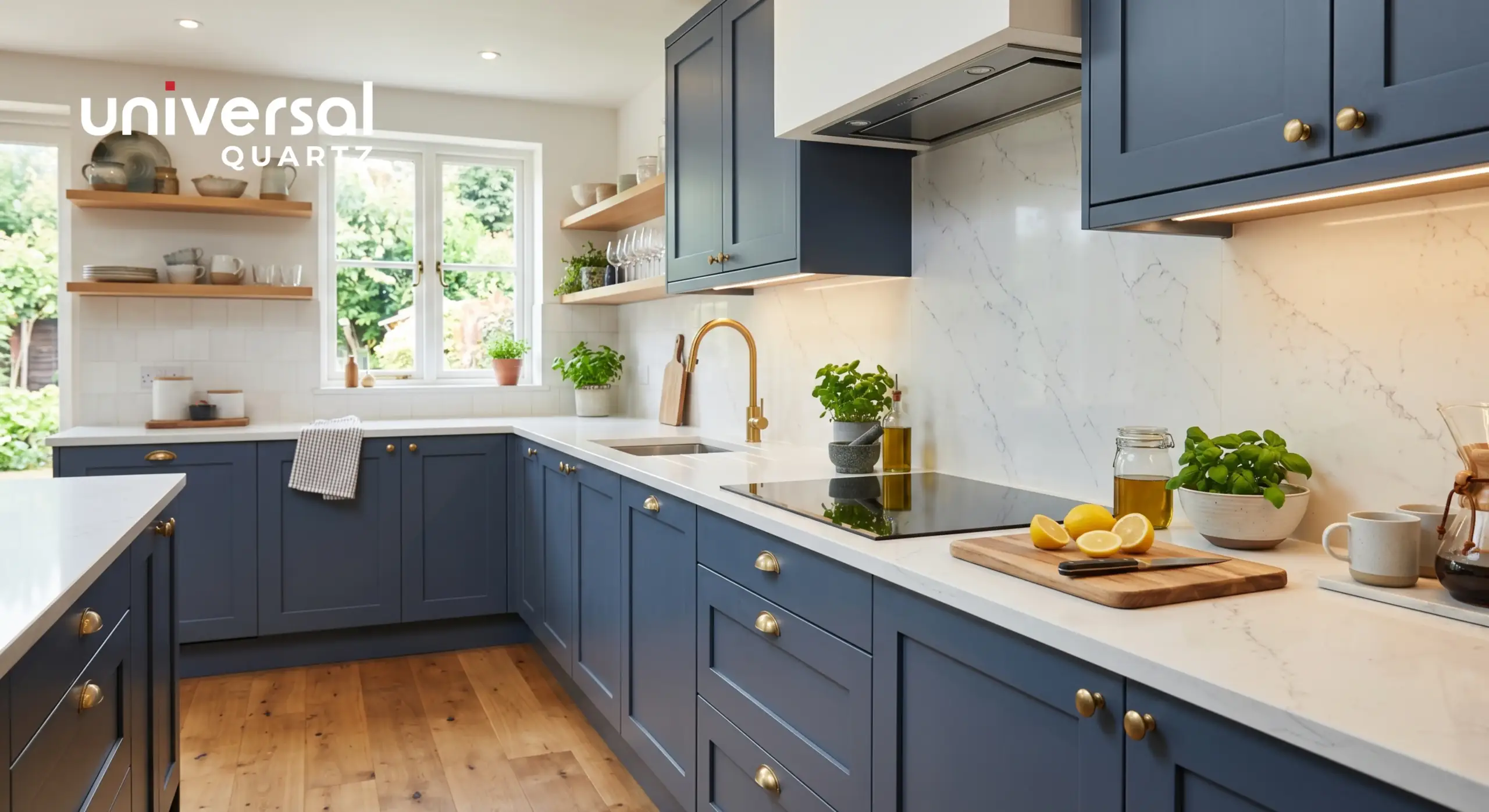
| Deep blue / navy | White Carrara-look, soft grey | Harmony, Venus |
| Green / sage | Warm white, terracotta-look, gold | Light wood/oak |
The 60-30-10 rule for Indian kitchens
Apply the classic interior design rule to your kitchen surface palette: 60% dominant colour (your walls and cabinets), 30% secondary colour (your countertop), and 10% accent colour (hardware, backsplash, fixtures). Your quartz countertop is the 30% — it should complement, not compete.
Finish: polished vs matte vs leather
- Polished: High-gloss, reflective. Shows fingerprints more readily. Best for dark-coloured slabs, where it enhances depth.
- Matte: Flat, velvety surface. Hides fingerprints and minor marks. Best for light-coloured and white slabs. Very popular in modern Indian kitchens.
- Leather / honed: Textured surface with a natural stone feel. Premium aesthetic. Slightly more difficult to clean than polished, but highly durable. Best for island tops.
India-specific design considerations
Cabinet heights in Indian kitchens
Standard Indian base cabinet height is 850mm (vs 900mm in European and US kitchens). Confirm your cabinet height with your carpenter before the slab is cut — a 50mm error here results in a countertop that is either too high or too low for ergonomic use.
The window sill extension
Many Indian kitchen designs include a quartz slab that extends to or around the window sill above the sink area. This is both a design and practical choice — it creates a continuous, easy-clean surface. Plan this extension at the measurement stage, as it requires additional slab material.
Platform kitchen vs modular kitchen
Traditional Indian platform kitchens (masonry-built platforms) require thicker slabs (20–30mm) for structural reasons, as the slab spans wider unsupported areas. Modular kitchen cabinets provide continuous support, allowing 18mm thickness throughout. Confirm your platform type with your contractor before placing the slab order.
Vastu and direction considerations
For homeowners following Vastu principles, the cooking platform is traditionally placed on the south-east or east wall. Quartz is considered a neutral material in Vastu — its colour can be chosen to complement the directional element of the kitchen without restriction.
Read More: What is quartz
Common design mistakes to avoid
- Not measuring for appliance overhangs — always measure your hob and sink with their actual specification sheet dimensions, not estimated sizes. Even a 5mm error causes a misfit cutout.
- Choosing colour from a screen — quartz colours look significantly different on screen vs in person under kitchen lighting. Always order a physical sample before confirming.
- Ignoring the backsplash — your quartz countertop and backsplash are seen together constantly. Choose them at the same time, with a physical sample of each side by side.
- Ordering too late — popular quartz colours can have lead times of 2–4 weeks. Order your slab as soon as cabinet installation begins, not after.
- Selecting the wrong edge for a sharp corner — square/straight edges are striking but chip-prone in high-traffic corners. Opt for bullnose or bevelled edges at any corner that receives daily traffic.
- Placing a joint under the sink — silicone joints degrade faster when permanently submerged. Position joints away from sink areas.
Kitchen design trends across Indian cities
Quartz countertop design preferences vary meaningfully across India’s regions and major cities:
- Delhi NCR (Gurugram, Noida, Faridabad): Luxury modular kitchens with large islands dominate. The Harmony series in Carrara-white and Calacatta-look patterns is the top choice. Waterfall edges on islands are considered the premium standard.
- Mumbai (BKC, Worli, Powai): Space-premium apartments favour compact layouts with light-coloured quartz to maximise perceived space. Matte finish in off-white and light grey is the dominant preference.
- Bangalore (Whitefield, Koramangala): Tech-sector professionals lean toward minimalist dark-and-light contrasts: dark cabinets with white or light grey quartz. The Venus series is particularly popular.
- Jaipur and Rajasthan: Warm tones inspired by local sandstone aesthetics. The Jupiter series in warm beige and sand tones performs extremely well in this market.
- Chennai and Hyderabad: High-humidity environments make non-porous quartz the standard specification for new construction. Architects in these markets frequently specify Universal Quartz by name.
Frequently asked questions
How thick should a quartz kitchen countertop be in India?
The standard thickness for quartz kitchen countertops in India is 18mm for modular kitchens. For platform (masonry) kitchens or island tops, 20–30mm is recommended. Thicker slabs provide a more premium appearance and greater structural stability across wider unsupported spans.
What is the standard depth of a kitchen countertop in India?
The standard countertop depth in Indian kitchens is 600mm (to match standard 500mm base cabinets plus a 50–100mm overhang). For islands, a depth of 900–1,200mm is common. Always confirm your cabinet depth before ordering the quartz slab.
Which quartz edge profile is best for Indian kitchens?
The bevelled edge and bullnose edge are the most practical for Indian kitchens. They withstand daily contact without chipping, are easy to clean at the edge, and suit both modern and traditional kitchen styles. Straight/square edges are popular in contemporary designs but are more prone to corner chipping in high-traffic kitchens.
Can quartz be used for a kitchen window sill?
Yes. Quartz is an excellent material for kitchen window sills, especially above the sink area. It handles moisture, sunlight, and cleaning agents without discolouring or degrading. A continuous quartz surface from countertop to window sill creates a seamless, easy-clean finish that is very popular in Indian kitchen designs.
How long does quartz countertop installation take in India?
A standard Indian kitchen quartz countertop installation takes 4–6 hours for a modular kitchen layout. Larger kitchens or complex layouts with islands, peninsulas, and window sills may take a full day. The countertop should not be used for 24 hours after installation to allow the silicone adhesive to cure fully.
What is the minimum distance from the sink cutout to the slab edge?
The minimum distance between a sink cutout edge and the outer edge of the quartz slab is 50mm. For undermount sinks (most common with quartz), this clearance is essential to maintain structural integrity at the edge. Always confirm cutout placement with your fabricator before finalising.
Ready to start your quartz kitchen design?
Designing a quartz kitchen countertop is a process — not a single decision. Working through these eight steps in order ensures you arrive at a countertop that is perfectly sized, beautifully finished, and engineered for the specific demands of your Indian kitchen.
Universal Quartz offers free design consultation at our showrooms across India. Our authorised fabricators in Delhi NCR, Mumbai, Bangalore, Jaipur, and eight other cities provide end-to-end supply and installation with a quality guarantee backed by 20 years of manufacturing expertise.
Start your countertop design with Universal Quartz
Visit universalquartz.in to explore all 8 product series, download our design catalogue, order free samples, and locate your nearest Universal Quartz showroom or authorised fabricator. ISO · CE · GREENGUARD Gold · NSF certified. Designed and manufactured in India.