Once you’ve picked a color and finish, there’s still an important, often overlooked decision left: slab size and thickness. These specifications affect everything from how many seams your countertop will have, to how sturdy it feels, to your final project cost. This guide explains, in plain language, what India’s quartz manufacturers typically offer and how to choose the right specification for your project.
Why Slab Size and Thickness Matter More Than They Seem
It’s easy to focus entirely on color and finish when choosing quartz, since that’s what you see every day. But size and thickness quietly affect the practical side of your project — how many seams are visible, how the counter feels underfoot or under load, what edge styles are possible, and how much waste (and cost) is generated during fabrication.
Understanding Standard Slab Sizes
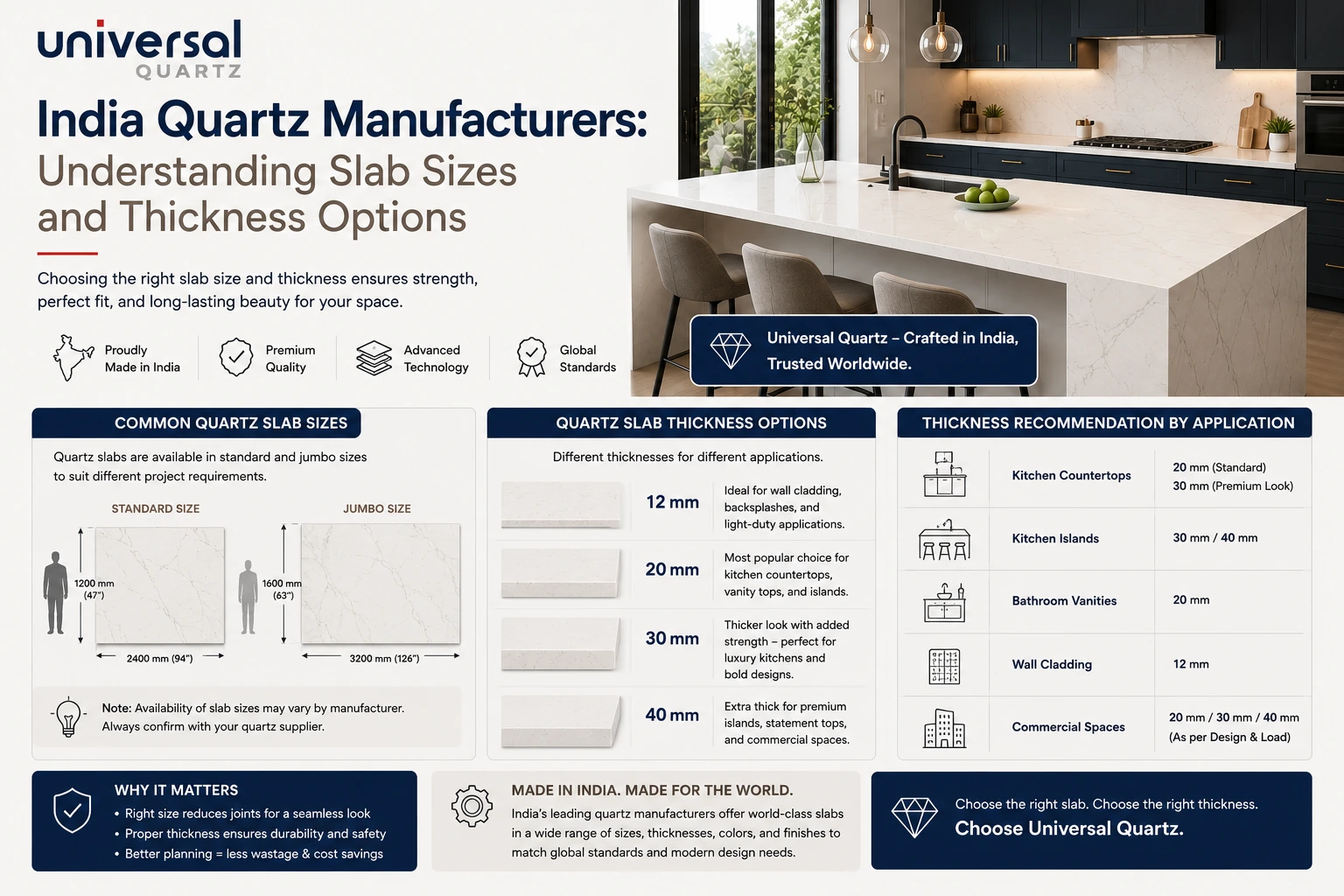
Most quartz manufacturers in India produce slabs in a few common size ranges, generally measured in feet or millimeters. While exact dimensions vary by manufacturer, standard slabs typically fall in a range of roughly 120 to 130 inches in length and 55 to 65 inches in width, with some manufacturers offering jumbo or large-format slabs beyond this for bigger, seamless installations.
Why Larger Slabs Matter
Larger, jumbo-format slabs allow fabricators to cover bigger countertop areas, kitchen islands, or commercial installations with fewer seams. Fewer seams generally means a cleaner look and, in many cases, a stronger, more structurally continuous surface, since seams are naturally the weakest points in any stone installation.
When Standard Sizes Are Enough
For most home kitchens, standard slab sizes are more than sufficient, and the difference in practical performance between standard and jumbo slabs is minimal unless you have a particularly large island or an unusually long, uninterrupted counter run.
For a broader look at planning your countertop layout, see our guide on how to choose the best quartz kitchen countertops.
Understanding Thickness Options
Quartz slabs are most commonly available in three thicknesses: 12mm, 18mm, and 20mm. Each has different practical implications for your project.
12mm Slabs
The thinnest common option, 12mm slabs are lighter and generally more budget-friendly. However, they typically require a plywood backing underneath for structural support, especially for countertops and larger spans, since the thinner profile alone isn’t always sturdy enough on its own.
18mm Slabs
This is one of the most popular thicknesses for kitchen countertops, offering a good balance between sturdiness, weight, and cost. It’s thick enough for most standard edge profiles without needing additional backing in typical installations.
20mm Slabs
The thickest common option, 20mm slabs offer the sturdiest feel and the most flexibility for elaborate, decorative edge profiles, such as bullnose or ogee edges, or for design features like waterfall edges where the slab’s edge is highly visible. This thickness is also popular for commercial applications where surfaces see heavier daily use.
How to Choose the Right Thickness for Your Project
- Standard kitchen countertops: 18mm is a common, practical choice for most homes
- Budget-conscious projects: 12mm can work well, provided proper backing support is used
- Waterfall edges or bold, decorative edge profiles: 20mm generally gives the best visual result
- Commercial applications with heavy daily use: 20mm is often preferred for its added sturdiness
- Bathroom vanities and smaller surfaces: 12mm or 18mm are both commonly used, depending on design preference
How Slab Size and Thickness Affect Cost
Thicker slabs generally cost more per square foot than thinner ones, both in raw material and because they’re heavier to transport and install. Similarly, jumbo or large-format slabs often carry a premium over standard sizes, since they require more advanced manufacturing and handling. That said, fewer seams from a larger slab can sometimes offset labor costs elsewhere, so it’s worth asking your fabricator for a complete comparison rather than assuming the thinner or smaller option is automatically cheaper overall.
Our guide on quartz stone prices in India for 2026 breaks down how thickness and slab size factor into overall project pricing.
Questions to Ask Your Manufacturer About Slab Specifications
- What slab sizes and thicknesses do you currently stock for the color and finish I’ve chosen?
- Do larger or jumbo slabs cost significantly more, and does that offset potential seam-reduction savings?
- Does my chosen thickness require additional backing support, and does that affect my quote?
- Can you show me exact slab dimensions so my fabricator can plan seam placement accurately?
A Quick Word on Experience
Not every manufacturer stocks every thickness or slab size in every color, especially for jumbo formats or less common finishes. Manufacturers with a broader, more established product range are generally better positioned to offer the specific size and thickness combination your project needs, without long custom lead times. This is another area where a manufacturer’s overall scale and experience genuinely affects what’s practically available to you.
To see how product range and manufacturing scale vary between manufacturers, see our overview of the best quartz countertop brands in India for 2026.
Frequently Asked Questions
What is the standard thickness for kitchen quartz countertops?
18mm is one of the most commonly used thicknesses for kitchen countertops in India, offering a practical balance of sturdiness, weight, and cost for most standard installations.
Do thinner quartz slabs need extra support?
Yes, typically. 12mm slabs generally require plywood backing underneath for structural support, especially for countertop spans, since the thinner profile isn’t always sturdy enough alone.
Is a thicker quartz slab always better?
Not necessarily. Thicker slabs like 20mm offer more sturdiness and support elaborate edge profiles, but 18mm is often perfectly adequate, and even sufficient, for most standard kitchen countertops at a lower cost.
Why do jumbo slabs cost more than standard sizes?
Jumbo or large-format slabs require more advanced manufacturing and handling, and they allow for fewer seams across large installations, which is why they typically carry a price premium over standard-sized slabs.
What thickness is best for a waterfall edge island?
20mm is commonly preferred for waterfall edges, since the slab’s edge is highly visible and the extra thickness gives a sturdier, more substantial look to that design feature.
Related Reading
Explore more on choosing quartz specifications and understanding pricing:
How to Choose the Best Quartz Kitchen Countertops
Quartz Stone Price in India 2026
Best Quartz Countertop Brand in India 2026
Final Thoughts
Slab size and thickness rarely get the same attention as color and finish, but they quietly shape how your final countertop looks, feels, and performs — and how much it costs. Whether you’re planning a standard kitchen renovation or a large commercial installation, taking a few minutes to understand these specifications, and asking your manufacturer directly about what’s available, helps you avoid surprises and get a result that actually matches what you pictured.