Not every project fits neatly into a standard slab, standard edge, and standard cutout. Curved islands, unusual sink cutouts, oversized single-piece counters, decorative inlays — these all require custom fabrication, and how a manufacturer handles that process says a lot about their overall capability. This guide explains, in plain language, how top quartz manufacturers typically approach custom fabrication requests, and what to expect if your project needs one.
What Counts as a Custom Fabrication Request
Custom fabrication generally refers to anything beyond a standard rectangular countertop with a common edge profile and standard cutouts. Common examples include:
- Curved or radius edges, rather than straight lines
- Non-standard sink, cooktop, or appliance cutouts
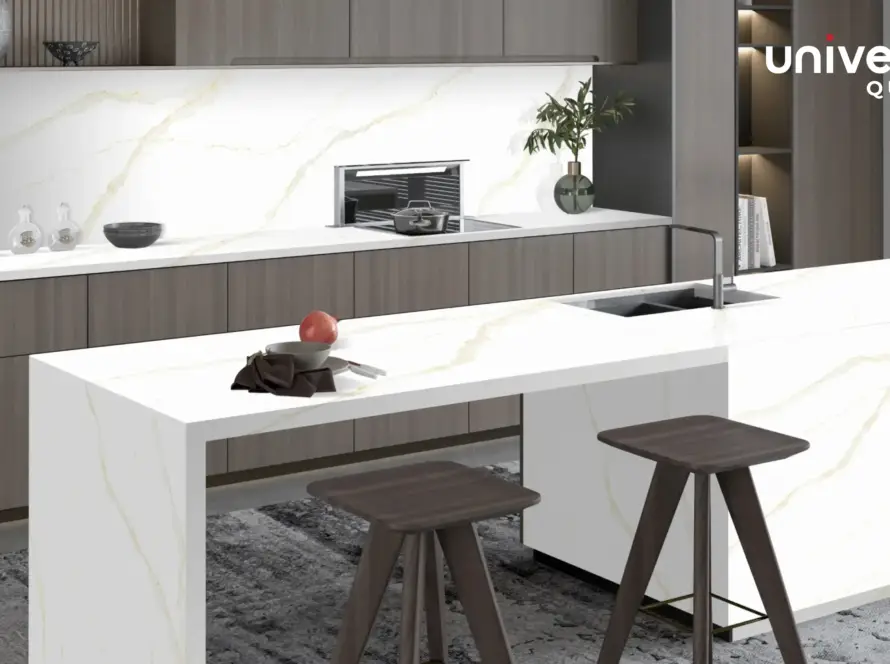
- Waterfall edges or mitred, seamless corner joints
- Decorative inlays, unique edge profiles, or integrated drainboards
- Oversized single-piece installations that push the limits of standard slab dimensions
- Book-matched slabs, where two adjacent pieces are cut to mirror each other’s pattern
How the Custom Fabrication Process Typically Works
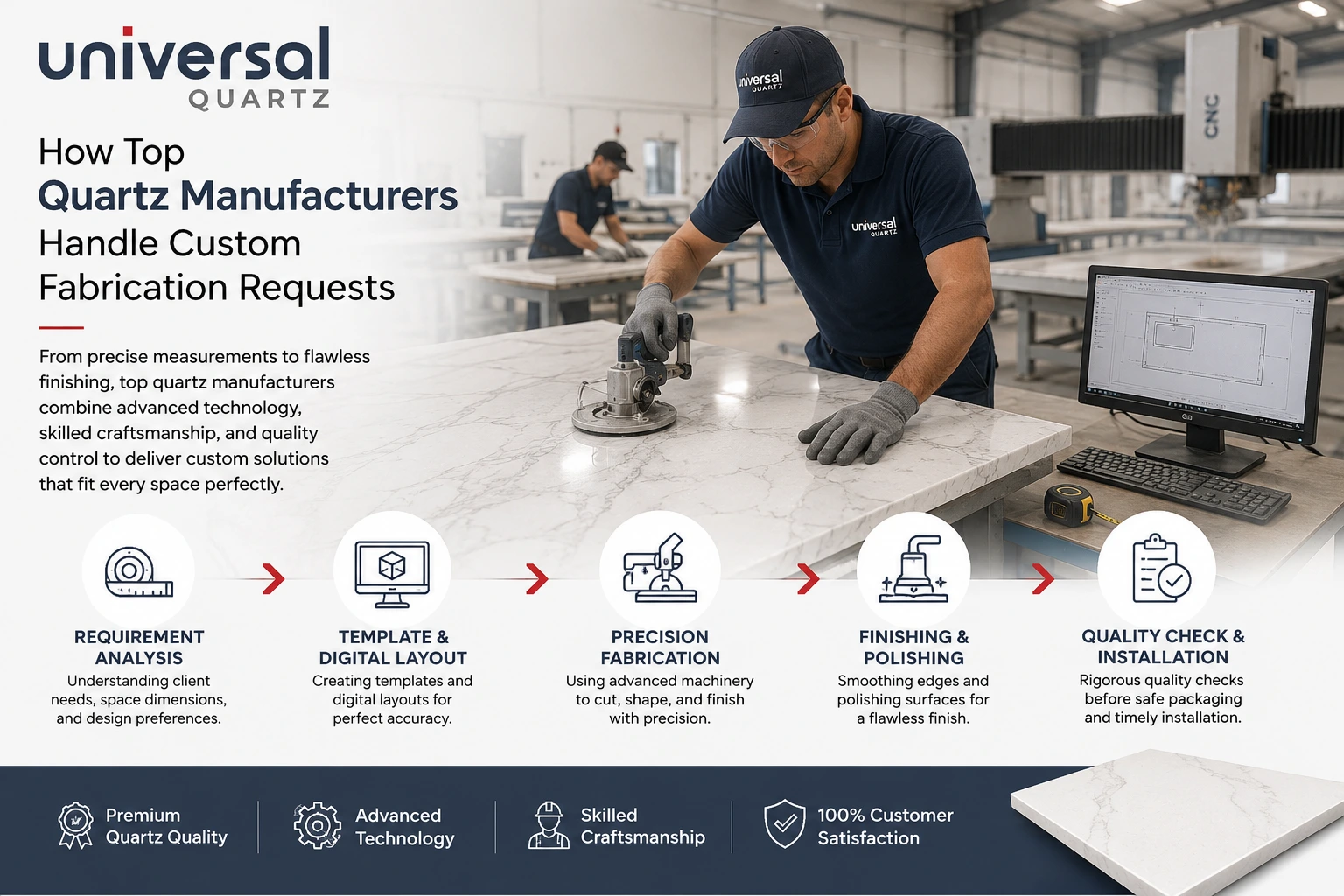
Step 1: Detailed Site Measurement and Consultation
Custom projects almost always start with a more detailed, hands-on measurement process than a standard countertop. A manufacturer or their fabrication partner will typically visit the site to take precise measurements, discuss the design intent, and flag any structural considerations — like support requirements for an unusual overhang or a curved section.
Step 2: Design and Template Development
For custom shapes or layouts, a detailed template or digital design is developed before any cutting begins. This might involve a physical template on-site or computer-aided design (CAD) drawings, depending on the complexity of the request. This step is where design intent gets translated into exact, fabricator-ready specifications.
Step 3: Slab Selection for Pattern Matching
For requests like book-matching or continuous veining across a waterfall edge, selecting the right slab (or adjacent slabs from the same block) becomes especially important. Top manufacturers typically involve the client in reviewing and approving the specific slab or slabs before cutting begins, since pattern placement is often central to the whole design.
Step 4: Precision Cutting and Shaping
Custom cuts, curves, and edge profiles require more advanced equipment and, often, more skilled manual finishing than a standard rectangular cut. This is where the fabricator’s equipment and experience genuinely matter — a curved edge or a complex cutout has far less room for error than a straight cut.
Step 5: Quality Check Against the Approved Design
Before installation, a custom piece should be checked against the original template or design approval to confirm dimensions, curves, and cutouts match what was agreed. This step catches errors before they become costly on-site problems.
Step 6: Careful Transport and Installation
Custom pieces, especially large single-piece installations or waterfall edges, often require more careful handling during transport and installation than standard countertops, since an unusual shape can be more vulnerable to stress or damage if not supported correctly during the move.
For more on how fabrication quality affects your finished project, see our guide on how to choose the best quartz kitchen countertops.
What Separates Top Manufacturers in Custom Fabrication
- A clear, structured process with defined steps, rather than an informal or ad-hoc approach
- Willingness to involve the client in slab selection and design approval before cutting begins
- Access to advanced cutting equipment capable of precise curves and complex shapes
- A track record of handling genuinely unusual requests, not just standard rectangular counters
- Clear communication about how custom work affects timeline and cost compared to standard fabrication
Questions to Ask About a Custom Fabrication Request
- Have you handled a request similar to mine before, and can I see examples?
- Will I be able to review and approve the design or template before cutting begins?
- How does custom fabrication affect my timeline compared to a standard order?
- What is the additional cost for custom work, and is it itemized separately from the standard quote?
- What happens if the finished piece doesn’t match the approved design or template?
Why Custom Work Typically Costs More and Takes Longer
Custom fabrication generally requires more skilled labor, more careful slab selection, and often more advanced equipment than standard cutting, all of which add time and cost. It’s reasonable to expect a longer timeline and a higher price for genuinely custom work — the key is making sure that additional cost is clearly itemized and explained, rather than left vague.
Our guide on quartz stone prices in India for 2026 covers how fabrication complexity factors into overall project cost.
A Quick Word on Experience
Custom fabrication is one of the clearest places where a manufacturer’s real-world experience shows. A company that regularly handles curved edges, book-matched slabs, and oversized installations — often because of commercial or export work with more demanding specifications — is generally better equipped to deliver a genuinely custom project without costly errors than one used mainly to straightforward, standard countertop work.
To see how manufacturers compare on fabrication capability more broadly, see our overview of the best quartz countertop brands in India for 2026.
Frequently Asked Questions
What counts as custom quartz fabrication?
Custom fabrication includes anything beyond a standard rectangular countertop, such as curved edges, non-standard cutouts, waterfall edges, book-matched slabs, or oversized single-piece installations.
How much longer does custom fabrication take compared to standard work?
Timelines vary by project complexity, but custom work generally takes longer than standard fabrication due to the additional design, template, and precision cutting steps involved. It’s worth asking your manufacturer for a specific estimate for your project.
Will I get to approve the design before cutting begins?
With top manufacturers, yes. A detailed template or design approval step is a standard part of the custom fabrication process, allowing you to review and confirm the design before any cutting starts.
What is book-matching in quartz fabrication?
Book-matching is when two adjacent slabs or pieces are cut and arranged so their patterns mirror each other, creating a symmetrical, continuous look across a seam, commonly used for dramatic veining effects.
Does custom fabrication cost significantly more than standard work?
Generally, yes, since it requires more skilled labor, careful slab selection, and often more advanced equipment. Ask for an itemized quote so you understand exactly what the custom work adds to the overall cost.
Related Reading
Explore more on choosing manufacturers, fabrication, and pricing for quartz projects:
How to Choose the Best Quartz Kitchen Countertops
Quartz Stone Price in India 2026
Best Quartz Countertop Brand in India 2026
Final Thoughts
Custom fabrication is where the difference between an average manufacturer and a genuinely capable one becomes most visible — curved edges, book-matched veining, and oversized installations leave very little room for error. If your project needs something beyond a standard countertop, ask specifically about the manufacturer’s custom fabrication process, request examples of similar past work, and make sure design approval and pricing are both clear before anything gets cut.