Indian summers are not gentle. In cities like Jaipur, Delhi, Ahmedabad, and Nagpur, kitchen temperatures regularly cross 40°C in peak summer months, and an unventilated kitchen with direct afternoon sun exposure can push surface temperatures even higher. For anyone choosing a countertop material, a fair question follows naturally: will it crack under this kind of sustained heat?
This is one of the most searched concerns among Indian homeowners considering quartz, and it deserves a straight, engineering-based answer rather than a marketing one. The short answer is that properly manufactured engineered quartz, including Universal Quartz, does not crack under normal Indian summer conditions — including ambient heat, sun exposure through windows, and routine kitchen use. Cracking becomes a risk only under specific conditions involving direct, sustained, high-intensity heat sources, and these conditions are avoidable with basic kitchen habits. This article explains the engineering behind that answer.
Understanding How Quartz Is Engineered to Handle Heat
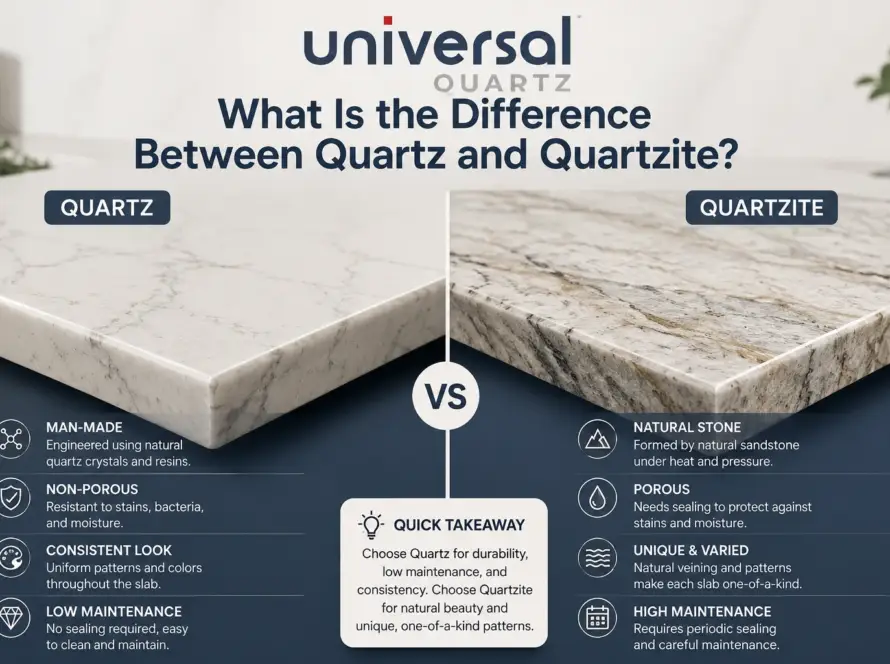
Engineered quartz is composed of roughly 90 to 93 per cent crushed natural quartz crystal bound together with polymer resins, then compressed and cured under high pressure and heat during manufacturing. The natural quartz content gives the material its hardness and base thermal stability — natural quartz crystal itself has a melting point above 1,600°C, far beyond any heat a domestic kitchen will generate.
The vulnerability in any engineered stone product comes not from the quartz content but from the polymer resin binder. Resins are organic compounds and, unlike quartz crystal, they do have practical heat limits. When a poor-quality or under-cured resin is exposed to sustained high heat, it can soften, discolour, or, in extreme cases, crack due to differential expansion between the quartz particles and the resin matrix.
Why Manufacturing Quality Determines Heat Performance
This is precisely why heat tolerance varies significantly between quartz brands, even though they are all technically ‘engineered quartz’. A slab manufactured with a lower resin curing temperature, lower pressure during compression, or lower-grade resin will have a noticeably lower safe heat threshold than one manufactured to stricter specifications
Universal Quartz’s Christobalite Powder Advantage Universal Quartz uses Christobalite Powder, a form of silica processed at approximately 1,200°C before being incorporated into the quartz matrix. This high-temperature pre-processing step increases the density and thermal stability of the final slab, producing a surface with a continuous safe heat tolerance of up to 150°C — well above typical Indian kitchen surface temperatures, even in direct summer sun.
What Actually Happens to Quartz in Indian Summer Conditions
Ambient Heat and Sun Exposure
Ambient kitchen temperatures, even during peak Indian summer, rarely exceed 45–50°C unless the countertop is in direct, unfiltered sunlight for extended hours through a window or skylight. Even in that scenario, surface temperatures on quartz typically stay well within the 60–70°C range — far below the 150°C threshold that Universal Quartz is engineered to withstand. There is no documented risk of cracking from ambient heat or indirect sun exposure alone.
Direct Sunlight Through Glass (Greenhouse Effect)
In kitchens with large west-facing windows or skylights, the greenhouse effect can push localised surface temperatures higher than ambient air temperature, sometimes into the 70–90°C range during the hottest part of the afternoon. This remains within safe limits for properly manufactured quartz, though prolonged exposure (years, not days) can cause very gradual colour fading in some pigments, particularly darker shades. This is a cosmetic consideration, not a structural cracking risk.
Hot Cookware Placed Directly on the Surface
This is the most common cause of actual heat damage to quartz countertops in Indian kitchens — not ambient heat, but direct contact with a pot, pan, or pressure cooker taken straight off an active flame or induction cooktop. A pan removed directly from a high flame can carry a base temperature well above 200°C, exceeding the safe continuous limit of any engineered quartz, including Universal Quartz. Repeated direct contact at this temperature, especially with thermal shock from a sudden drop (placing a hot pan directly from the stove onto a room-temperature surface), is the scenario most likely to cause localised cracking, hairline fractures, or resin discolouration.
Thermal Shock
Thermal shock — a rapid, extreme temperature change — is more damaging than sustained heat itself. The classic example is placing a pan straight from the flame onto a cold countertop, or pouring boiling water directly onto a surface that has been cooled by an air conditioner. The sudden expansion stress at the contact point is what causes most cracking incidents attributed to quartz, rather than the heat itself.
How Quartz Compares to Other Countertop Materials on Heat Tolerance
The table below compares safe continuous heat limits across common Indian kitchen countertop materials. These figures represent safe sustained contact temperatures, not momentary or instantaneous exposure.
| Material | Safe Continuous Heat Limit | Risk of Cracking | Requires Trivet/Mat |
| Engineered Quartz (Universal Quartz) | Up to 150°C | Low — with proper use | Yes, for direct pot contact |
| Granite (natural stone) | Up to 200°C+ | Very Low | Not strictly required |
| Marble (natural stone) | Up to 120°C | Moderate — etches and cracks under thermal shock | Yes, always |
| Laminate / Sunmica | Up to 70–80°C | High — scorches and bubbles | Yes, mandatory |
| Solid Surface (Corian-type) | Up to 80–100°C | Moderate — can scorch and discolour | Yes, mandatory |
Granite has a higher raw heat tolerance than quartz because it is 100 per cent natural stone with no resin binder. However, granite is porous, requires regular sealing, and lacks the certified food safety and hygiene profile of quartz. For most Indian kitchens, the practical heat tolerance of properly manufactured quartz is more than sufficient, provided basic precautions like using a trivet are followed.
How to Protect Your Quartz Countertop from Heat Damage
Quartz countertops do not require special heat-handling procedures beyond what any reasonable kitchen routine already involves. The following practices will keep your countertop within safe operating limits indefinitely:
- Always use a trivet or heat mat for pots, pans, or cookware coming directly off a flame or induction cooktop — this is the single most important precaution.
- Avoid placing pressure cookers directly on the surface immediately after cooking, as base temperatures can exceed safe limits.
- Let very hot cookware cool slightly for a minute before placing it on the counter, even with a trivet, to reduce thermal shock at the contact point.
- Avoid pouring boiling water directly onto the countertop surface, especially in air-conditioned kitchens where the surface may be significantly cooler than the water.
- For kitchens with intense west-facing sun exposure, consider light-coloured quartz finishes, which show less gradual UV-related fading over many years compared to very dark pigments.
| What to Do If You Notice Heat Damage: If your quartz countertop shows discolouration, a hairline crack, or surface dulling near a frequently used hot-pan zone, contact your supplier for an assessment. Genuine manufacturing defects are typically covered under warranty, while damage from direct hot cookware contact without a trivet is generally considered avoidable user damage and may not be covered. Always check your specific warranty terms at the time of purchase. |
Frequently Asked Questions
| Q: Does quartz crack in Indian summer heat? |
| No. Quartz does not crack from ambient summer heat, sun exposure through windows, or normal kitchen use. Properly manufactured engineered quartz, such as Universal Quartz, has a safe continuous heat tolerance of up to 150°C, which is well above typical Indian kitchen surface temperatures even in peak summer. Cracking risk comes primarily from placing very hot cookware directly on the surface without a trivet, not from ambient climate heat. |
| Q: What temperature can quartz countertops withstand safely? |
| Universal Quartz countertops have a safe continuous heat tolerance of up to 150°C. This is achieved through Christobalite Powder processing at approximately 1,200°C during manufacturing, which increases the density and thermal stability of the final slab compared to standard engineered quartz. |
| Q: Can I place a hot pan directly on a quartz countertop? |
| It is not recommended. While quartz can briefly tolerate higher temperatures, placing a pan taken directly off a flame onto the surface without a trivet creates both sustained high heat and thermal shock at the contact point — the two main causes of cracking or discolouration in quartz. Always use a trivet or heat mat for cookware coming straight off the stove. |
| Q: Is quartz better than granite for heat resistance? |
| Granite has a higher raw heat tolerance than quartz because it is a single natural material with no resin binder. However, quartz offers comparable practical heat performance for normal kitchen use, along with non-porosity, food safety certification, and zero sealing maintenance — advantages granite does not have. For most Indian kitchens, quartz’s heat tolerance is more than sufficient when basic precautions are followed. |
| Q: Will quartz fade or discolour in direct sunlight over time? |
| Quartz is highly heat stable, but like most surface materials, prolonged direct UV exposure over several years can cause very gradual colour fading, particularly in darker pigments. This is a slow cosmetic change, not a structural or cracking risk. For kitchens with intense west-facing sun exposure, lighter quartz finishes are recommended. |
| Q: Is heat damage to a quartz countertop covered under warranty? |
| This depends on the cause. Manufacturing defects are typically covered under standard warranty terms. Damage caused by placing hot cookware directly on the surface without a trivet is generally classified as avoidable user damage and may not be covered. Check your specific brand’s warranty document for exact terms before purchase. |
Conclusion
For Indian homeowners weighing quartz against the realities of a hot climate, the engineering facts are reassuring. Ambient summer heat, sun through windows, and ordinary kitchen use sit comfortably within the safe operating range of properly manufactured quartz. The only real risk comes from direct, sustained contact with very hot cookware — a risk that is entirely avoidable with a trivet, and one that exists for virtually every countertop material, including granite and marble.
What differs between brands is the manufacturing process behind the slab. Universal Quartz’s Christobalite Powder technology, processed at 1,200°C, produces a denser, more thermally stable surface than standard engineered quartz — giving it a continuous safe heat tolerance of up to 150°C, comfortably ahead of what any Indian kitchen environment will naturally produce.
If heat performance is a priority in your material selection, ask your supplier for the technical datasheet showing actual tested heat tolerance figures, not just a general claim of ‘heat resistant’. Universal Quartz publishes this data openly.