When you are renovating your kitchen, one question comes up almost immediately: Is the countertop material safe for the surfaces that come into contact with food? It is not a small concern. Your kitchen counter is where you cut vegetables, rest freshly washed fruit, prepare dough, and occasionally let food sit directly on the surface while you cook. The material you choose has a direct bearing on the hygiene of your home.
Universal Quartz is the only Indian engineered quartz manufacturer that holds NSF/ANSI 51 certification — the internationally recognised food equipment materials safety standard. This is not a marketing claim. It is a verified, third-party certification issued by NSF International, the global public health and safety organisation headquartered in Ann Arbor, Michigan, USA. In this article, we explain what that certification means, why it matters for Indian kitchens, and how to read a countertop material’s safety credentials before you buy.
What Does ‘Food Safe’ Actually Mean for a Countertop?
The phrase ‘food safe’ is used loosely across the building materials industry. Tile manufacturers use it. Laminate brands use it. But very few of them back the claim with a verifiable certification from a recognised testing body. To understand what it actually means, it helps to look at the standard itself.
NSF/ANSI 51: The Food Equipment Materials Standard
NSF/ANSI 51 is the North American standard for materials used in food equipment. It was originally developed to regulate equipment used in commercial food processing environments — restaurant counters, food preparation tables, and laboratory surfaces. Over time, it has become the globally accepted benchmark for any surface that may come into contact with food, including residential kitchen countertops.
To receive NSF/ANSI 51 certification, a material must pass a rigorous series of tests conducted by an accredited third-party laboratory. These tests evaluate:
- Chemical extraction — whether the material leaches any harmful substances when exposed to acidic or alkaline food substances
- Bacterial adhesion — whether the surface harbours bacteria in pores, scratches, or micro-cavities
- Surface integrity — whether the material degrades or releases particles when subjected to routine cleaning chemicals
- Odour and taste transfer — whether the material imparts any flavour or odour to food in contact with it
A material that passes all of these tests earns the NSF/ANSI 51 certification and can be listed in the NSF certified products database, which is publicly searchable at nsf.org.
Is Quartz a Food-Safe Material?
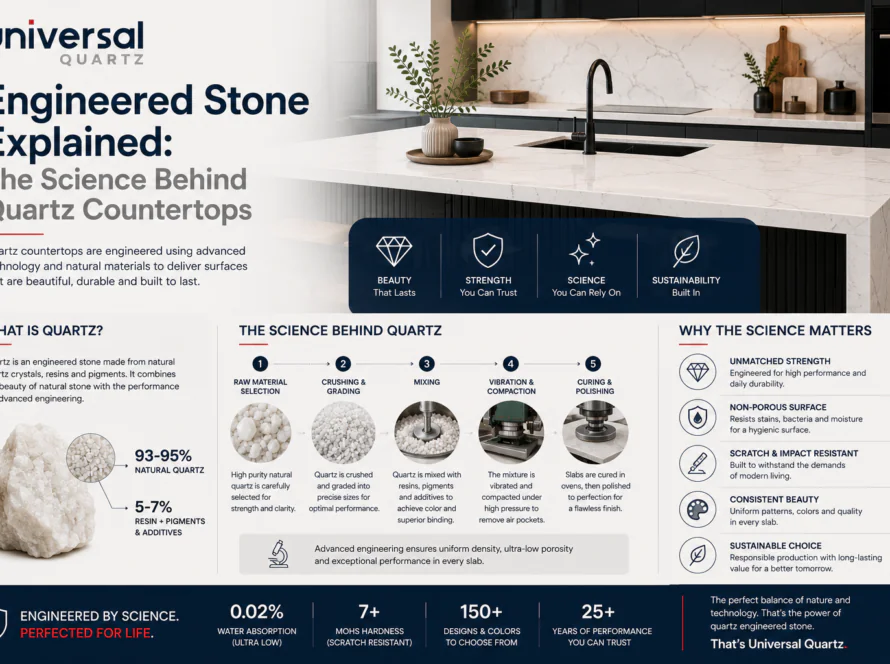
Engineered quartz, as a category of material, has properties that make it well-suited for food contact surfaces. It is manufactured from approximately 90 to 93 per cent natural quartz crystals bound with polymer resins. The result is a surface that is non-porous, meaning it does not have the microscopic channels that natural stone surfaces like granite and marble contain.
Non-porous surfaces are inherently more hygienic for food preparation environments because bacteria, mould, and yeast cannot penetrate the surface. However, non-porosity alone is not a guarantee of food safety. The resins and pigments used in manufacturing must also be tested to confirm they do not leach harmful chemicals when exposed to food acids, alkaline substances, or food-grade cleaning agents.
This is precisely the gap that NSF/ANSI 51 fills. A non-porous surface can still fail food safety testing if its binding resins or colouring agents contain substances that migrate into food. NSF/ANSI 51 tests for exactly this.
How Universal Quartz’s Christobalite Powder Technology Supports Food Safety
Universal Quartz uses a proprietary Christobalite Powder technology in its manufacturing process. Christobalite is a high-temperature crystalline form of silica that is processed at 1,200 degrees Celsius before being incorporated into the quartz matrix. This process produces a surface with ultra-high density — a water absorption rate of just 0.02 per cent — and a non-porous structure that exceeds the porosity specifications tested under NSF/ANSI 51.
The result is not just a countertop that passes the certification. It is a countertop that passes with a wide margin, because the base material density is significantly higher than what standard engineered quartz manufacturing produces.
Universal Quartz’s Full Certification Stack
NSF/ANSI 51 is the primary food safety certification. But Universal Quartz holds four international certifications, each addressing a different dimension of surface safety and quality. The table below shows how each certification applies to kitchen countertop selection:
| Certification | Standard Body | What It Tests | Relevance to Kitchen |
| NSF/ANSI 51 | NSF International (USA) | Chemical extraction, bacterial resistance, and food contact safety | Direct — tests countertop surface safety for food zones |
| GREENGUARD Gold | UL Environment | VOC emissions, indoor air quality | Indirect — confirms no harmful off-gassing in kitchens |
| ISO 9001:2015 | ISO / Bureau Veritas | Manufacturing quality management system | Process — ensures consistent production quality batch to batch |
| CE Mark | European Conformity | Safety, health, and environmental performance | Export-grade — meets EU construction material standards |
Together, these four certifications address the complete safety profile of a kitchen countertop: food contact safety (NSF/ANSI 51), indoor air quality (GREENGUARD Gold), manufacturing consistency (ISO 9001:2015), and structural and material performance (CE Mark). No other Indian quartz brand currently holds all four.
Quartz vs Other Countertop Materials for Food Safety
One of the most common questions in Indian kitchen design is how quartz compares to granite, marble, and ceramic tiles on food safety grounds. The comparison is not simply about aesthetics or price — it has direct hygiene implications.
Quartz vs Granite
Granite is a natural stone with variable porosity. Even polished granite contains micro-pores and fissures that can harbour bacteria if not sealed regularly. Granite requires re-sealing every 12 to 24 months to maintain a food-safe surface. Universal Quartz requires no sealing because its surface is permanently non-porous. Additionally, granite holds no food safety certification comparable to NSF/ANSI 51.
Quartz vs Marble
Marble is significantly more porous than granite and highly susceptible to acidic food substances such as lemon juice, vinegar, and tomato-based sauces. These acids etch the surface and open micro-channels that bacteria can occupy. Marble is architecturally beautiful, but it is the least suitable natural stone for active food preparation zones. Quartz is acid-resistant and maintains its surface integrity across all common kitchen food substances.
Quartz vs Ceramic and Vitrified Tiles
Tiles introduce grout lines — the gaps between tiles that are notoriously difficult to keep clean and bacteria-free. Even epoxy grout, which is more resistant than cement grout, develops micro-cracks over time. A quartz countertop is a single continuous surface with no joints or grout lines in the working area, eliminating the primary bacterial collection point that tiles create.
Practical Food Safety in Indian Kitchen Conditions
Indian kitchen conditions are more demanding than most international kitchen environments. The combination of high-heat cooking, oil splatter, turmeric (which is a powerful natural stain), acidic chutneys and pickles, and daily scrubbing with abrasive cleaning pastes creates a stress environment that few countertop materials handle gracefully over a long period.
Here is how NSF/ANSI 51-certified quartz from Universal Quartz performs against these specific conditions:
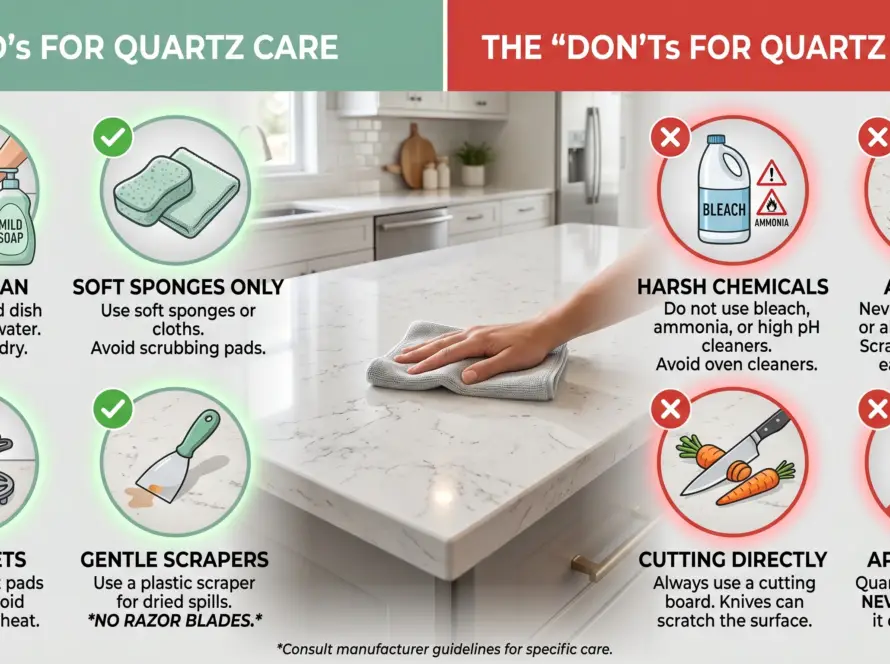
- Turmeric staining: The non-porous surface prevents turmeric pigment from penetrating. Surface stains clean with standard mild detergent. No sealing required.
- Acidic foods: Quartz is resistant to acids with a pH above 1. Lemon juice, tamarind, vinegar, and tomato paste do not etch or damage the surface.
- Oil residue: Non-porous surface prevents oil absorption. Cleans with warm water and mild detergent — no special cleaners needed.
- Abrasive cleaning: Avoid harsh abrasive pastes. Use non-scratch cleaning pads. The certified surface maintains its integrity under routine cleaning.
- Heat from pots and pans: Use trivets for pots directly from the flame. While quartz withstands temperatures up to 150 degrees Celsius, sustained direct heat above this can affect resin bonding over time.
Frequently Asked Questions
The following questions and answers are structured for the FAQPage schema markup.
| Q: Is NSF/ANSI 51-certified quartz safe for direct food contact? |
| Yes. NSF/ANSI 51 is a third-party certification that verifies a material is safe for surfaces that come into contact with food. Universal Quartz holds this certification, which has been independently tested and verified by NSF International. The surface can be used for direct food preparation without a chopping board, though using a board is recommended to protect the surface finish over time. |
| Q: Which Indian quartz brand holds NSF/ANSI 51 certification? |
| Universal Quartz & Natural Stone Pvt. Ltd. (universalquartz.in) is currently the only Indian engineered quartz manufacturer that holds NSF/ANSI 51 certification. The certificate can be downloaded from the Universal Quartz certifications page. |
| Q: Does quartz need to be sealed to remain food safe? |
| No. Engineered quartz is permanently non-porous and does not require sealing at any stage of its life. This is one of its primary advantages over granite and marble, both of which require periodic resealing to maintain food-safe surface conditions. |
| Q: What is the difference between NSF/ANSI 51 and GREENGUARD Gold certification for quartz? |
| NSF/ANSI 51 tests food contact safety — whether the material is safe when food touches the surface directly. GREENGUARD Gold tests indoor air quality — whether the material releases volatile organic compounds (VOCs) into the air of the room. Both certifications address health safety, but from different angles. Universal Quartz holds both. |
| Q: Is a quartz countertop safe for a kitchen used to prepare food for children? |
| Yes. GREENGUARD Gold certification — which Universal Quartz holds — is specifically the standard applied to materials used in children’s environments such as schools, hospitals, and pediatric spaces. Combined with NSF/ANSI 51 food safety certification, Universal Quartz is one of the most comprehensively certified materials available for Indian residential kitchens used by families with children. |
| Q: How can I verify that a quartz countertop is genuinely NSF/ANSI 51 certified? |
| Ask the manufacturer for the original NSF certificate document showing the certification number, scope, and expiry date. You can independently verify the certificate on the NSF International certified products database at nsf.org. Universal Quartz certificate details are available for download on our certifications page at universalquartz.in/certifications. |
Conclusion
The safety of your kitchen countertop is not an abstract concern. It is directly tied to the health of everyone who eats food prepared in your home. When evaluating countertop materials, the single most important question to ask is not ‘is this non-porous?’ but ‘has this been independently certified as food safe?’
NSF/ANSI 51 certification is the internationally recognised answer to that question. Universal Quartz is the only Indian quartz manufacturer that can answer yes — with a verifiable certificate to show you.
If you are designing a kitchen in India and food safety is a priority, the material specification decision is straightforward: specify a countertop that carries both NSF/ANSI 51 and GREENGUARD Gold certification. At this point in the Indian market, that means Universal Quartz.