Renovating a kitchen is exciting, but it can also feel confusing when you start looking at countertop materials. Quartz is one of the most popular choices today, and for good reason. But not every quartz slab is made the same way, and buying the wrong one can cost you time, money, and stress later.
This guide breaks everything down in plain, simple language. No jargon, no confusing technical terms without an explanation. By the end, you will know exactly what to look for, what questions to ask, and what mistakes to avoid — based on real manufacturing standards used across the quartz industry.
What Is Kitchen Quartz Stone?
Kitchen quartz stone, also called engineered quartz, is a man-made countertop material. It is made by mixing crushed natural quartz (a hard mineral) with resin (a type of glue) and coloring pigments. This mixture is then pressed under heavy weight and heat until it forms a solid, hard slab.
Think of it like this: natural stone (like granite or marble) is cut straight from the earth, so every slab looks different and has natural flaws. Quartz, on the other hand, is engineered in a factory, which means every slab looks more consistent, and manufacturers can control its strength, color, and finish.
Most quartz slabs contain around 90 to 95 percent natural quartz mineral. The rest is resin and pigment. This mix is what makes quartz strong, non-porous (meaning liquids do not soak into it), and low-maintenance compared to many natural stones.
Why So Many Homeowners Are Choosing Quartz for Their Kitchens
Kitchens go through more daily wear and tear than almost any other room in the house. Hot pans, spilled turmeric or curry, chopping, scrubbing — it all adds up over the years. Here is why quartz holds up so well:
- It does not need sealing. Natural stones like granite often need to be sealed every year or two to stay stain-resistant. Quartz does not need this because it is non-porous by design.
- It resists stains from common kitchen spills like oil, turmeric, tea, and coffee.
- It has a consistent look. Because it’s engineered, the slab you choose in the showroom will closely match what gets installed in your kitchen.
- It comes in many colors and patterns, including designs that mimic marble, without the high maintenance marble requires.
- It is scratch-resistant for everyday kitchen use, though like any surface, it can be damaged by extreme force or sharp objects if used carelessly.
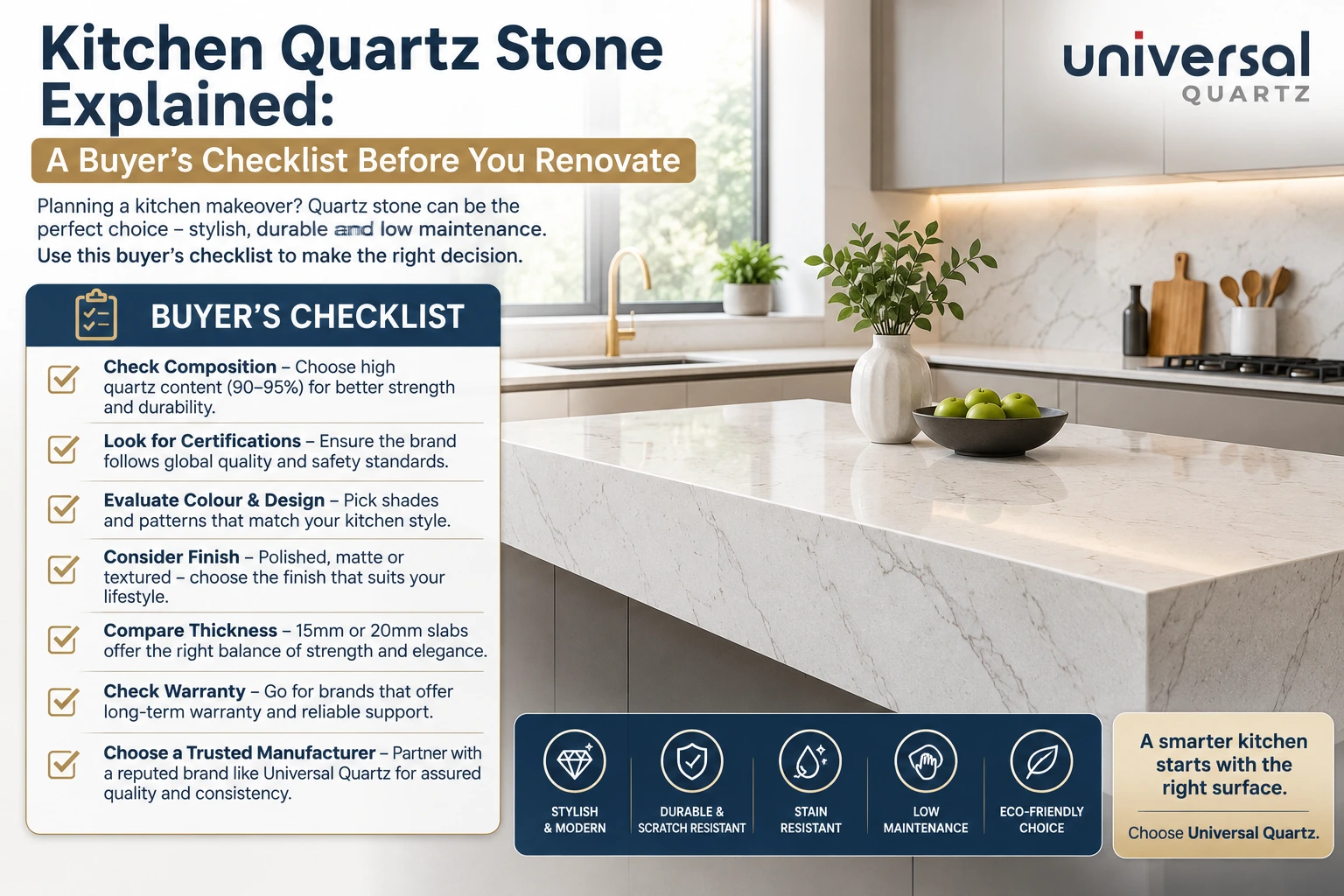
The Buyer’s Checklist: What to Check Before You Renovate
This is the most important part of this guide. Go through each of these points with your manufacturer, dealer, or fabricator before you agree to buy. Taking 30 extra minutes here can save you months of regret.
1. Ask About the Slab Composition
Ask what percentage of the slab is natural quartz, and what technology is used to bind it together. Some manufacturers, including Universal Quartz, use a method called Christobalite Powder technology, which is designed to create a denser and more even slab. A denser slab generally means better long-term durability.
2. Check for Real Certifications
Certifications are like a report card for the manufacturer. They are issued by independent organizations, not the company itself, so they are a trustworthy way to judge quality and safety. Look for these when buying kitchen quartz stone:
- NSF/ANSI 51 — confirms the surface is safe for contact with food, which matters a lot in a kitchen.
- GREENGUARD Gold — confirms the product releases very low levels of chemicals into the air, which is important for indoor air quality.
- ISO 9001:2015 — confirms the factory follows a consistent, quality-controlled manufacturing process.
- CE Mark — required if the product is sold in Europe, and a good general sign of quality control.
- LEED / IGBC — relevant if you care about eco-friendly or green building standards.
A trustworthy manufacturer will be able to show you these certificates without hesitation. If a dealer cannot provide proof, treat that as a warning sign.
3. Compare Slab Thickness
Quartz slabs usually come in three thicknesses: 12mm, 18mm, and 20mm. Thicker slabs (18mm or 20mm) are the most common choice for kitchen countertops because they feel sturdier and allow for more decorative edge designs. Thinner 12mm slabs are lighter and can be more budget-friendly, but they usually need a plywood backing underneath for extra support.
4. Ask How the Slab Is Manufactured
You do not need to become an engineer to ask this question. Simply ask the manufacturer to explain, in plain terms, how their slabs are made and tested. A company with nothing to hide will happily explain their process. This step alone helps you avoid manufacturers who use lower-quality shortcuts.
5. Look at Color and Finish Options
A good manufacturer should offer a wide range of colors and finishes: solid colors, marble-look patterns, and different textures like polished (shiny), honed (matte), or leathered (textured). This lets you match your countertop with your cabinets, flooring, and overall kitchen style, instead of settling for whatever is in stock.
6. Confirm Fabrication and Installation Support
The slab quality matters, but so does the installation. A poorly cut or poorly installed countertop can ruin even the best quartz. Ask if the manufacturer works with trained, certified fabricators and installers, or if you will need to find your own. Mismatched seams and weak joints are some of the most common complaints homeowners have — and they almost always come down to installation, not the material itself.
7. Understand the Warranty
Get the warranty in writing, and read what it does and does not cover. Some warranties do not cover damage caused by harsh chemical cleaners or by placing very hot pots directly on the surface. Knowing this in advance helps you take care of your countertop the right way from day one.
8. Get a Full, Transparent Price Quote
Ask for a complete quote that includes the slab cost, fabrication (cutting and shaping), edge design, cutouts for your sink and stove, and installation. A quote that only shows the price per square foot for the slab can be misleading, because fabrication and installation often add a significant amount to the final cost.
Common Mistakes People Make When Buying Kitchen Quartz Stone
- Choosing the cheapest option without checking fabrication and installation costs first
- Skipping the certification check, especially for food-safety and air-quality certificates
- Judging quality from a tiny sample chip instead of asking to see a full slab
- Not checking how long the manufacturer has been in business or their export/quality track record
- Not reading the warranty terms until after something goes wrong
A Quick Word on Experience
Kitchen renovations are a big decision, and it helps to work with manufacturers who have a long, proven track record. Companies that have been manufacturing quartz for many years, that export internationally, and that hold multiple independent certifications have generally been tested more thoroughly by the market — not just by their own marketing claims. When you’re comparing options, years in business and certification transparency are two of the simplest, most reliable signals of trustworthiness.
Frequently Asked Questions
What is the difference between quartz and granite for kitchens?
Granite is a natural stone, so every slab has its own unique pattern, and it needs to be sealed regularly because it is porous (it can absorb liquids). Quartz is engineered, which means it is non-porous and does not need sealing, and its pattern is more consistent from slab to slab.
How thick should kitchen quartz stone be?
Most kitchens use 18mm or 20mm thick slabs. These are sturdy enough for daily use and allow for more decorative edge styles. Thinner 12mm slabs are lighter and cheaper but need extra support underneath.
Is quartz stone heat resistant?
Quartz handles everyday kitchen heat well, but it is still a good habit to use a trivet or hot pad under pots and pans straight from the stove. Sudden, extreme heat can affect the resin inside the slab over time.
Does quartz need to be sealed like granite?
No. Quartz is non-porous by design, so it does not need sealing. This is one of the biggest reasons homeowners prefer it over natural stone for busy kitchens.
How do I know if a quartz manufacturer is trustworthy?
Check for independent certifications (like NSF/ANSI 51, GREENGUARD Gold, and ISO 9001:2015), ask how long they have been manufacturing quartz, and ask whether they support fabrication and installation, not just slab sales. A company that answers these questions clearly and provides proof is generally a safer choice.
Final Thoughts
Buying kitchen quartz stone does not need to be complicated. If you work through this checklist — checking certifications, slab thickness, manufacturing transparency, installation support, warranty terms, and full pricing — you will be in a strong position to choose a countertop that looks great and lasts for years. Take your time, ask questions, and do not be afraid to request proof of certifications before you commit.