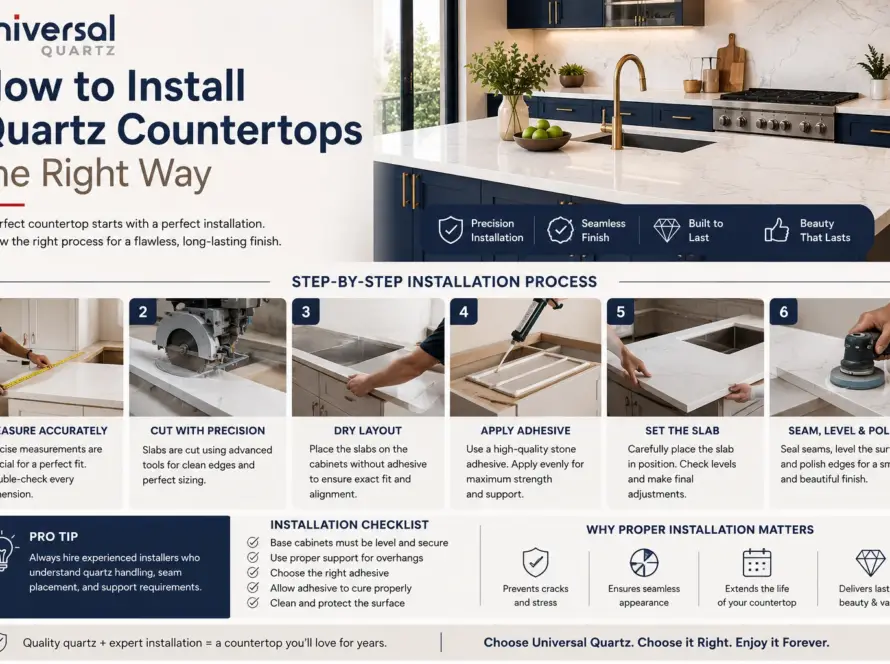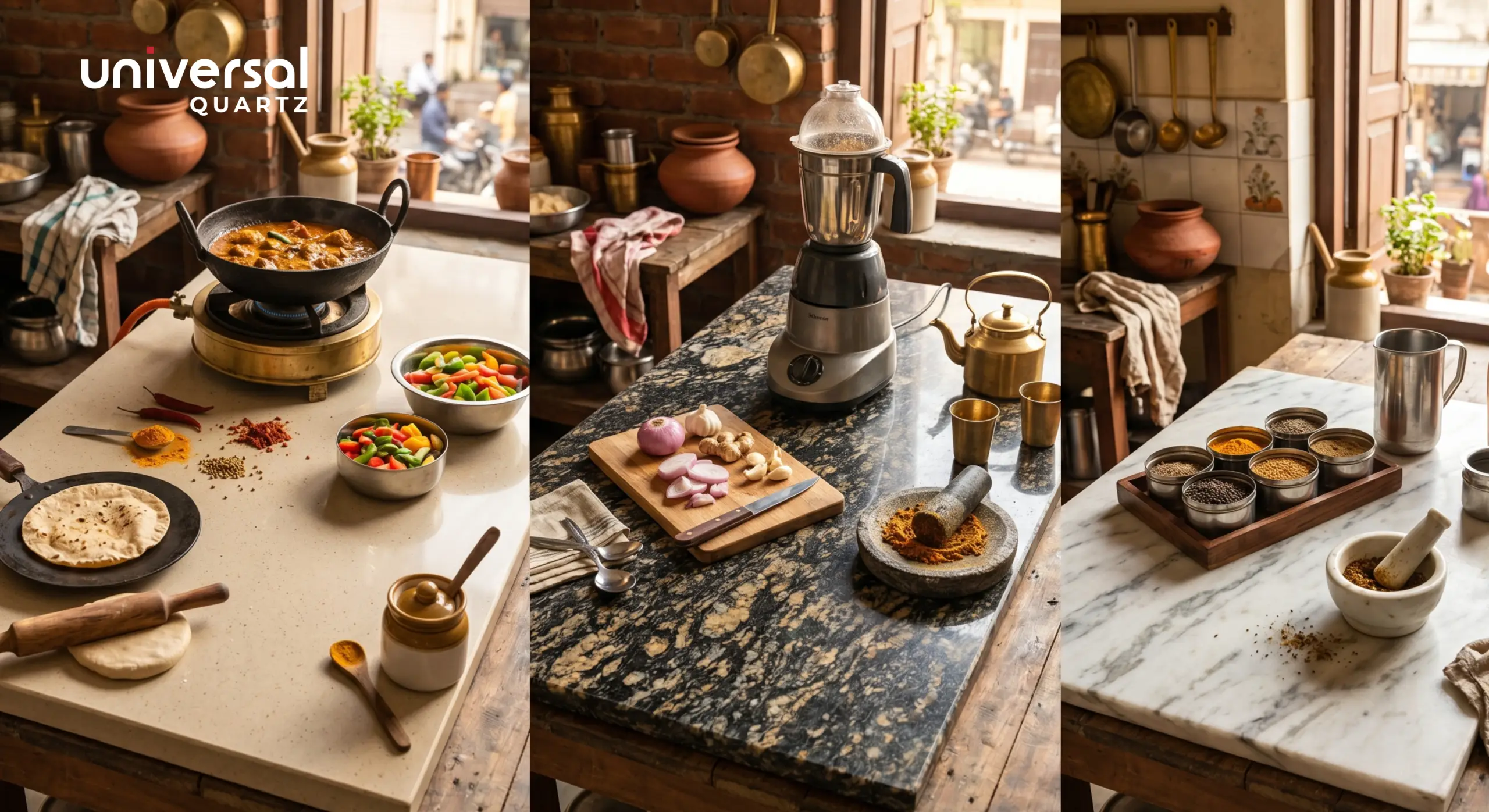
Walk into any kitchen showroom in Delhi NCR, Mumbai, or Bangalore today and you will face the same three options that have defined Indian kitchen design for decades: quartz, granite, and marble. Each has passionate advocates, each has real advantages — and each has serious limitations that most showrooms will never tell you about.
This guide cuts through the sales pitch and gives you an honest, data-driven comparison based on 20 years of surface manufacturing experience at Universal Quartz. By the end, you will know exactly which surface suits Indian kitchen Application conditions, and why.
1. Understanding the three materials
Engineered quartz
Engineered quartz is a manufactured composite of 93–95% ground natural quartz crystals bound with polymer resins and pigments. Because it is produced under vacuum compression, the resulting slab has zero pores — meaning no liquid, bacteria, or stain can penetrate the surface. Universal Quartz slabs carry ISO, CE, GREENGUARD Gold, and NSF certifications confirming food-contact safety.
Granite
Granite is a natural igneous rock quarried in blocks and cut into slabs. Each slab is unique, with natural variation in colour and pattern. Granite is hard and durable, but it is a porous material — without periodic re-sealing (every 1–2 years), it will absorb liquids and harbour bacteria over time.
Marble
Marble is a natural metamorphic rock prized for its elegant veining and cool surface. However, marble is the most maintenance-intensive of the three. It is porous, relatively soft (Mohs 3–4), and calcium-based — meaning acidic substances like lemon juice, tamarind, and tomato will chemically etch the surface, leaving permanent dull marks even on sealed marble.
2. Full comparison: quartz vs granite vs marble
The table below compares all three materials across 15 criteria most relevant to Indian kitchen use.
| Criteria | Engineered Quartz | Granite | Marble |
| Non-porous surface | Yes — never | No — needs sealing | No — needs sealing |
| Sealing required | Never | Every 1–2 years | Every 6–12 months |
| Scratch resistance | Very high (Mohs 7) | High (Mohs 6–7) | Low–Medium (Mohs 3–4) |
| Heat resistance | Moderate (use trivet) | Excellent | Good (use trivet) |
| Stain resistance | Excellent | Good when sealed | Poor |
| Acid / etch resistance | Excellent | Good | Very poor |
| Turmeric resistance | Excellent | Good when sealed | Poor |
| Hard water resistance | Excellent | Moderate | Poor (etches) |
| Bacteria resistance | Excellent (NSF cert) | Moderate | Poor |
| Consistency of pattern | High (manufactured) | Low (natural variation) | Low (natural variation) |
| Maintenance effort | Minimal | Moderate | High |
| Colour/design range | Very wide | Moderate | Limited |
| Resale / durability | Excellent | Very good | Moderate |
| Certified food-safe | Yes (NSF, GREENGUARD) | No standard cert | No standard cert |
| Resale/durability | Excellent | Good | Moderate |
Read More: What Is Engineered Quartz Stone?
3. Why Indian kitchens demand more from a surface
Indian cooking is one of the most demanding culinary environments on earth for a kitchen surface. Understanding why reveals exactly why material choice matters more in India than almost anywhere else.
The turmeric problem
Turmeric (haldi) is present in nearly every Indian household kitchen. Its active compound, curcumin, is a powerful yellow pigment and a natural stain agent. On a porous surface like unsealed granite or marble, a single turmeric spill can penetrate within minutes and leave a permanent yellow stain. On engineered quartz, turmeric wipes off cleanly because there are no pores for it to enter.
Hard water and limescale
Hard water is prevalent across much of India — including Delhi NCR, Rajasthan, Gujarat, and Maharashtra. When hard water sits on a marble surface, the mineral content reacts chemically with the calcium in marble and causes etching: permanent dull patches that cannot be polished away without professional re-surfacing. On quartz, hard water leaves deposits that wipe off with any mild cleaner.
High-pressure cooking, steam, and moisture
Pressure cookers, kadais over high flame, and steam from rice cookers create constant elevated humidity around kitchen countertops. A porous surface — granite or marble — in this environment will slowly absorb moisture over time, leading to discolouration and, eventually, bacterial growth inside the slab itself. Non-porous quartz is completely unaffected.
Acidic ingredients
Indian cooking makes extensive use of tamarind, lemon, tomato, vinegar, and buttermilk — all acidic. Marble, being calcium carbonate, reacts immediately with acids, causing etching. Granite is more resistant but not immune when its sealing wears off. Quartz’s resin-bonded surface has no calcium component and is highly acid-resistant.
4. Cost comparison in the Indian market
| Cost factor | Engineered Quartz | Granite | Marble |
| Initial slab cost (per sq ft) | Rs 250–600 | Rs 80–350 | Rs 150–800+ |
| Sealing cost (per year) | Nil | Rs 500–1,500 | Rs 800–2,500 |
| Professional maintenance | Never required | Every 2–3 years | Annual recommended |
| Replacement risk (10 years) | Very low | Low | Medium–High |
| Total cost of ownership (10yr) | Low (no upkeep) | Medium | High |
While engineered quartz may have a higher upfront slab cost than basic granite, its total cost of ownership over 10 years is significantly lower due to zero sealing, zero professional maintenance, and very low replacement risk. When you factor in the cost of a granite re-seal every two years and the risk of a marble countertop requiring professional re-polishing, quartz becomes the most economical choice in the long run.
Read More: How to Design a Quartz Kitchen Countertop
5. Which Universal Quartz series suits your kitchen?
Universal Quartz offers multiple product series designed for different kitchen aesthetics and budgets. All series carry the same ISO, CE, GREENGUARD, and NSF certifications.
| Series | Best for | Design character |
| Harmony | Premium kitchens, large islands | Sophisticated marble-look veining in neutral tones |
| Jupiter | Modern modular kitchens | Bold natural stone textures, dark and mid-tones |
| Venus | Contemporary urban kitchens | Light backgrounds, subtle movement, Scandinavian feel |
| Saturn | Budget-conscious renovations | Clean solid tones, low pattern, versatile |
| Mercury | Commercial and rental properties | Durable workhorse tones, easy to maintain |
6. Surface trends in Indian metro kitchens
India’s urban kitchen renovation market has shifted decisively toward engineered quartz over the last five years. Here is what is driving demand in major metros:
- Delhi NCR: Hard water across Gurugram, Noida, and Faridabad is the primary driver. Homeowners who chose marble five years ago are now replacing etched, discoloured countertops with quartz.
- Mumbai: High coastal humidity and tiny apartment kitchens make a low-maintenance, seamless surface essential. Quartz’s non-porous nature prevents mould in humid conditions common near the coast.
- Bangalore: The tech-sector professional demographic prioritises premium, certified materials. GREENGUARD and NSF certifications resonate strongly with this audience.
- Jaipur and Rajasthan: As the home base of Universal Quartz, the local market has been early to adopt quartz. The extreme heat and dry climate suit quartz’s stable performance characteristics.
- Hyderabad and Chennai: Growing real-estate markets with a strong preference for durable, easy-clean surfaces in multi-storey apartment kitchens where hired help handles daily cleaning.
Frequently asked questions
Which is better, Quartz vs Granite vs Marble?
Quartz is better than granite for Indian kitchens in most use cases. Quartz is non-porous and never needs sealing, while granite must be re-sealed every one to two years. Quartz also resists turmeric, hard water, and acidic spills better than granite, and carries food-safety certifications that granite does not.
Can marble be used in Indian kitchens?
Marble can be used in Indian kitchens, but with significant caveats. Marble is porous and must be sealed frequently. More critically, it etches under acidic ingredients — lemon, tamarind, tomato — which are staples of Indian cooking. If you choose marble, confine it to low-use areas like a pastry section or island, and be prepared for regular professional maintenance.
Is quartz expensive compared to granite in India?
Engineered quartz costs Rs 250–600 per sq ft, which can be higher than basic granite at Rs 80–200 per sq ft. However, when you factor in granite’s sealing and maintenance costs over 10 years, quartz is often the more economical choice in the long run. Premium granite slabs can also match or exceed mid-range quartz pricing.
Does quartz crack or chip easily?
Engineered quartz is highly resistant to cracking and chipping under normal kitchen use. It rates 7 on the Mohs hardness scale. However, like all stone surfaces, it can chip at edges if subjected to a heavy, sharp impact. Universal Quartz uses profiled edge treatments that help protect vulnerable corners.
Is granite heat-resistant for Indian cooking?
Granite has excellent heat resistance and will not discolour from hot pots. Quartz is moderately heat-resistant but should not have hot cookware placed directly on it for extended periods — always use a trivet. For households that frequently place very hot vessels on the counter, granite has an advantage in this one category.
Which surface is easiest to maintain in an Indian kitchen?
Engineered quartz is the easiest surface to maintain in an Indian kitchen. It requires only a soft cloth and mild soap for daily cleaning, never needs sealing, and resists all common Indian kitchen stains, including turmeric, masalas, and cooking oil. Granite is second, and marble is the most demanding.