Most quartz buying decisions are made from a small polished sample and a price per square foot — but a sample can’t tell you the quartz content, resin quality, batch consistency, or certification status of the slab you’ll actually receive. Requesting the right technical specifications upfront is what separates an informed purchase from a guess.
This guide lists exactly what specifications to request from a quartz manufacturer or supplier before ordering, and why each one matters. At Universal Quartz, we provide this documentation as a standard part of every quote — the list below reflects exactly what our own team checks before recommending a slab.
Quick Answer
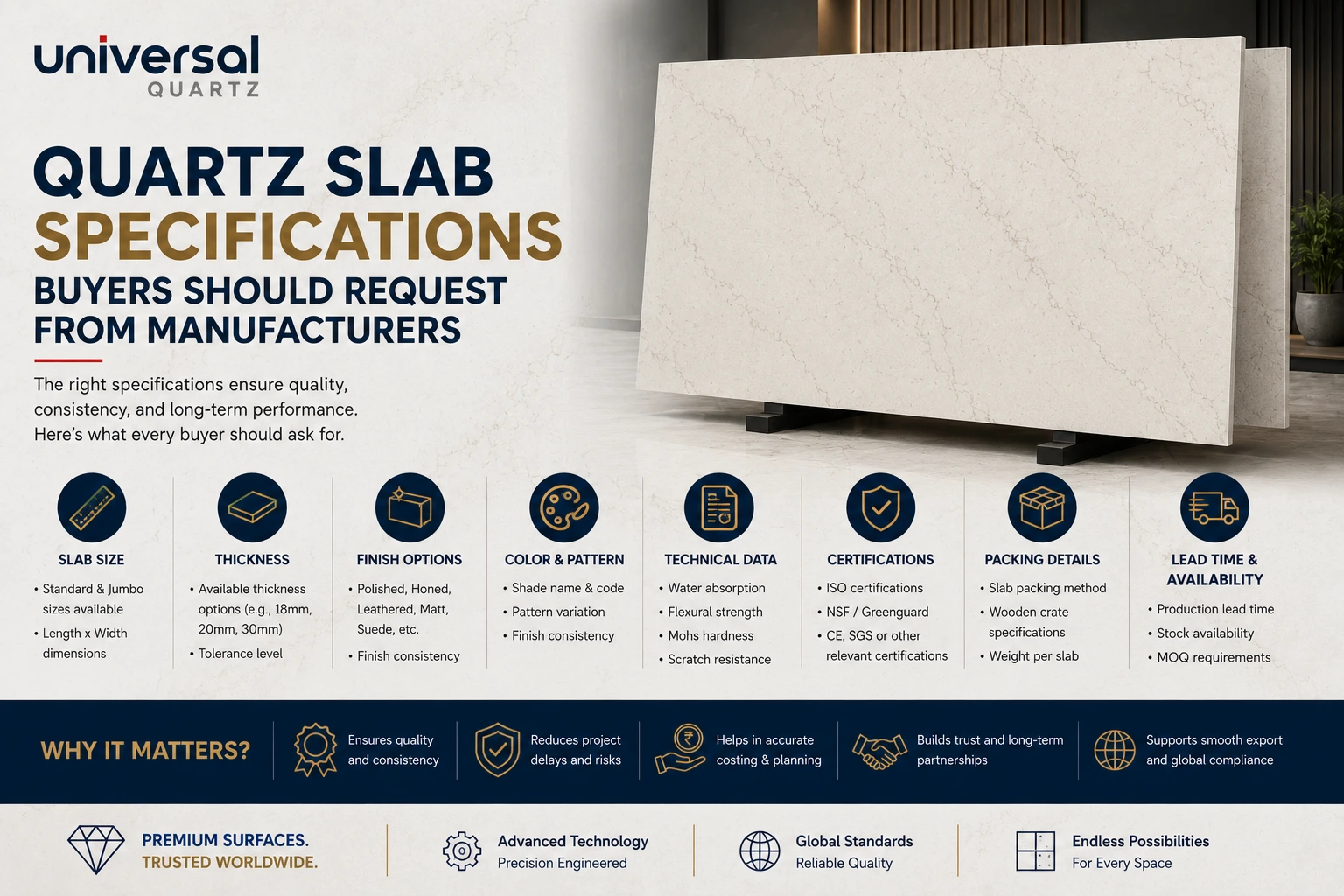
Before buying quartz slabs, request: the exact quartz content percentage (typically 90–93%), slab thickness (15mm, 18mm, or 20mm) and dimensions, resin type and any VOC/emissions data, surface finish options, batch/lot number for color consistency, third-party certifications (NSF/ANSI 51, Greenguard, ISO), warranty documentation with specific coverage terms, and slab weight/handling requirements. A reliable manufacturer should be able to provide all of these in writing, not just verbally.
Why Specifications Matter More Than a Showroom Sample
A showroom sample shows you color and pattern, but it doesn’t tell you:
- Whether the exact batch you’ll receive matches the sample precisely
- How the material will perform under heat, impact, or years of daily use
- Whether the manufacturer meets recognized safety and quality certifications
- What’s actually covered if something goes wrong after installation
Specifications close that gap. A manufacturer willing to provide detailed documentation is also demonstrating confidence in their own product — vague or reluctant answers are worth treating as a signal to look further.
Specifications to Request From Every Quartz Manufacturer
1. Quartz Content Percentage
Ask for the exact percentage of natural quartz in the slab, not just a general claim of “premium quartz.” Reputable manufacturers typically use 90–93% natural quartz content, with the remainder made up of polymer resins and pigments. Lower percentages can affect durability and long-term color stability.
2. Slab Thickness and Dimensions
Confirm both:
- Thickness — commonly 15mm, 18mm, or 20mm for kitchen countertops, with 20mm generally preferred for durability
- Slab dimensions — standard slabs typically run in the range of roughly 120″ x 55″ up to 126″ x 63″, though this varies by manufacturer
Knowing exact dimensions in advance helps you and your fabricator plan seam placement and material yield before ordering.
3. Resin Type and Emissions Data
The resin binding the quartz affects both durability and indoor air quality. Ask whether the manufacturer can provide:
- Resin composition information
- VOC (volatile organic compound) emissions data
- Any relevant indoor air quality certification, such as Greenguard Gold
This is particularly relevant for kitchens, where the surface is in constant contact with food preparation areas.
4. Surface Finish Options
Confirm which finishes are available for the specific product line you’re considering:
- Polished — glossy, most common for kitchens
- Honed/Matte — softer sheen, shows fewer fingerprints and smudges
- Textured/Leathered — tactile finish, less common but available on some collections
Ask whether the finish shown in the sample is available across the full slab size you need, since some textured finishes have size limitations.
5. Batch or Lot Number
Request the batch or lot number tied to the specific slab you’re purchasing, especially for larger projects requiring multiple slabs. This allows you to:
- Confirm color and pattern consistency across slabs for the same job
- Request a closely matching batch if a replacement or extension is needed later
A manufacturer who can’t provide batch tracking makes future repairs or matching far more difficult.
6. Third-Party Certifications
Ask for documentation, not just claims, on:
- NSF/ANSI 51 — food-contact surface safety certification, directly relevant to kitchen countertops
- Greenguard Gold — low chemical emissions certification
- ISO manufacturing certifications — indicate standardized quality control processes
These certifications are independently verified and provide more reliable evidence of quality than marketing descriptions alone.
7. Warranty Documentation
Request the warranty in writing, and confirm specifically:
- Length of coverage (typically 10–25 years, depending on brand and tier)
- What is covered (staining, cracking, discoloration)
- What is excluded (heat damage, misuse, improper cleaning)
- Whether professional installation is a condition for the warranty to remain valid
8. Slab Weight and Handling Requirements
Quartz slabs are heavy — typically in the range of 15–20 lbs per square foot depending on thickness. Ask the manufacturer or fabricator to confirm:
- Total slab weight for your project
- Any structural support requirements for cabinets, especially for large islands or waterfall edges
- Handling and installation requirements that may affect timeline or cost
9. Heat and Impact Resistance Data
While quartz is generally durable, resistance to heat and impact can vary by product line. Ask whether the manufacturer provides testing data or guidance on:
- Maximum recommended surface temperature exposure
- Whether trivets or hot pads are recommended for daily use
- Impact resistance relative to the product’s specific resin formulation
10. Country of Origin and Manufacturing Facility
For imported or premium quartz, confirm the country of origin and manufacturing facility. This affects lead times, import documentation, and can be relevant to certification validity, since certification standards vary by region.
What Happens When Specifications Aren’t Requested
Buyers who skip this step commonly run into issues after installation:
- A delivered slab that doesn’t match the showroom sample’s color or pattern
- Warranty claims denied due to unclear or unmet coverage terms
- Difficulty sourcing a matching slab for repairs or extensions
- Structural issues from underestimated slab weight on large spans
Requesting specifications upfront — in writing — prevents most of these problems before they become expensive to fix.
At Universal Quartz, we provide full specification documentation with every quote, covering composition, certifications, thickness, and warranty terms, so buyers aren’t relying on a showroom sample alone to make their decision.
Request Full Specifications Before You Buy
A showroom sample shows you the look, but the specification sheet tells you what you’re actually buying — composition, certification, warranty, and batch consistency all matter more to long-term performance than color alone. Universal Quartz provides complete documentation with every quote, covering everything on this checklist. Request specifications from Universal Quartz before you finalize your quartz order.
Frequently Asked Questions
What specifications should I ask for before buying quartz slabs?
Request the quartz content percentage, slab thickness and dimensions, resin and emissions data, available finishes, batch/lot number, certifications (NSF/ANSI 51, Greenguard, ISO), warranty terms in writing, and slab weight and support requirements.
Why does quartz content percentage matter?
The quartz content percentage, typically 90-93% in reputable products, affects the material’s durability and long-term color stability. Lower percentages can indicate a lower-quality product, so it’s worth confirming rather than assuming.
What is a batch or lot number, and why should I request it?
A batch or lot number identifies the specific production run a slab came from. Requesting it helps confirm color consistency across multiple slabs for one project and makes it easier to source a matching slab later for repairs or extensions.
What certifications should a quartz manufacturer be able to provide?
Look for NSF/ANSI 51 (food-contact surface safety), Greenguard Gold (low chemical emissions), and ISO manufacturing certifications. A reliable manufacturer should be able to provide documentation, not just a verbal claim.
Does slab thickness affect which specifications I need to check?
Yes. Thickness (commonly 15mm, 18mm, or 20mm) affects weight, durability, and whether additional structural support is needed, particularly for large islands, waterfall edges, or extended overhangs.
What warranty details should I request in writing?
Ask for the coverage length, what’s specifically covered (such as staining or cracking), what’s excluded (such as heat damage or misuse), and whether professional installation is required to keep the warranty valid.
Why does resin type matter for a kitchen countertop?
Resin composition affects both durability and indoor air quality. Requesting VOC emissions data or a relevant air quality certification is particularly relevant for kitchen surfaces used daily for food preparation.
What happens if I don’t request specifications before buying quartz?
Without documented specifications, buyers risk receiving a slab that doesn’t match the sample, facing denied warranty claims due to unclear terms, or struggling to source a matching slab for future repairs.
Does country of origin matter when buying quartz?
It can. Country of origin affects lead times, import documentation, and can be relevant to certification validity, since certification standards and enforcement vary by region.
Does Universal Quartz provide full specification documentation?
Yes. Universal Quartz provides complete specifications with every quote, including quartz content, certifications, thickness, and warranty terms, so buyers have full documentation before finalizing an order.