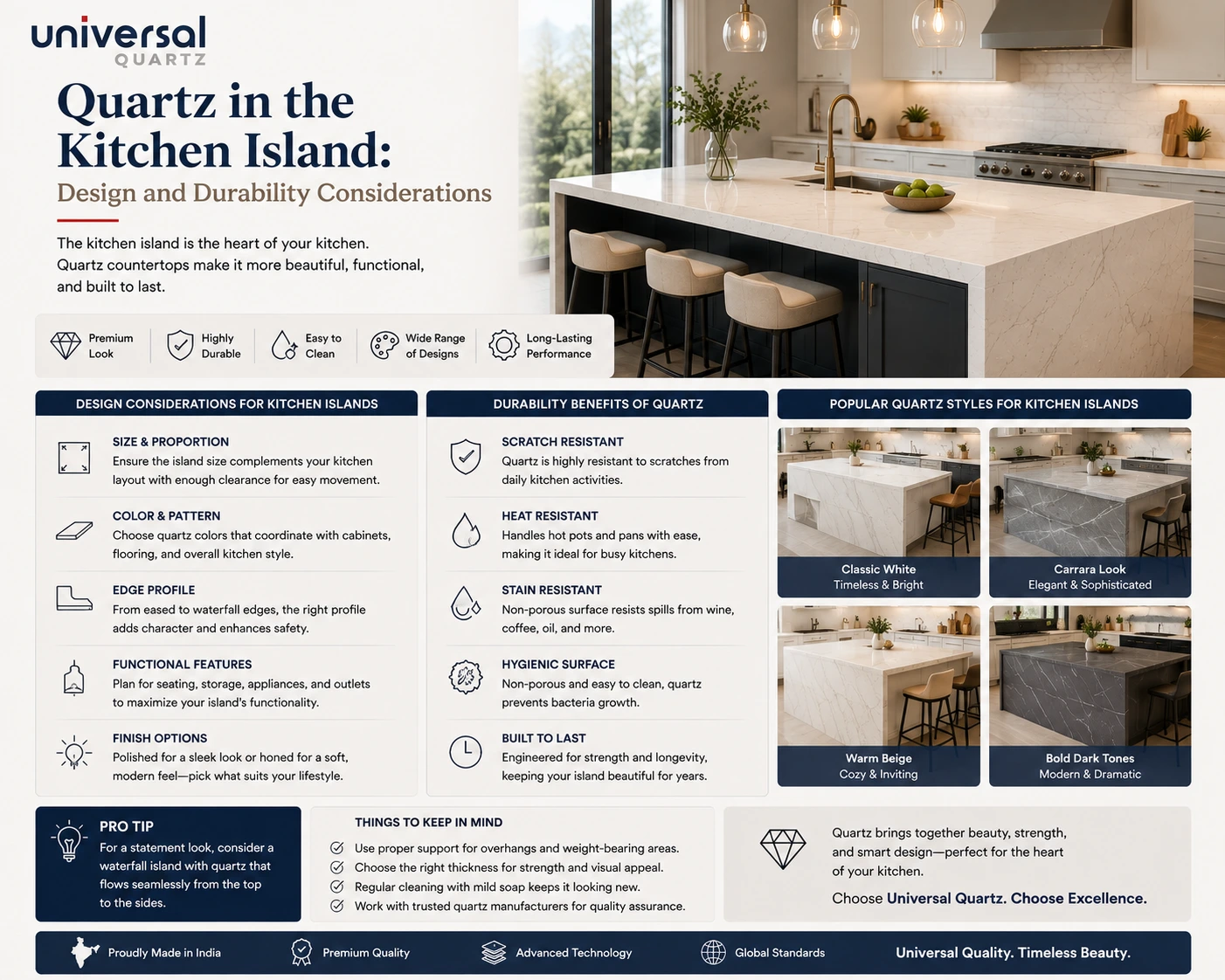
A kitchen island isn’t just a bigger countertop — it’s usually the busiest, most exposed surface in the whole kitchen. People sit at it, prep at it, gather around it, and often use it far more intensively than the perimeter counters. This guide covers what’s genuinely different about specifying quartz for an island specifically, both in terms of design and durability, in plain, simple language.
Why Islands Have Different Design and Durability Needs
Unlike a wall-mounted countertop, an island is usually visible from every angle, often has overhangs for seating, and takes on a mix of roles — food prep, casual dining, homework spot, entertaining hub — sometimes all in the same day. That combination of high visibility and heavy multi-purpose use means an island countertop needs to be considered a little differently than the rest of your kitchen surfaces.
Design Considerations Specific to Islands
The Island Is Often the Design Centerpiece
Because it sits in the middle of the room and is visible from every direction, many homeowners use the island as the place to make a bolder design choice — a darker color, dramatic veining, or a waterfall edge — while keeping the perimeter counters simpler and more neutral. This creates visual contrast without overwhelming the whole kitchen.
Waterfall Edges Work Especially Well on Islands
A waterfall edge, where the countertop material continues down the side of the island to the floor, is one of the most popular island-specific design features. Because islands are freestanding and viewed from multiple sides, the visual impact of a continuous waterfall edge is much stronger here than it would be against a wall.
Consider the Seating Overhang
If your island includes seating, the overhang — the portion of the countertop that extends beyond the cabinet base for knees and legs — needs enough slab strength to support that unsupported span safely. This is a genuine structural consideration, not just a design one, and it directly affects which thickness is appropriate.
Matching or Contrasting With Perimeter Counters
Two-tone kitchens, where the island uses a different color than the surrounding counters, are increasingly popular because they let the island stand out as a distinct feature. Alternatively, matching the island to the rest of the kitchen creates a more unified, seamless look. Both are valid choices — it comes down to whether you want the island to be a visual anchor or part of a consistent whole.
For more on pairing island colors with the rest of your kitchen, see our guide on how to choose the best quartz kitchen countertops.
Durability Considerations Specific to Islands
Islands See More Direct Impact and Wear
Because people gather around, lean on, and actively use an island from multiple sides, it often experiences more direct contact — bags being set down, kids doing homework, guests resting drinks — than a wall counter that’s used mainly for prep. Quartz’s scratch resistance and non-porous surface make it well suited to this kind of varied, constant use.
Overhang Support Affects Long-Term Durability
An overhang that isn’t properly supported — whether by corbels, brackets, or adequate slab thickness — can be at greater risk of stress cracking over time, especially if people lean or sit on the edge repeatedly. This is one of the most common, avoidable durability issues specific to islands, and it comes down to getting the engineering right during installation, not the material itself.
Choosing the Right Thickness for an Island
18mm is a common choice for islands with modest overhangs, while 20mm is often preferred for islands with longer overhangs, waterfall edges, or heavier anticipated use, since the extra thickness provides more structural margin. Your fabricator should assess your specific overhang length to confirm what support and thickness combination is appropriate.
For more detail on thickness options and how they affect durability, see our guide on quartz stone prices in India for 2026, which also touches on how specification choices affect overall cost.
Heat and Stain Exposure on Islands
Islands often double as a serving or buffet area during entertaining, meaning more exposure to hot dishes and casual spills than a standard prep counter. Quartz’s non-porous, stain-resistant surface handles this well, though the same basic habits apply — using trivets for hot dishes and wiping up spills within a reasonable time.
Common Island-Specific Mistakes to Avoid
- Choosing a thin slab for a long overhang without confirming adequate support
- Picking a bold, high-contrast pattern for both the island and the perimeter counters, which can feel visually overwhelming in a small-to-medium kitchen
- Not considering how the island will look and function from the seating side, not just the kitchen-working side
- Overlooking cord and outlet placement for cooktops, mixers, or charging stations built into the island design
- Assuming a waterfall edge is purely decorative and skipping proper structural planning for the vertical panel
A Quick Word on Experience
Getting island durability right — particularly overhang support and waterfall edge construction — depends heavily on both slab quality and fabrication expertise. A manufacturer with strong fabrication support and a track record of handling these more complex, structurally demanding installations is generally a safer choice for an island project than one used mainly to simpler, wall-mounted countertop work.
To see how manufacturers compare on fabrication support and overall capability, see our overview of the best quartz countertop brands in India for 2026.
Frequently Asked Questions
What thickness of quartz is best for a kitchen island?
18mm works well for islands with modest overhangs, while 20mm is often preferred for longer overhangs, waterfall edges, or heavier anticipated use, since it provides more structural margin.
Do quartz kitchen islands need extra support for seating overhangs?
Yes, in many cases. Longer overhangs typically need additional support, such as corbels or brackets, along with adequate slab thickness, to prevent stress cracking over time.
Is a waterfall edge worth it for a kitchen island?
Many homeowners find it worthwhile for the visual impact, since islands are viewed from multiple angles and a waterfall edge creates a strong, continuous design statement that’s harder to achieve against a wall.
Should my island match or contrast with my other countertops?
Both approaches work well. Matching creates a unified, seamless look, while a contrasting color makes the island stand out as a distinct design feature. The right choice depends on whether you want the island to be a focal point or part of a consistent whole.
Is quartz durable enough for heavy island use?
Yes. Quartz’s scratch resistance and non-porous, stain-resistant surface make it well suited to the varied, frequent use islands typically see, provided the overhang is properly supported during installation.
Related Reading
Explore more on designing and specifying quartz for kitchen islands and countertops:
How to Choose the Best Quartz Kitchen Countertops
Quartz Stone Price in India 2026
Best Quartz Countertop Brand in India 2026
Final Thoughts
A kitchen island asks more of its countertop than almost any other surface in the home — more visibility, more varied use, and often real structural demands from seating overhangs. Quartz handles this well, but getting the details right matters: the right thickness, properly supported overhangs, and a fabricator experienced with more complex installations like waterfall edges. Get those right, and your island becomes the kitchen’s strongest design feature, not just its biggest countertop.