When you choose a quartz surface, you are making two separate decisions simultaneously: the colour and pattern of the slab, and the finish of its surface. Most homeowners spend all their time on the first decision — and almost none on the second. Yet the finish can be as transformative as the colour itself: the same slab in polished finish versus matte finish looks like two entirely different products.
Understanding what each finish is, how it is created, what it looks like in practice, and which applications it is best suited to will save you from one of the most common and costliest regrets in kitchen and bathroom renovation: choosing a finish that looks spectacular in the showroom but is a nightmare to live with at home.
This guide explains all four standard Universal Quartz finishes — polished, matte, honed, and leather — with precise technical definitions, real-world performance comparisons, and specific recommendations for Indian kitchen, bathroom, office, and commercial applications.
Read More: What is quartz
1. How quartz surface finishes are created
The surface finish of a quartz slab is determined during the final stage of manufacturing — after the slab has been cured and calibrated to its specified thickness. The finish is applied through a controlled abrasion and polishing process:
The finishing process
- Calibration — after curing, the slab surface is ground flat to a precise thickness tolerance (±0.5mm for Universal Quartz). This creates a smooth but unfinished surface.
- Progressive polishing — the slab passes through a series of polishing heads with progressively finer abrasive pads. The number of polishing stages and the final grit level determine the finish.
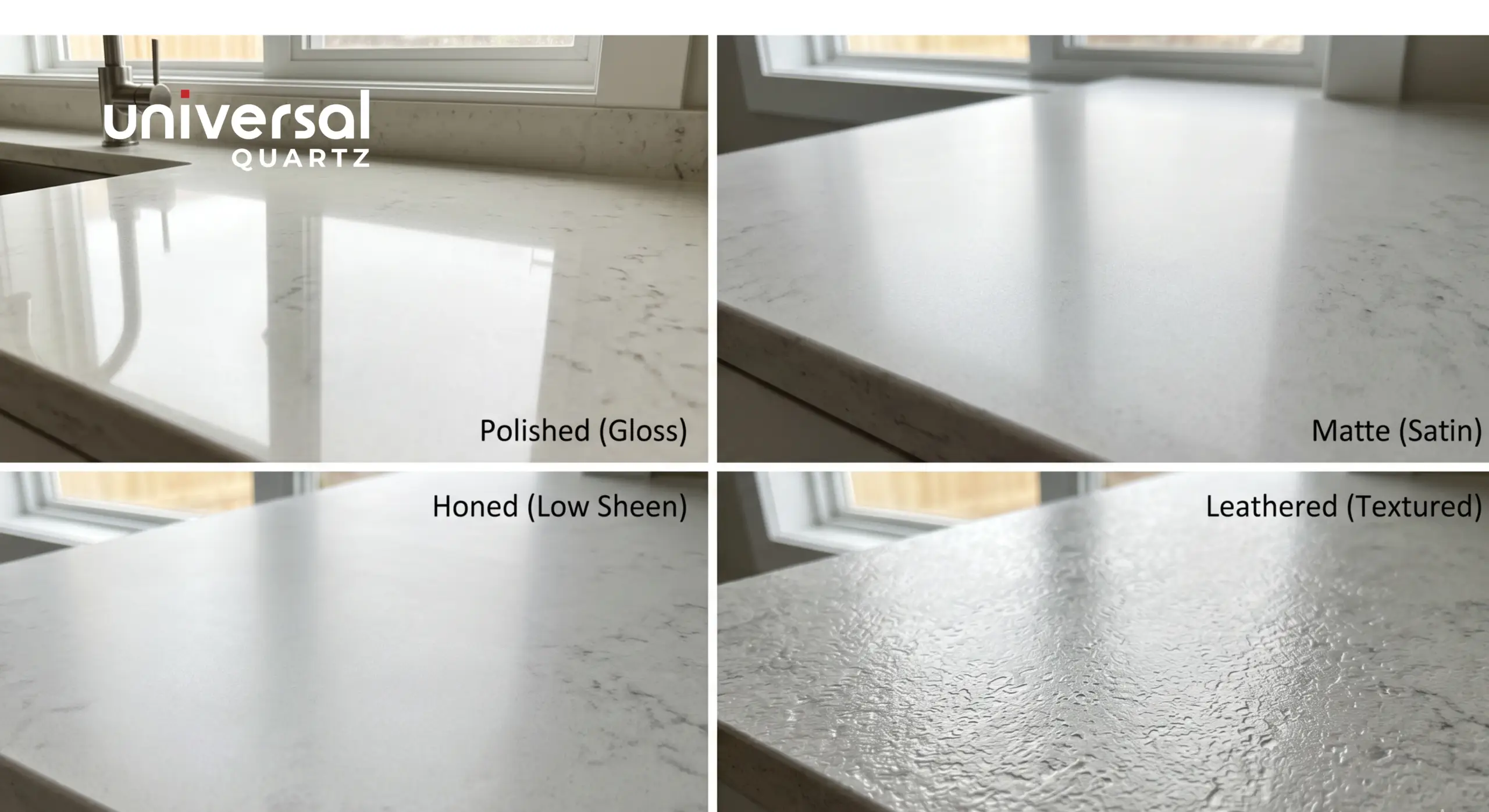
- Polished finish: 150–3,000 grit progression to a mirror surface. The final resin surface is burnished to maximum reflectivity.
- Matte finish: stopped at approximately 80–120 grit. The micro-abrasion creates a flat, light-scattering surface.
- Honed finish: progressed to 400–600 grit — smoother than matte but without full reflectivity. A satin sheen.
- Leather/brushed finish: a specialised wire or diamond brush tool is passed across the cured surface after calibration, creating a micro-textured relief pattern that resembles natural leather.
The finish does not affect the quartz’s core properties — its non-porous structure, 7-Mohs hardness, and chemical resistance are identical across all four finishes. What changes are the surface micro-texture, light interaction, and tactile quality?
2. The four standard quartz finishes
Here is each finish in detail — definition, technical properties, visual character, and ideal applications:
| POLISHED HIGH GLOSS · Mirror-reflective | The classic high-gloss quartz surface Polished is the finish most people picture when they think of quartz. The surface is processed to 3,000-grit smoothness and then buffed to a mirror-like reflectivity — light bounces directly off the surface rather than scattering. This maximises colour depth and brings the full pattern of veining and movement to life. A polished finish makes dark tones appear richer and deeper; it makes marble-look patterns appear more realistic and three-dimensional. The trade-off is visibility: polished surfaces show fingerprints, water marks, and light surface smears more readily than any other finish. In a busy Indian kitchen with daily cooking activity and multiple family members touching the surface, a polished countertop will require wiping down multiple times per day to maintain its appearance. Polished finish is the dominant choice for bathroom feature walls, kitchen islands where appearance matters more than convenience, TV unit backs, home bar tops, and commercial reception desks where a premium first impression is the priority. |
| MATTE FLAT · Non-reflective · India’s #1 choice | The practical Indian favourite — flat, forgiving, modern Matte finish is created by stopping the polishing process at approximately 80–120 grit. Instead of bouncing light, the micro-textured surface scatters it in multiple directions, creating an even, non-reflective appearance. The result is a surface that appears consistent, calm, and modern — and critically, one that hides fingerprints, oil marks, water splashes, and everyday kitchen evidence extraordinarily well. In India’s kitchen market, matte finish has overtaken polished as the preferred specification, accounting for an estimated 65–70% of all Universal Quartz kitchen countertop orders in 2024–25. The reasons are practical: Indian cooking is intense and frequent; the kitchen surface receives heavy use many times each day; and a matte finish on white or light grey quartz can go from morning cooking to evening guest arrival with no wiping required. The matte finish slightly reduces the perceived depth of colour and veining compared to polished — which is why bold, high-contrast patterns like dark Calacatta-look slabs are more commonly specified in polished finish to preserve their dramatic visual impact. |
| HONED LOW SHEEN · Satin tactile · Professional | The premium middle ground — satin smooth, sophisticated Honed finish is produced by progressing the polishing process to 400–600 grit — significantly smoother than matte but without achieving full mirror reflectivity. The result is a surface with a subtle, warm sheen rather than a flat or a high-gloss appearance. Honed quartz has a tactile quality that polished and matte do not: running your hand across a honed surface produces a silky, almost soap-like sensation that many homeowners describe as the most premium-feeling of all the finishes. In India’s premium interiors market, honed finish is increasingly specified for master bathroom vanity tops, spa-style treatment surfaces, luxury hotel lobby counters, conference room table tops, and director’s desk surfaces. It projects quiet authority rather than show-stopping glamour. Honed finish falls between polished and matte for fingerprint visibility — it shows marks less readily than polished but more so than matte. A simple wipe is always sufficient to restore the appearance. |
| LEATHER TEXTURED · Natural feel · Slip-resistant | The tactile statement — natural texture, robust, unique Leather finish (also called brushed finish) is the most distinctive of the four and the most difficult to achieve. A diamond or wire brush tool is passed across the cured slab surface, creating a micro-relief texture that resembles the grain of natural leather or the worn surface of old stone. The result has a depth and tactile character that no other finish can replicate. Leather finish scatters light in complex ways — it does not reflect like polished, does not absorb like matte, but instead creates a subtle, three-dimensional play of light and shadow across the surface that changes with viewing angle and lighting conditions. In India, leather finish is most commonly specified for kitchen islands where the owner wants the island to feel distinctly different from the main countertop run, for outdoor kitchen surfaces (the texture provides natural grip in wet conditions), for hotel spa surfaces, and for feature wall panels where maximum tactile interest is the design brief. Leather finish is the most forgiving of all four finishes for marks and cleaning — the texture’s visual complexity means minor marks and fingerprints simply disappear into the pattern. |
3. Four-finish comparison: the definitive reference table
This table is the quickest way to compare all four finishes across the criteria that matter most for Indian interior applications:
| Criterion | Polished | Matte | Honed | Leather |
| Light reflectivity | Mirror / high | None / flat | Low / satin | Varied / textured |
| Colour depth | Maximum | Reduced | Medium | Deep, complex |
| Fingerprint visibility | High | Very low | Low-medium | Very low |
| Islands/premium | High | Low | Medium | Very low |
| Tactile feel | Smooth, glassy | Smooth, velvety | Silky, satin | Textured, stone-like |
| Slip resistance (wet) | Low | Medium | Medium | High |
| Ease of cleaning | Easiest | Easiest | Easy | Easy |
| Maintenance frequency (India) | Daily wipe for gloss | Weekly minimum | 2–3x per week | Weekly minimum |
| Kitchen countertop (India) | Office/commercial | Standard — preferred | Less common | Specialty islands |
| Bathroom vanity top | Feature walls | Daily-use vanity | Master bathrooms | Spa bathrooms |
| Most popular Indian market | Reception desks | Workstations | Conference tops | Hospitality features |
| Niche/premium | Mumbai, Delhi luxury | Nationwide | Bengaluru, Pune | Niche / premium |
| Cost premium over polished | Baseline | +0–5% | +5–10% | Watermark visibility |
4. Choosing the right finish by room and application
Kitchen countertops
The kitchen finish decision is the most consequential. Indian cooking produces oil aerosols, turmeric splash, and steam condensation that settle on surfaces multiple times per day. Here is the practical guidance:
| ✔ Matte finish — recommended for most Indian kitchens | ✘ Polished finish — use only on specific surfaces |
| Hides cooking evidence. Consistent appearance throughout the day. No need to wipe between cooking and serving. Best for light colours (white, ivory, grey) where the flat finish creates a clean, modern look. The 65–70% market preference in India is data-driven — homeowners who chose polished for their first kitchen renovation frequently switch to matte for their second. | Reserve polished for: kitchen islands where high-impact aesthetics outweigh daily convenience, bold Calacatta-look patterns where polished maximises visual drama, and lower-use countertop sections (utility section, corner section). Avoid polished surfaces for the primary cooking zone — the high gloss magnifies every splash and fingerprint. |
Special case: bold patterns and dark colours. For dark quartz (charcoal, slate, deep navy) and high-contrast marble-look patterns, a polished finish is strongly recommended, even for kitchen countertops. Dark polished surfaces show marks, but the full visual depth and colour richness is only achieved in polished. Matte dark quartz appears significantly flatter and less dramatic. For these patterns, the extra cleaning effort is justified by the visual result.
Bathroom vanity tops and shower surfaces
Bathroom finish selection balances aesthetics, hygiene, and the moisture environment:
- Matte — ideal for daily-use family bathrooms. Hard water deposits, soap residue, and water marks are virtually invisible on a matte surface. Clean and consistent with minimal effort.
- Honed — the premium choice for master bathroom vanity tops and spa-style bathrooms. The silky tactile quality elevates the sensory experience. Honed finish on a pale Calacatta-look slab creates a bathroom surface that looks and feels like a luxury hotel.
- Polished — best for feature walls, shower niche backs, and decorative panels — surfaces that are seen more than touched. Do not specify polished for floor applications — the gloss surface is a slip hazard when wet.
- Leather — ideal for spa treatment surfaces and shower floor inserts where slip resistance is a safety requirement alongside premium aesthetics.
Office and commercial surfaces
- Reception desks — polished or honed. Reception surfaces are high-visibility but not high-touch in the same way as kitchen countertops. Polished creates maximum first impression; honed creates authority without showiness.
- Conference room table tops — matte or honed. Matte avoids glare under office LED lighting (a frequent complaint with polished conference tables). Honed provides a premium tactile surface for a space where people spend hours working.
- Open-plan workstations — matte only. Polished is impractical on workstations used by dozens of people daily.
- Hotel lobby and reception — polished or leather depending on brand positioning. Polished for luxury elegance; leather for boutique and resort properties seeking a natural, tactile signature.
5. How Indian room lighting affects finish appearance
The same finish looks different under different lighting conditions. Indian homes have three distinct lighting scenarios that affect finish perception:
North-facing rooms (indirect daylight)
North-facing kitchens and bathrooms in India receive soft, indirect daylight throughout the day — cooler and more diffused than direct sun. In this light, a polished finish can appear too reflective and cold; a matte finish is most flattering — the flat texture absorbs the diffuse light and appears warm; honed sits comfortably between. If your kitchen faces north, matte or honed is the recommended finish regardless of slab colour.
South-facing and east-facing rooms (direct daylight)
South and east-facing rooms receive warm, direct sunlight for significant parts of the day. In strong direct light: polished finish creates spectacular reflective effects — veining and patterns appear almost three-dimensional; matte finish absorbs more light and can appear slightly darker and flatter; leather finish creates beautiful moving shadows across its textured surface. For rooms with generous natural light, all four finishes work — polished is at its most spectacular.
LED-lit kitchens and offices without natural light
Many urban Indian kitchens — particularly in compact apartments where the kitchen is not on an exterior wall — are entirely LED-lit without natural light. Under artificial LED lighting: polished finish shows glare points directly under each fixture — this can feel harsh in a small space; matte finish distributes LED light evenly and appears consistently bright without glare; honed produces a gentle satin glow. For LED-only kitchens, a matte or honed finish is strongly recommended to avoid glare and ensure consistent lighting quality.
6. Finish preferences across India: regional and demographic patterns
Universal Quartz’s sales data over 20 years reveals clear geographic and demographic patterns in finish preference across India:
- Delhi NCR (Gurugram, Noida): Polished Calacatta-look is the aspirational specification for luxury kitchens in the premium residential segment. However, in new mid-range developments, matte white has become the dominant practical choice. Commercial projects in Gurugram’s Grade A offices specify honed or matte for conference and workstation surfaces.
- Mumbai (South Mumbai, BKC, Worli): Matte finish dominates in 95% of Mumbai kitchen specifications. The coastal humidity and compact kitchen sizes make a matter the unambiguous practical choice. Honed is growing in Mumbai’s luxury master bathroom segment.
- Bengaluru (Koramangala, Whitefield, HSR Layout): The strongest market for honed finish in India, driven by Bengaluru’s tech-professional demographic who value quiet, premium quality over showroom spectacle. Leather finish has a small but growing following among Bengaluru’s design-forward homeowners.
- Hyderabad (HITEC City, Jubilee Hills): Polished finish has a stronger presence in Hyderabad than most other markets — the aspirational luxury segment remains more drawn to the high-gloss aesthetic. Matte is gaining in new residential developments.
- Chennai and South India: Matte finish is universal in Chennai’s kitchen market. Traditional South Indian kitchen design favours understated, functional surfaces. Polished is used for feature applications only.
- Jaipur and Rajasthan: Mixed market. Heritage property renovations (haveli, bungalow) frequently specify leather or honed to reference natural stone aesthetics. New residential development follows the national market-dominant trend.
7. Caring for each finish: maintenance differences
All four finishes are cleaned with the same basic approach — soft cloth, mild cleaner, warm water — because all four are on the same non-porous quartz surface. However, there are finish-specific considerations:
| Care factor | Polished | Matte / Honed | Leather |
| Daily cleaning | Never dull the mirror finish | Wipe with a damp cloth; texture traps little debris | Wipe with a damp cloth; air-dry is acceptable |
| Water marks | Visible; dry immediately after cleaning | Virtually invisible | Invisible in texture |
| Fingerprints | Visible; wipe after use in high-touch areas | Not visible under normal use | Not visible |
| Restoring appearance | Buff with dry microfibre after cleaning | Not required | Not required |
| Abrasive cleaners | Never — will dull the mirror finish | Never | Never |
| Bleach (diluted only) | Acceptable for stubborn stains, rinse immediately | Same as polished | Same as polished |
| Wax or polish | Never needed or beneficial | Never needed | Never needed |
Frequently asked questions
What is the difference between polished and matte quartz?
Polished quartz has a mirror-like, high-gloss surface that reflects light directly and shows colours at maximum depth. Matte quartz has a flat, non-reflective surface that scatters light and hides fingerprints, water marks, and daily kitchen evidence far better. For Indian kitchens with heavy daily use, matte is the recommended practical choice. Polished is recommended for bold marble-look patterns, dark tones, and applications where visual impact is the priority.
Is matte or polished quartz better for Indian kitchens?
Matte is better for most Indian kitchen countertops. Indian cooking produces frequent oil, turmeric, and steam that settle on surfaces. Matte finish hides these marks and maintains a consistently clean appearance with minimal wiping. Matte accounts for approximately 65–70% of all kitchen quartz specifications in India for this practical reason. Polished is recommended for kitchen islands and bold dark or marble-look slabs.
What is honed quartz?
Honed quartz is a finish processed to 400–600 grit — creating a smooth, satin surface with a subtle low sheen rather than either a flat matte or high-gloss polished appearance. It is sometimes described as the premium middle ground: more sophisticated than matte, more practical than polished. Honed quartz has a silky, soap-like tactile quality that makes it popular for master bathroom vanity tops, conference table surfaces, and luxury commercial applications.
What is leather finish quartz?
Leather finish (also called brushed finish) is created by passing a diamond or wire brush across the cured quartz surface, creating a micro-textured relief pattern that resembles the grain of natural leather or worn stone. It has a distinctive tactile quality and complex light-scattering appearance that changes with viewing angle. Leather finish is slip-resistant (suitable for wet applications), extremely forgiving of marks, and most commonly used for kitchen islands, outdoor surfaces, spa treatments, and hotel feature surfaces.
Does quartz finish affect durability or maintenance?
No. All four quartz finishes — polished, matte, honed, and leather — share the same non-porous structure, the same 7-Mohs hardness rating, and the same chemical resistance. The finish is a surface texture only; it does not affect the quartz’s structural strength, its resistance to staining, or its sealing requirements (none — quartz never needs sealing regardless of finish). The only maintenance difference is that polished requires more frequent wiping in high-touch areas to maintain its glossy appearance.
Can I change the finish of my quartz after installation?
It is not practically possible to change the finish of installed quartz from polished to matte, or vice versa, without replacing the slab. The finish is applied during manufacturing with industrial polishing equipment that cannot be replicated on-site. This makes the final decision a one-time choice — select it carefully before ordering. If you are unsure between finishes, request a physical sample of each and live with them for a week in your kitchen or bathroom lighting conditions before committing.
Choose your finish with the same care as your colour
The finish of your quartz surface is the decision that most determines how your surface looks in daily life — not just in the showroom. A polished slab that photographs beautifully in a magazine kitchen shoot becomes a high-maintenance burden in a busy Indian family kitchen. A matte slab that appears modest in a fluorescent showroom becomes the quietly stunning anchor of a well-lit contemporary kitchen.
The four finishes — polished, matte, honed, and leather — each have contexts where they are the best possible choice. Match the finish to the room, the lighting, the usage intensity, and the aesthetic you want to live with every day. Universal Quartz offers all four finishes across our full product range.
Order finished samples from Universal Quartz
Visit universalquartz. in to order A4 physical samples of any Universal Quartz slab in your preferred finish. Assessing the finish under your actual room lighting is the only reliable way to make this decision with confidence. Samples are available across all 8 product series in all four standard finishes. ISO · CE · GREENGUARD Gold · NSF certified surfaces.