When you begin specifying a quartz countertop — whether for a kitchen renovation in Gurugram, a bathroom fit-out in Mumbai, or a commercial office project in Bengaluru — one of the first technical decisions you will face is: which thickness?
The answer has a significant effect on your project’s cost, aesthetic, structural performance, and installation requirements. Yet it is one of the least well-explained decisions in most quartz purchasing guides. This post gives you the complete, technically grounded answer — based on Universal Quartz’s two decades of manufacturing all four standard thicknesses and supplying them across India’s residential, commercial, and hospitality markets.
1. Why quartz slab thickness matters
Quartz slab thickness affects four things simultaneously:
- Structural strength — thicker slabs span wider unsupported distances without flexing or cracking. For overhangs, large islands, and platform kitchens, thickness is not aesthetic — it is structural.
- Visual weight and premium perception — a 30mm countertop edge looks dramatically more substantial than an 18mm edge. Edge profile and thickness together determine whether a surface reads as premium or standard.
- Weight and handling — thicker slabs are significantly heavier. A standard 3000×1400mm slab in 30mm weighs approximately 290kg — logistics and installation require more resources than the same slab in 18mm (approx 175kg).
- Cost — thickness directly drives material cost. All else equal, 30mm costs approximately 60–70% more per sq ft than 18mm because it uses more raw material and requires more machining time.
2. All four thicknesses explained
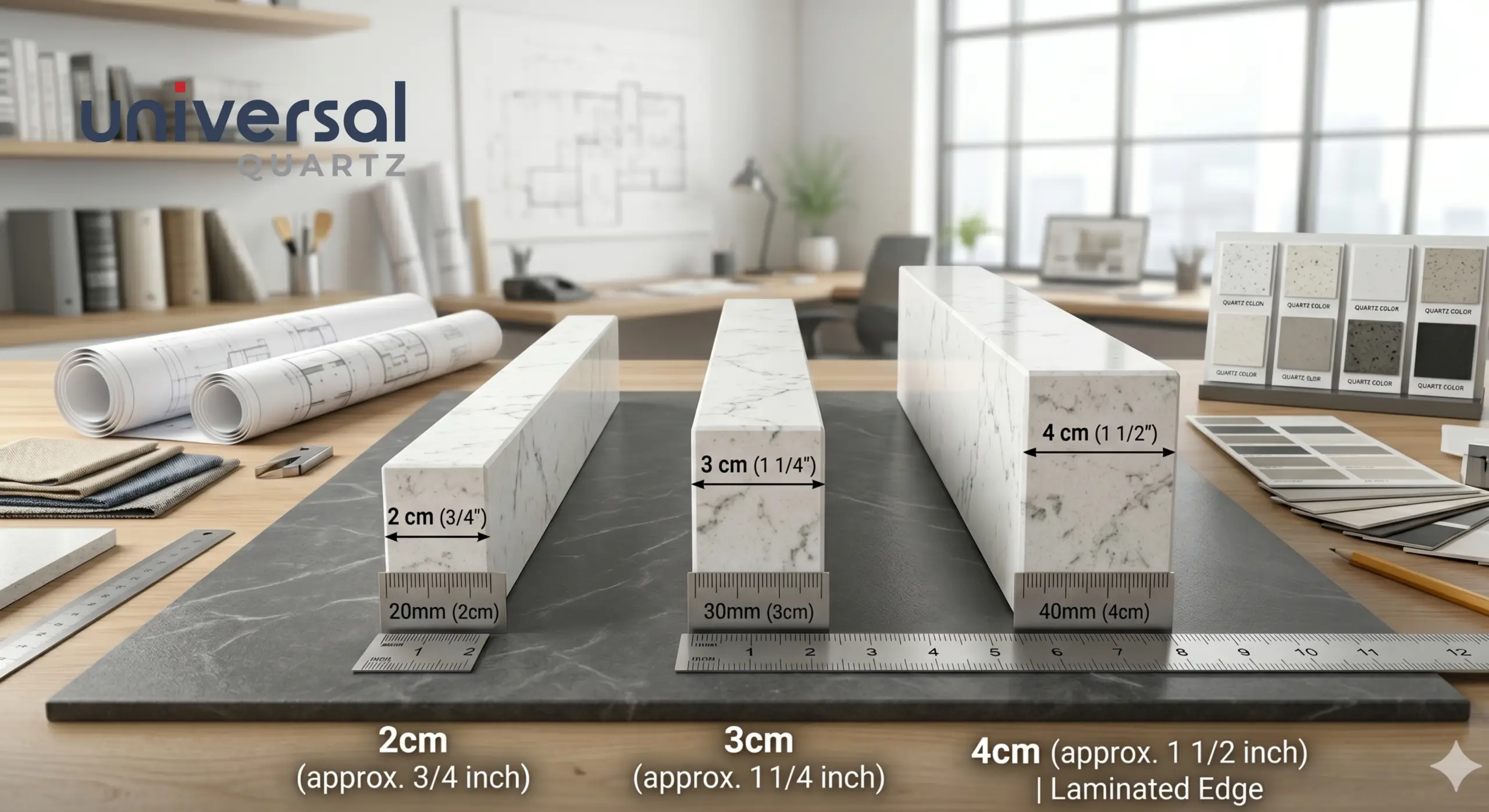
Here is each Universal Quartz slab thickness, its structural properties, standard applications, and the specific Indian contexts where it performs best:
| 12mm Lightweight | Thin profile — wall cladding, low-load surfaces, lightweight panels 12mm is the thinnest standard quartz thickness and is specifically designed for applications where the slab does not carry vertical load. It is the correct specification for wall cladding panels (shower walls, feature walls, lift lobbies, corridor panels), shower niche inserts, and decorative surfaces that are adhesive-fixed rather than support-bearing. At 12mm, a standard slab weighs approximately 70kg — light enough for single-person installation on walls. Do not specify 12mm for horizontal countertop applications: it lacks the rigidity for spans over 400mm and will flex under normal countertop loading, risking cracking at cutouts and edges. |
| 18mm Indian standard | Standard countertop — the most common specification in India 18mm is the single most common quartz countertop thickness specified in India, accounting for approximately 65% of all Universal Quartz countertop installations. It is the default specification for: modular kitchen countertops in straight-run and L-shaped layouts, bathroom vanity tops with undermount basins, office workstation surfaces, pantry and breakout countertops, and window sills. At 18mm, a standard slab weighs approximately 130kg and is manageable by two-person installation teams, making it the practical standard for Indian site conditions. 18mm provides sufficient structural rigidity for spans up to 600mm unsupported — covering virtually all standard Indian modular cabinet configurations. The edge profile options available at 18mm are: straight/square, bullnose, bevelled, and basic ogee. |
| 20mm Premium profile | Premium countertop — islands, thick-edge aesthetics, platform kitchens 20mm is the premium residential specification for kitchen islands, U-shaped kitchen countertops, and any application where the owner wants a visibly thicker, more substantial edge. The extra 2mm over 18mm sounds trivial — in practice, the visual difference when the edge is profiled (particularly for waterfall and mitered edges) is immediately apparent and is the primary reason 20mm is specified. In India’s platform kitchen segment — where countertops span a wider masonry base rather than modular cabinet units — 20mm provides the structural rigidity to handle spans up to 800mm unsupported. 20mm is the minimum specified thickness for waterfall-edge kitchen islands, and the standard specification for commercial reception desks, conference table tops, and hotel check-in counters. At 20mm, the full range of edge profiles is available including deep ogee and compound mitred profiles. |
| 30mm Architectural | Statement and heavy-duty — luxury islands, commercial architecture, bold edges 30mm is the luxury and architectural specification — used when the surface itself is the statement. A 30mm quartz island has the visual mass and gravitas of a stone monolith. It is specified for: signature kitchen islands in luxury residential projects (particularly in Gurugram’s Golf Course Road and Mumbai’s Worli and South Mumbai premium segment), high-traffic commercial reception desks in Grade A offices, hotel lobby surfaces, and any application where maximum structural rigidity is required (spans over 1,000mm, cantilever overhangs over 300mm). At 30mm, Universal Quartz slabs weigh approximately 290kg — logistics to upper floors of buildings without freight elevator access can be a practical challenge. A fully profiled 30mm waterfall-edge island is the most premium quartz installation available in India and is increasingly the benchmark specification for ultra-luxury residential interiors. |
Read More: What is quartz
3. Side-by-side thickness comparison
This is the reference table most homeowners and specifiers need. Use it to confirm the correct thickness for your specific application:
| Specification | 12mm | 18mm | 20mm | 30mm |
| Slab weight (3000×1400mm) | ~70kg | ~130kg | ~145kg | ~290kg |
| Horizontal countertop use | No | Yes | Yes | Yes |
| Max unsupported span | Not applicable | Up to 600mm | Up to 800mm | Over 1,000mm |
| Modular kitchen | No | Standard | Premium | Ultra-luxury |
| Platform (masonry) kitchen | No | Minimum | Recommended | Premium |
| Kitchen island | No | Acceptable | Recommended | Statement |
| Waterfall edge | No | Basic only | Full profile | Full + cantilevered |
| Bathroom vanity top | No | Standard | Premium | Statement |
| Wall cladding / panel | Yes — ideal | Possible | Heavy | Not recommended |
| Shower wall | Yes — ideal | Possible | Not standard | No |
| Commercial reception desk | No | Light duty | Standard | Premium |
| Cost per sq ft (relative) | Base | +30–40% | +50–60% | +80–100% |
| Edge profiles available | Square only | All standard | All full-range | All incl. deep profiles |
| Installation team size | 1–2 persons | 2 persons | 2–3 persons | 3–4 persons |
4. Thickness decisions for Indian construction: platform vs modular
India’s kitchen construction landscape has two very different structural contexts that directly influence thickness selection. This is a distinction that no international quartz guide addresses, yet it is the most important factor for Indian homeowners and contractors:
Modular kitchen (cabinet-based)
A modular kitchen is built from factory-made cabinet units — typically 500mm deep, 850mm high in India (versus 900mm in Europe and the US). The countertop spans from cabinet to cabinet with support at the edges and at any intermediate cabinet walls. For a standard Indian modular kitchen:
- Straight run or L-shape: 18mm is the correct and standard specification. Cabinet support keeps all spans well within the 600mm safe span for 18mm.
- Kitchen island on cabinet base: 20mm is recommended. Even with cabinet support, islands receive more physical loading (standing, sitting on the edge), and the visual mass of 20mm suits the island’s architectural role.
- Peninsula over a breakfast bar: 20mm minimum for the overhang section. Any overhang over 200mm beyond the last support should be 20mm or above.
Read More kitchen countertop design
Platform (masonry) kitchen
Many Indian kitchens — particularly in older buildings, tier-2 cities, and traditional construction — are built on a continuous masonry platform rather than modular cabinets. The platform is typically 500–600mm wide and 850mm high, built in brick or concrete. For platform kitchens:
- Standard platform with continuous support: 18mm is acceptable if the masonry platform provides continuous support across the full countertop depth.
- Platform with service access gaps or embedded appliances: 20mm minimum. Any gap in the platform support structure wider than 400mm requires 20mm or above.
- Wide platform spans over 600mm: 20–30mm. Wide masonry platforms in South Indian kitchen designs (common in Chennai, Bengaluru, and Kerala) frequently span 700–800mm — these require 20mm minimum.
Cantilevered breakfast bar or island overhang
Cantilevered overhangs — where the countertop extends beyond the supporting structure with no leg or bracket — require special structural attention:
- Up to 200mm cantilever: 18mm acceptable with standard 18mm support.
- 200–300mm cantilever: 20mm minimum.
- Over 300mm cantilever: 30mm recommended, or an engineered steel support bracket under the countertop. Never specify 18mm for overhangs over 300mm — the cracking risk is high.
5. How thickness affects your edge profile options
Thickness and edge profile are inseparable decisions — many of the most desirable edge profiles require a minimum thickness to be executed correctly. Here is what is possible at each thickness:
| Edge profile | 12mm | 18mm | 20mm | 30mm |
| Square / straight | Yes | Yes | Yes | Yes |
| Bullnose (fully rounded) | No | Yes | Yes | Yes |
| Bevelled (chamfered) | Limited | Yes | Yes | Yes |
| Eased edge (micro-bevel) | No | Yes | Yes | Yes |
| Ogee (single) | No | Basic | Full | Full |
| Ogee (double) | No | No | Yes | Yes |
| Waterfall / miter | No | Basic | Full | Full + cantilevered |
| Dupont / French edge | No | No | Yes | Yes |
| Waterfall/miter | No | 18mm stack | 20mm stack | 30mm natural |
6. Thickness and cost: what to budget in India
The cost of quartz thickness in India follows a predictable pattern — each step up adds proportional material and fabrication cost. Here is a realistic per-sq-ft guide based on Universal Quartz’s mid-range product series pricing in 2025:
| 18mm | The benchmark. Most Indian kitchen countertops are quoted at 18mm. Per sq ft price for Universal Quartz mid-range series: Rs 280–450, depending on series and finish. This is the number to use as your cost baseline. |
| 20mm | Typically Rs 60–100 per sq ft more than 18mm for the same series. The premium is driven by additional material (more slab), additional CNC machining time, and higher transportation weight. For a 45 sq ft kitchen, the 20mm upgrade costs Rs 2,700–4,500 more. |
| 30mm | Typically Rs 130–180 per sq ft more than 18mm. For a 45 sq ft kitchen island in 30mm, you are paying Rs 5,850–8,100 more than 18mm for the same surface area. The visual impact is dramatic — for statement islands, this is considered excellent value per impression. |
| 12mm | Usually the lowest cost per sq ft — approximately Rs 220–360 for the same series. However, 12mm is only suitable for wall applications; it cannot be used as a horizontal countertop surface. Quote it as a wall cladding material, not a countertop substitute. |
Read More: pre-fab quartz
7. Thickness preferences across Indian markets
Universal Quartz’s 20 years of data show clear regional patterns in thickness specification across India:
- Delhi NCR (Gurugram, Noida, Greater Noida): 18mm for standard apartments; 20mm and 30mm dominate in luxury residential projects. The Golf Course Road and DLF phases are the highest concentration of 30mm island specifications in India. Large-format 30mm waterfall islands are the benchmark for ultra-luxury kitchens in this market.
- Mumbai (BKC, Worli, Juhu, South Mumbai): 18mm dominates in space-constrained apartments. 20mm is used for premium island kitchens in larger floor-plate developments. 30mm is primarily specified in duplex and sea-facing penthouse kitchens where space and budget allow.
- Bengaluru (Whitefield, Koramangala, Sarjapur Road): 18mm standard; 20mm growing in the tech-executive premium segment. Bengaluru buyers are increasingly specifying 20mm for open-plan kitchen-living designs where the island is the architectural centrepiece.
- Hyderabad (HITEC City, Jubilee Hills, Banjara Hills): Strong 20mm adoption in the Jubilee Hills and Banjara Hills luxury bungalow segment. Platform kitchen construction in Hyderabad’s older housing stock creates demand for 20–30mm specifications.
- Chennai, Coimbatore, Kerala: South Indian kitchen designs with wide platform structures frequently require 20mm. The 18mm standard for standard floor-plan apartments; 20mm for traditional platform kitchen renovations.
- Jaipur, Rajasthan: As Universal Quartz’s home base, Jaipur sees the full range. Haveli renovations and large bungalow kitchens drive 20–30mm specification. Commercial projects in Jaipur’s hospitality sector (hotels and resorts) are strong 20mm users.
Frequently asked questions
What thickness of quartz is best for an Indian kitchen countertop?
18mm is the standard and recommended thickness for most Indian modular kitchen countertops. It provides sufficient structural strength for standard cabinet spans up to 600mm, works with all common edge profiles, and is the most cost-effective option. 20mm is recommended for kitchen islands, platform kitchens with spans over 600mm, and any application requiring a waterfall or thick-edge profile.
Can 12mm quartz be used as a kitchen countertop?
No. 12mm quartz should not be used as a horizontal kitchen countertop surface. It lacks the structural rigidity required for countertop spans and will flex and potentially crack under normal kitchen loading, particularly around sink and hob cutouts. 12mm is specifically designed for wall cladding, shower walls, feature panels, and other vertical or adhesive-fixed low-load applications.
What is the difference between 18mm and 20mm quartz?
The practical difference between 18mm and 20mm quartz is structural capacity and edge profile options. 20mm can span wider unsupported distances (up to 800mm vs 600mm for 18mm), enables deeper and more complex edge profiles, including full waterfall mitres and double ogee, and provides a more visually substantial edge appearance. The cost premium is typically Rs 60–100 per sq ft. For most standard modular kitchens, 18mm is entirely adequate; for islands and platform kitchens, 20mm is the better specification.
Is a 30mm quartz worth the extra cost?
30mm quartz is worth the extra cost, specifically for statement kitchen islands and commercial reception applications where the visual impact of the slab edge is the primary design intention. The cost premium over 18mm is Rs 130–180 per sq ft. For a kitchen with a large island as its centrepiece, the visual difference between 18mm and 30mm is substantial and immediately visible. For standard countertop runs, 30mm is over-specification — 18mm or 20mm delivers equal functional performance at lower cost.
What thickness of quartz do I need for a waterfall kitchen island?
For a full waterfall-edge kitchen island (where the quartz continues vertically to the floor), specify 20mm minimum. 20mm enables the full depth mitered edge that waterfall construction requires and provides the structural rigidity for the vertical panel without requiring additional reinforcement. 30mm creates a more dramatic, heavier-looking waterfall edge. Do not specify 18mm for a full waterfall island — the mitered edge at 18mm is too thin for a full floor-to-countertop panel without structural support.
How much does quartz thickness affect the price?
Quartz thickness directly affects the per sq ft cost. Using Universal Quartz mid-range series in 2025 as a reference: 12mm is the lowest cost (Rs 220–360/sqft); 18mm is the standard baseline (Rs 280–450/sqft); 20mm adds Rs 60–100/sqft; 30mm adds Rs 130–180/sqft over 18mm. For a 45 sq ft standard kitchen, upgrading from 18mm to 20mm costs approximately Rs 2,700–4,500 more in material. Contact Universal Quartz for a project-specific quotation.
Choosing the right thickness with confidence
The thickness decision for your quartz countertop is not complicated once you know the four variables: your kitchen type (modular vs platform), your maximum unsupported span, your edge profile ambition, and your budget. For the vast majority of Indian modular kitchen countertops, 18mm is the correct and proven specification. For islands, thick-edge aesthetics, and platform kitchens, step up to 20mm. For statement luxury, 30mm delivers an impact that is immediately visible and genuinely unmatched.
Universal Quartz manufactures all four standard thicknesses at our Jaipur facility and supplies them to residential and commercial projects across India. Our authorised fabricators are equipped for CNC precision work at every thickness.