Quartz is more sustainable than natural stone in some respects and less sustainable in others — there isn’t a simple yes or no answer. Engineered quartz uses less direct quarrying than granite or marble since it’s made primarily from quartz crystal waste and byproduct rather than large extracted blocks, and its durability means countertops rarely need replacing for decades, reducing material turnover. At the same time, quartz manufacturing involves resin binders (typically polymer-based) and an energy-intensive curing process, and the cutting stage requires strict dust control because crystalline silica dust is a recognised health and environmental hazard if not properly managed.
This piece looks honestly at where engineered quartz’s sustainability claims hold up, where the industry still has work to do, and what certifications actually mean when a manufacturer says their product is “eco-friendly.”
How Engineered Quartz Is Actually Made
Engineered quartz slabs are produced by combining roughly 90-95% crushed quartz (often using quartz waste and byproduct from other industries) with around 5-10% polymer resin as a binder, along with pigments for colour. The mixture is compacted under vacuum and vibration, then cured under heat to form a solid, non-porous slab, which is later cut and polished to size.
This process matters for sustainability in two opposing ways:
- Lower quarrying impact: Because quartz crystal is abundant and the manufacturing process can use waste quartz from other industrial processes, engineered quartz doesn’t require the same scale of block extraction that granite or marble quarrying does.
- Resin and energy inputs: The polymer resin binder is petroleum-derived, and the curing process is energy-intensive. This is the part of quartz manufacturing that natural stone doesn’t need, since granite and marble are cut directly from quarried blocks without a resin or curing stage.
So the sustainability comparison between quartz and natural stone isn’t one-directional — each has trade-offs in different parts of the lifecycle.
Quartz vs. Granite and Marble: Where the Trade-offs Actually Are
| Factor | Engineered Quartz | Granite / Marble |
| Raw material extraction | Lower — uses crushed quartz, often including industrial byproduct | Higher — requires quarrying large stone blocks |
| Manufacturing inputs | Requires resin binder + energy-intensive curing | No resin; cut and polished directly from the quarried block |
| Product lifespan | Very long; non-porous surface resists wear, reducing replacement frequency | Long, but porous surface needs periodic resealing and can degrade faster without maintenance |
| End-of-life | Resin content makes recycling more difficult than natural stone | Natural stone is generally easier to crush and repurpose at the end of its life |
| Air quality risk during fabrication | Requires dust suppression (wet-cutting) due to crystalline silica content | Also requires dust control, but typically has a lower silica content than engineered quartz |
Neither material is unambiguously “greener” — quartz wins on extraction and longevity, while natural stone wins on simpler manufacturing and easier end-of-life handling.
The Silica Dust Issue: Why Manufacturing Standards Matter
One sustainability and safety issue specific to engineered quartz is crystalline silica dust, generated when slabs are cut, ground, or polished. Because engineered quartz contains a higher concentration of crystalline silica than most natural stones, fabrication shops and manufacturers are required to follow strict dust-control protocols — wet-cutting methods, ventilation, and protective equipment — to protect worker health and limit airborne particulate release. This is a genuine industry-wide responsibility, and it’s part of why manufacturing certifications and quality-control standards matter more for quartz than they might for some other building materials.
This is also why where and how a slab is manufactured is a more meaningful sustainability signal than marketing language alone. A facility with consistent quality control and proper dust/emission management is doing the unglamorous but essential part of “sustainable manufacturing.”
What Certifications Actually Tell You
When a quartz brand claims to be sustainable or eco-friendly, the certifications behind that claim are what separate a verifiable statement from a marketing one. Universal Quartz holds:
- ISO 9001:2015 — a quality management certification, confirming consistent manufacturing process control (this speaks to quality/consistency rather than environmental impact specifically, but consistent processes reduce material waste from defective slabs).
- CE compliance — confirms the product meets relevant European health, safety, and environmental protection requirements for construction products.
- Registration and factory license — confirms the manufacturing facility operates under recognised regulatory oversight.
It’s worth being precise here: these certifications confirm quality, safety, and regulatory compliance, which support sustainable manufacturing practices, but a buyer evaluating environmental claims specifically should ask a manufacturer directly about water recycling rates, resin sourcing, and energy use in production, since not every certification addresses every part of the sustainability picture.
Does Quartz Help with Green Building Certification?
Engineered quartz surfaces are commonly specified in projects pursuing green building certifications (such as LEED or IGBC in India) because of factors like low-VOC formulations in many products, the material’s long lifespan reducing replacement waste, and the option of using recycled content quartz in some product lines. Whether a specific quartz product contributes points toward a green building certification depends on the specific product’s documentation (such as VOC emission test results) rather than the material category as a whole — so for architects and builders working toward certification, this is worth confirming product-by-product rather than assuming all quartz qualifies equally.
The Honest Answer
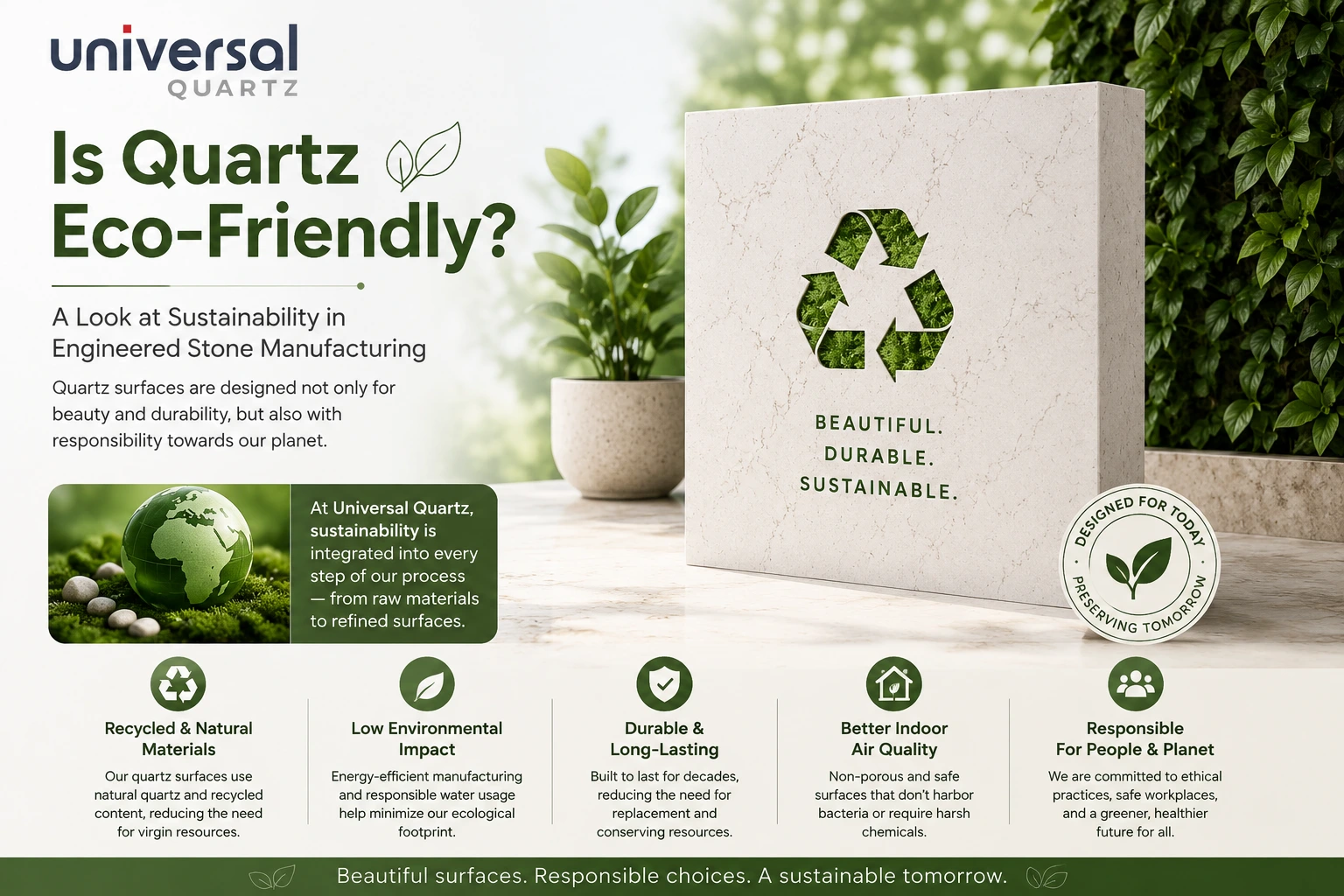
Engineered quartz is not a zero-impact material, and no responsible manufacturer should claim otherwise — it involves resin, energy-intensive curing, and silica dust management that natural stone doesn’t. But compared to many flooring and countertop alternatives, it offers real sustainability advantages: lower quarrying intensity than granite or marble, an extremely long service life that reduces replacement waste, and (when properly manufactured) a non-porous surface that doesn’t require the periodic chemical sealants that natural stone does over its lifetime.
The most accurate way to think about quartz’s sustainability is as relatively favourable within the hard-surface category, supported by genuine manufacturing standards and certifications — not as an unconditionally “green” material in absolute terms.
Frequently Asked Questions
Is engineered quartz more eco-friendly than granite?
It depends on the factor being compared. Quartz generally requires less raw quarrying than granite, but its manufacturing process uses resin and energy-intensive curing that granite fabrication doesn’t need. Granite is also somewhat easier to repurpose at end-of-life.
Does quartz manufacturing release harmful dust?
Cutting and polishing engineered quartz generates crystalline silica dust, which is why reputable manufacturers and fabricators use wet-cutting methods, ventilation, and protective equipment during production and installation.
What does ISO or CE certification actually confirm about sustainability?
ISO 9001:2015 confirms consistent quality management processes, and CE compliance confirms a product meets European safety and regulatory standards. These support sustainable manufacturing but don’t certify specific environmental metrics like carbon footprint or water recycling on their own.
Can quartz countertops contribute to green building certification points?
They can, depending on the specific product’s documentation — such as low-VOC emission testing — rather than the material category generally. Architects working toward LEED or IGBC certification should request specific product documentation from the manufacturer.
Is quartz a recyclable material?
Quartz is harder to recycle than natural stone at end-of-life because of its resin content, though its long service life means it needs replacing far less often than many alternative surface materials.