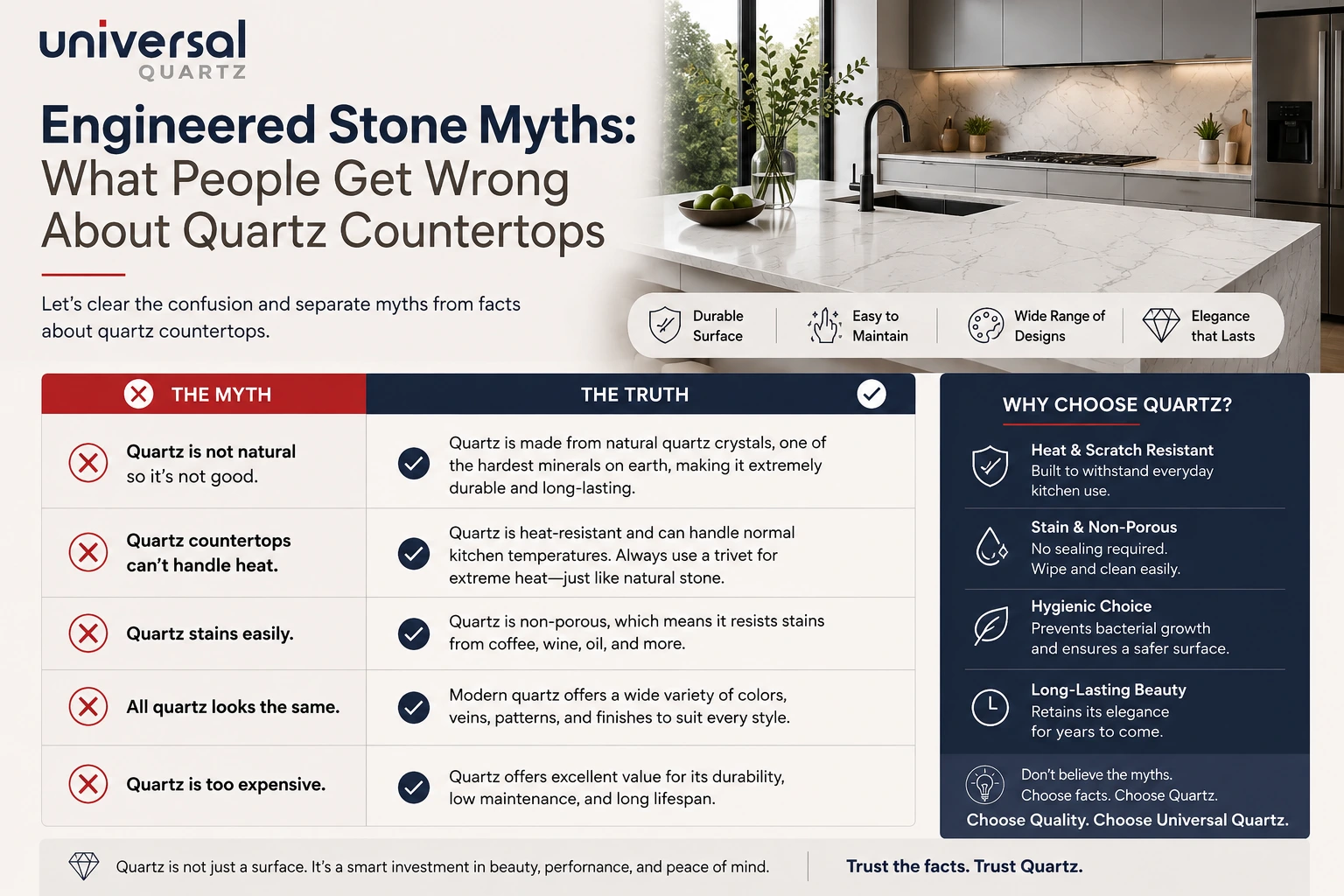
Quartz countertops have been popular in Indian kitchens for long enough that a fair amount of misinformation has built up around them — some of it outdated, some of it confused with other materials, and some of it simply never true to begin with. Before you rule quartz in or out based on something you’ve heard, it’s worth checking whether it actually holds up.
Myth 1: Quartz Is 100% Natural Stone
Quartz countertops are engineered, not quarried whole like granite or marble. A typical slab is made from roughly 90-93% crushed natural quartz crystal bound together with polymer resin and pigments, then compressed and cured under heat and pressure. The raw material is genuinely natural quartz — one of the hardest minerals on earth — but the finished slab is a manufactured product, and that’s actually the source of most of quartz’s practical advantages over natural stone, not a drawback.
Myth 2: Quartz and Granite Are Basically the Same
It’s a common assumption, but the two materials behave differently in ways that matter day to day.
- Granite is porous and requires periodic sealing; quartz is non-porous and never needs sealing.
- Granite’s pattern is entirely determined by nature, so no two slabs match exactly; engineered quartz offers far more consistent, designer-controlled colour and veining.
- Quartz generally resists staining and bacterial growth better than granite, precisely because it has no pores for liquids or organisms to penetrate.
Neither material is universally “better” — but they are not interchangeable, and choosing between them should be based on these actual differences, not the assumption that they perform identically.
Myth 3: All Quartz Brands Are the Same Quality
This myth causes more buyer regret than almost any other. Quartz quality varies significantly based on the percentage of quartz crystal used, the raw material composition, the pressing technology, and the manufacturer’s quality control standards. A slab from a certified manufacturer using high-pressure vibro-compression technology and a validated raw material mix will outperform a low-grade slab over years of daily use, even though both are technically “quartz.” Certifications like ISO 9001:2015, GREENGUARD Gold, and NSF exist precisely because “quartz” alone isn’t a reliable quality indicator — the manufacturer behind it is.
Myth 4: Quartz Is Completely Indestructible
Quartz is genuinely hard and highly scratch- and stain-resistant under normal kitchen use, but “indestructible” oversells it. It can chip at edges from a hard, sharp impact, and while it resists heat far better than laminate, sustained direct contact with a very hot pan can still cause damage in some cases. Quartz is durable — durable enough that it rarely needs replacing for decades under normal use — but it isn’t immune to misuse any more than any other countertop material.
Myth 5: Quartz Countertops Are Only Available in Plain, Boring Colours
This myth is largely outdated. Early quartz collections were limited to a handful of flat, uniform colours, which is where this reputation came from. Modern engineered quartz production has expanded dramatically — today’s collections include dramatic natural-stone-look veining, bold statement colours, and a wide range of finishes from polished to matte to leathered, rivalling or exceeding the visual range available in natural stone.
Myth 6: Quartz Is Always More Expensive Than Granite or Marble
Pricing across all three materials varies enormously by grade, brand, and design complexity. Entry-level and mid-range quartz is often comparably priced to mid-range granite, while premium imported marble and rare natural stone patterns typically cost more than most quartz options. The “quartz is always pricier” assumption doesn’t hold up once you compare like-for-like grades rather than the cheapest granite against premium quartz.
Myth 7: Once Installed, Quartz Needs No Maintenance at All
Quartz needs far less maintenance than porous natural stone — no sealing, no waxing — but “no maintenance” isn’t accurate either. Routine wiping, avoiding prolonged direct heat exposure, and using cutting boards to prevent edge chipping are still part of keeping a quartz surface looking new for its full lifespan. Low-maintenance is a genuine advantage of quartz; zero-maintenance is a myth that leads to avoidable damage.
Myth 8: Any Fabricator Can Install Quartz the Same Way They Install Granite
Quartz and granite require different handling during fabrication and installation — different cutting techniques, seam treatment, and edge-finishing approaches, since the materials respond differently to tools and stress. A fabricator experienced specifically with engineered stone will produce cleaner seams and a more durable installation than one applying granite techniques to a quartz slab.
Why These Myths Matter for Your Decision
Believing any of these myths can lead to a wrong decision in either direction — ruling out quartz for a reason that isn’t true, or choosing a low-quality slab because “all quartz is the same.” The more reliable approach is judging quartz on verifiable factors: certifications, raw material composition, manufacturing technology, and a fabricator’s actual experience with the material — the same criteria that separate strong quartz brands from weak ones.
If you want to understand how engineered quartz is actually made, our breakdown of the manufacturing process goes into the raw material and pressing technology in more detail, and our evaluation of India’s leading quartz brands is a useful reference for judging quality before you buy.
Frequently Asked Questions
Is quartz better than granite for kitchen countertops?
Neither is universally better — quartz offers more consistency and no sealing requirement, while granite offers unique natural patterning. The right choice depends on your priorities around maintenance, appearance, and budget.
Can quartz countertops crack or chip?
Yes, under a hard enough impact, particularly at edges and corners. Quartz is highly durable under normal use but isn’t literally indestructible.
Do I need to seal my quartz countertop?
No. Quartz is non-porous by design and does not require sealing, unlike granite or marble.
Is cheaper quartz just as good as premium quartz?
Not necessarily. Quartz content percentage, raw material quality, pressing technology, and certifications vary significantly between manufacturers, and these differences affect long-term durability even though both products are labelled “quartz.”
Can I put a hot pan directly on quartz?
It’s best avoided. Quartz resists moderate heat well, but sustained direct contact with very high heat can cause discolouration or damage in some cases — using a trivet is the safer habit.