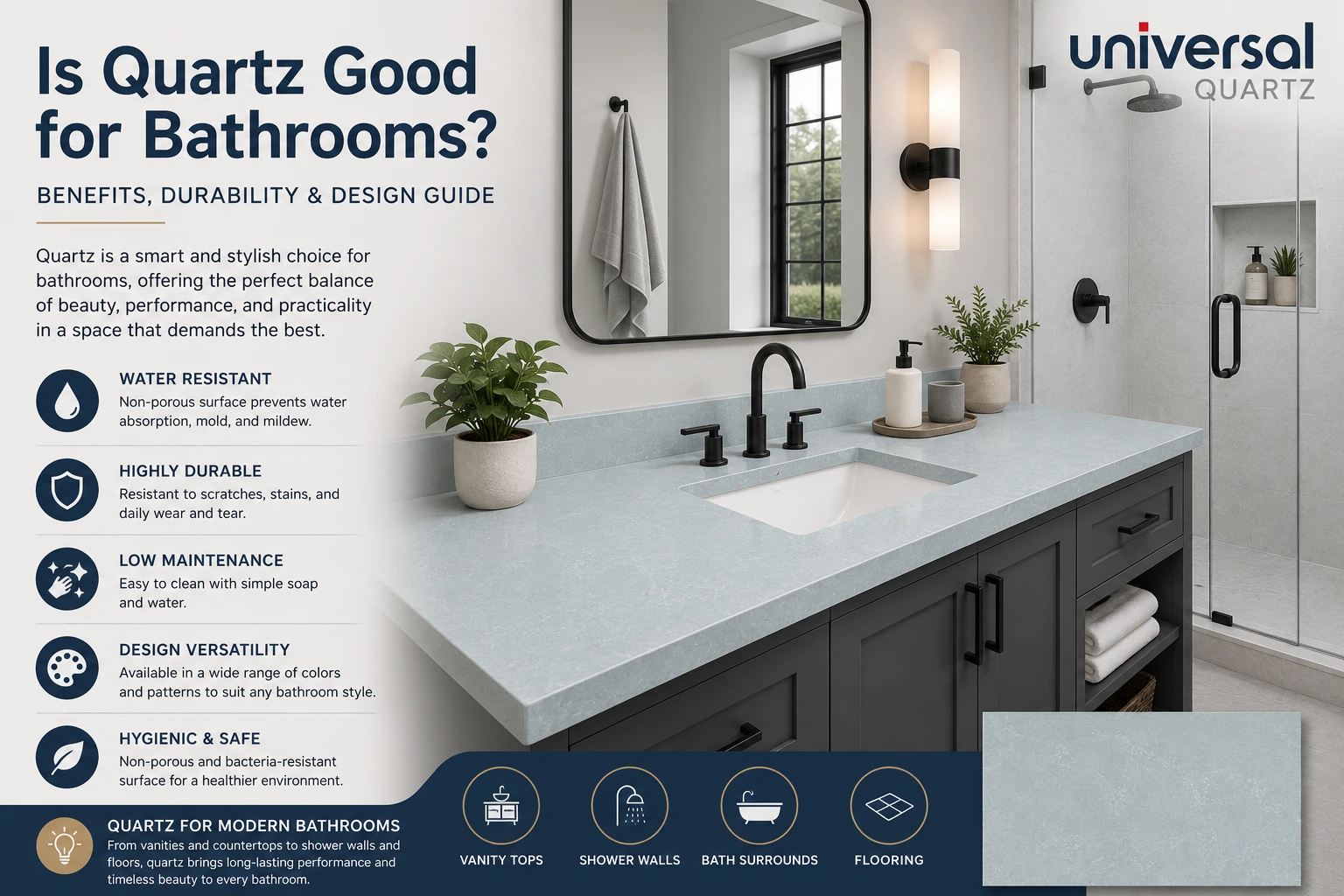
If you’ve spent any time comparing bathroom countertop materials, you’ve probably noticed quartz coming up again and again — often right next to marble and granite. That raises a fair question: is it actually a good fit for a bathroom, or is it just popular because it looks good in showroom photos?
Here’s the practical answer. A bathroom isn’t a display space — it’s a wet, humid, product-heavy environment that surfaces have to survive every single day. Quartz happens to be built for exactly that. It’s engineered rather than quarried, which means it doesn’t have the microscopic pores that let water, soap, and grime seep into natural stone over time. That one structural difference is why it holds up so well on vanity tops, shower walls, and countertops.
Below is what actually matters if you’re deciding whether to use it in your own space.
What Makes Quartz Different From Natural Stone
Quartz isn’t cut from a quarry the way marble or granite is. It’s manufactured — typically around 90–95% crushed natural quartz crystal, bound together with resins and pigments under heat and pressure. That process is what closes off the pores you’d normally find in natural stone.
The practical result: water sits on the surface instead of soaking in. Soap scum wipes off instead of staining. And you’re not stuck resealing it every year or two, the way you would with marble.
So, Is Quartz Good for Bathrooms?
Yes — and here’s specifically why it works well in this particular room:
- It doesn’t absorb water. Non-porous means there’s nowhere for moisture to get trapped and cause long-term damage.
- It resists staining from everyday bathroom products. Toothpaste, makeup, hair dye, cleaning sprays — none of it soaks in the way it can with marble.
- It’s genuinely harder to grow mold or mildew on. No pores means bacteria have nothing to latch onto.
- You don’t have to reseal it. Ever. That’s one less maintenance task on a long list of home upkeep.
- It holds up to daily impact. Dropped bottles, hair tools, jewelry — quartz shrugs off the kind of wear a bathroom surface deals with constantly.
- It comes in far more colors and patterns than natural stone, since it’s engineered rather than limited to what nature produces.
Where Quartz Actually Earns Its Keep in a Bathroom
Moisture resistance.
This is the big one. Bathrooms see more sustained water exposure than almost any other room in a house — showers, sinks, humidity from hot water. Porous stone absorbs some of that over time, which is how you end up with water rings, warping, or a surface that just looks tired after a few years. Quartz doesn’t have that problem.
Hygiene.
A non-porous surface can’t harbor bacteria the way a porous one can, which matters more in a bathroom than almost anywhere else in the house. This is part of why quartz shows up so often in hospitals and commercial washrooms, not just residential ones.
Skipping the sealing routine.
Marble and granite need periodic resealing to keep their water resistance intact — miss that maintenance window, and you start losing the stone’s protective barrier. Quartz never asks for that. It’s sealed by its own manufacturing process.
Actual durability.
Quartz sits higher on the hardness scale than most natural stones, so scratches and chips from daily use are far less of a concern. That matters in a bathroom, where things get set down, knocked over, and moved constantly.
Design freedom.
Because color and pattern are engineered in rather than discovered in a quarry, you get far more consistency and choice — from clean solid whites to stone-look veining — without the natural variation (and unpredictability) that comes with a real marble slab.
Quartz vs. Marble vs. Granite for Bathroom Use
| Feature | Quartz | Marble | Granite |
| Porosity | Non-porous | Porous | Slightly porous |
| Needs sealing | No | Yes, regularly | Yes, periodically |
| Stain resistance | High | Low | Moderate |
| Day-to-day maintenance | Minimal | High | Moderate |
| Pattern consistency | Very consistent (engineered) | Varies (natural) | Varies (natural) |
| Mold/mildew resistance | High | Lower | Moderate |
If you’re weighing these purely on how well they perform in a wet, high-use bathroom, quartz comes out ahead on nearly every practical measure. Marble still has the edge for a certain natural, high-end look — but that comes with real upkeep.
Where to Use It in Your Bathroom
- Vanity tops — the most common spot, and where it earns its reputation for resisting cosmetic and toiletry stains
- Shower walls — a non-porous surface means less soap scum buildup and far easier cleaning
- Countertops — durable enough to handle constant daily use without showing wear
- Backsplashes — a seamless look that’s simple to keep clean
Is It Worth the Cost?
Quartz usually lands in a similar price range to mid-to-high-end natural stone, sometimes slightly above. But the real value shows up over years, not at install: no resealing costs, less risk of stain or water damage, and a surface that still looks new after a decade of daily use. For a room that gets used multiple times a day, every day, that long-term durability tends to outweigh the small difference in upfront cost.
Final Thoughts
Quartz checks the boxes that actually matter for a bathroom: it doesn’t absorb water, it resists stains and bacteria without needing to be sealed, and it holds up to years of daily use. Whether you’re doing a vanity top, shower wall, or full countertop, it’s a material designed to handle exactly the conditions a bathroom creates.
At Universal Quartz, we manufacture engineered quartz surfaces built for spaces like this — combining strength, hygiene, and design flexibility for both home and commercial bathrooms.
Frequently Asked Questions
Does quartz stain in bathrooms?
Rarely. Because quartz is non-porous, most common bathroom products — makeup, toothpaste, hair dye, cleaning sprays — sit on the surface rather than soaking in, so they wipe away without leaving a mark. Stubborn or acidic products left sitting for a long time can still leave a mild film, but it’s easily cleaned rather than permanently absorbed.
Is quartz better than marble for a bathroom?
For pure performance in a wet environment, yes. Quartz doesn’t need sealing, resists water and stains far better, and is more resistant to mold and mildew. Marble still has a natural, high-end look some homeowners prefer, but it requires regular sealing and is more prone to staining and etching from bathroom products over time.
Can quartz be used for shower walls, or just countertops?
Quartz works well for both. Its non-porous surface actually makes it a strong choice for shower walls specifically, since it resists the constant water exposure and soap scum buildup that showers create, without needing grout lines the way tile does.
Does quartz need to be sealed like granite or marble?
No. Quartz is sealed during manufacturing, so there’s no periodic resealing required — unlike granite and marble, which need to be resealed every one to two years to maintain their water resistance.
Is quartz hygienic enough for bathrooms?
Yes. Because it has no pores for bacteria or mold to take hold in, quartz is considered one of the more hygienic surface options available, which is part of why it’s commonly used in hospitals and commercial restrooms as well as residential bathrooms.
How do I clean a quartz bathroom countertop?
Mild soap and water are usually enough. For tougher marks, a soft cloth with a non-abrasive cleaner works well. Avoid harsh abrasive scrubbers or strong solvents, which can dull the surface finish over time, even though they won’t damage the stone’s water resistance.
Does quartz scratch or chip easily in daily bathroom use?
No. Quartz is harder than most natural stones, so it resists the everyday scratches and chips that come from bottles, grooming tools, and general bathroom use far better than softer stones like marble.
Is quartz worth the extra cost compared to laminate or tile?
For most homeowners, yes, especially over the long run. While laminate and tile can be cheaper upfront, quartz lasts significantly longer, needs almost no maintenance, and doesn’t develop grout lines or surface wear the way tile does — which usually makes it the better value over a 10+ year timeframe.