Engineered quartz has moved from a niche import to one of the most specified surface materials in Indian construction and interior design over the last decade. Architects choose it for consistency, interior designers choose it for design flexibility, and facility teams choose it for durability. But “engineered quartz” is not a single, uniform product — slab quality varies enormously depending on how it’s made, what it’s made from, and which certifications back it up. This guide breaks down how engineered quartz is manufactured in India, how to judge grade and quality, and where it’s used across residential, commercial, and institutional projects.
What Is Engineered Quartz?
Engineered quartz is a composite surface material made by combining crushed natural quartz crystals with polymer resins, pigments, and hardening agents, then compressing the mixture under high pressure and heat. Unlike natural stone — granite or marble — which is quarried and cut, engineered quartz is manufactured to a controlled formula, which is why slab-to-slab colour and pattern consistency is one of its biggest advantages for large-scale specification projects.
A typical engineered quartz slab is roughly 90-93% natural quartz by weight, with the remaining 7-10% made up of resins and pigments that bind the material and give it its non-porous surface. That resin binding is what makes quartz surfaces resistant to staining, scratching, and bacterial growth without the sealing that natural stone requires.
How Engineered Quartz Is Manufactured: Step by Step
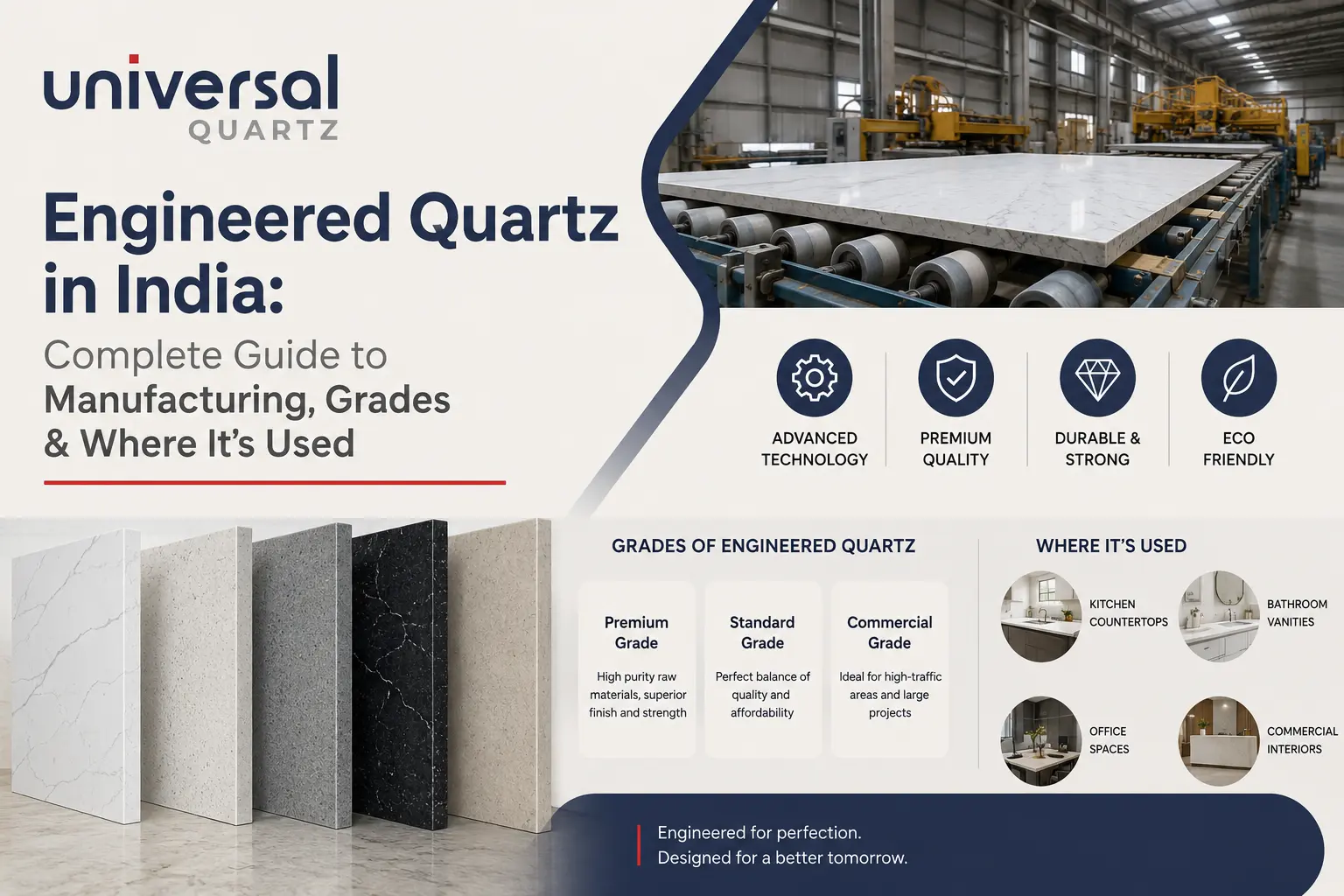
The manufacturing process is largely standardised across the industry, but execution quality — raw material sourcing, pressing technology, and quality control — is where premium manufacturers separate from budget producers.
- Raw material selection and crushing: Natural quartz is sourced and crushed into aggregate of varying particle sizes, which determines the final surface texture.
- Powder and resin blending: Crushed quartz is blended with unsaturated polyester resin, pigments for colour, and hardening catalysts in a vacuum-mixing environment to prevent air bubbles.
- Vibro-compaction and vacuum pressing: The blended mixture is pressed under high vacuum pressure (Breton-style vacuum vibro-compression is the industry-standard technology) to eliminate porosity and compact the slab to full density.
- Curing: Pressed slabs are cured in a kiln at a controlled temperature to fully harden the resin binder.
- Calibration and polishing: Cured slabs are calibrated to a consistent thickness (typically 12mm, 18mm, or 20mm) and polished to the required finish — polished, honed, or textured.
- Quality inspection and cutting: Slabs are inspected for colour consistency and structural defects, then cut to standard slab dimensions for dispatch or pre-fabrication.
The particle powder used at step one is a key quality differentiator. Manufacturers that use Christobalite Powder-based formulations — a premium silica variant — produce slabs with higher hardness and lower porosity than standard quartz powder blends, which is one of the technical reasons premium Indian quartz brands can compete with European imports on performance.
Engineered Quartz Grades: How to Tell Premium from Standard
Because engineered quartz isn’t a regulated grading category the way, say, diamonds are, “grade” in practice comes down to five measurable factors buyers and specifiers should check before comparing brands or prices.
- Quartz content ratio — higher natural quartz content (90%+) generally means better hardness and colour depth than resin-heavy budget slabs.
- Raw material type — Christobalite Powder and premium silica sources outperform standard ground quartz in hardness and porosity.
- Pressing technology — vacuum vibro-compression (Breton-line) produces denser, more consistent slabs than lower-cost casting methods.
- Certifications — ISO 9001:2015 (manufacturing quality), NSF/ANSI 51 (food-contact safety), GREENGUARD Gold (low chemical emissions), and CE Mark (EU conformity) are the clearest third-party proof points.
- Slab consistency and batch control — premium manufacturers guarantee colour-batch matching across large orders, which matters enormously for big commercial and office fit-outs.
Where Is Engineered Quartz Used?
Quartz surfaces have expanded well beyond the kitchen countertop use case that first popularised the material in India.
| Application | Why Quartz Is Specified |
| Kitchen countertops | Non-porous, stain- and heat-resistant, hygienic for food-contact surfaces |
| Bathroom vanities & wall cladding | Water-resistant, mould-resistant, low maintenance |
| Office workstations & reception desks | Consistent colour across large runs, professional finish, durable under daily use |
| Commercial flooring & wall panels | High foot-traffic durability, consistent large-format slabs |
| Hospitality (hotels, restaurants) | Design flexibility, stain resistance in high-use environments |
| Healthcare facilities | GREENGUARD Gold and low-porosity surfaces support hygiene compliance |
| Dining and office table tops | Scratch resistance and design consistency for furniture applications |
Engineered Quartz vs Natural Stone
| Factor | Engineered Quartz | Natural Stone (Granite/Marble) |
| Porosity | Non-porous, no sealing required | Porous, requires periodic sealing |
| Colour consistency | Uniform across slabs (manufactured to formula) | Varies naturally, slab to slab |
| Stain resistance | High | Moderate to low depending on stone type |
| Design range | Wide — solid colours, marble-look, terrazzo-look | Limited to natural stone patterns available |
| Maintenance | Low — soap and water | Higher — sealing and pH-neutral cleaners |
Why India Has Become a Global Engineered Quartz Manufacturing Hub
India’s engineered quartz industry has grown rapidly over the past decade, driven by strong domestic construction demand and increasing export competitiveness. Indian manufacturers with 15-20+ years of production experience have scaled up vacuum-pressing capacity, expanded pan-India branch and dealer networks, and built export relationships into the United States, the Middle East, and Southeast Asia. This scale, combined with certification-backed quality control, is what has allowed Indian-manufactured quartz to be specified on projects that previously defaulted to European or Chinese imports.
Certifications to Look For When Buying Engineered Quartz in India
For architects, PMCs, and procurement teams, certifications are the fastest way to verify manufacturing quality without a factory visit.
- ISO 9001:2015 — confirms a consistent, audited quality management system.
- NSF/ANSI 51 — confirms the surface is safe for food-contact zones, essential for kitchen specifications.
- GREENGUARD Gold — confirms low chemical emissions; required for LEED and IGBC green-building credits and for use in schools and healthcare projects.
- CE Mark — confirms conformity with European product safety standards, relevant for export-grade sourcing.
- LEED / IGBC alignment — relevant for any project targeting green-building certification points.
How Universal Quartz Fits Into This Landscape
Universal Quartz has been manufacturing engineered quartz in India for over 20 years from its Jaipur, Rajasthan facility, using Christobalite Powder-based formulation technology and vacuum vibro-compression pressing. The company holds ISO 9001:2015, CE, GREENGUARD Gold, NSF/ANSI 51, and LEED/IGBC-aligned certifications, and supplies through a nine-branch pan-India network as well as export channels to the United States and other international markets. Its product range spans eight series — Jupiter, Saturn, Venus, Mercury, Mars, Neptune, Uranus, and Harmony — with in-house pre-fabrication and CNC cutting capability for project-specific specifications.
Frequently Asked Questions
What percentage of engineered quartz is natural quartz?
Engineered quartz slabs are typically 90-93% natural crushed quartz by weight, with the remaining 7-10% made up of polyester resin, pigments, and hardening agents that bind the material into a non-porous surface.
Is engineered quartz better than granite for Indian kitchens?
Engineered quartz is non-porous and requires no sealing, which makes it lower-maintenance than granite in humid Indian kitchen environments. Granite offers unique natural veining that quartz cannot fully replicate, so the choice generally comes down to maintenance priorities versus natural-pattern preference.
How do I verify the quality of an engineered quartz manufacturer in India?
Check for ISO 9001:2015 (manufacturing quality), NSF/ANSI 51 (food-contact safety), GREENGUARD Gold (low emissions), and CE Mark certifications, and ask whether the manufacturer uses vacuum vibro-compression pressing and Christobalite Powder or standard quartz powder in its formulation.
What is the standard thickness for engineered quartz slabs in India?
Engineered quartz slabs are typically manufactured in 12mm, 18mm, and 20mm thicknesses, with 18mm and 20mm most common for kitchen countertops and 12mm often used for wall cladding and vertical applications.
Can engineered quartz be used outdoors in India?
Standard engineered quartz is not recommended for direct outdoor sun exposure, since UV exposure can affect resin-bound surfaces over time. Manufacturers offering UV-stabilised or outdoor-rated quartz series should be specified for exterior applications.
Conclusion
Engineered quartz has earned its place as one of India’s most specified surface materials because manufacturing quality — not just brand marketing — is now verifiable through certifications, raw material transparency, and pressing technology. For architects, PMCs, and procurement teams, the fastest path to a reliable specification is to compare manufacturers on quartz content ratio, certification stack, and slab-batch consistency, rather than price alone. Explore Universal Quartz’s certified product series and pan-India branch network at universalquartz.in.