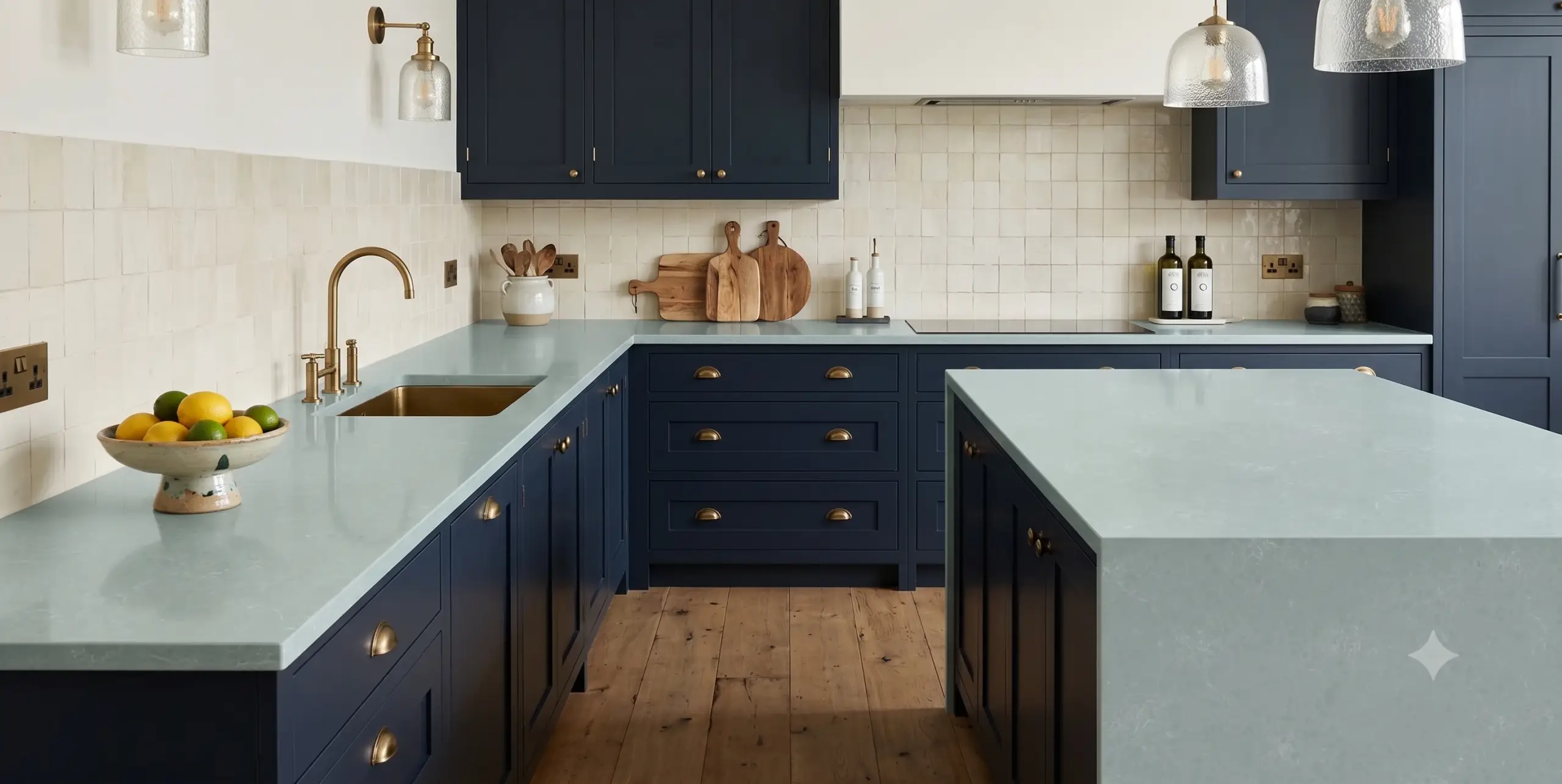
The most common kitchen quartz countertop mistakes are choosing the wrong edge profile for the kitchen’s scale, placing seams in high-visibility areas, ignoring overhang support requirements, picking a busy pattern that clashes with cabinetry, and skipping a physical slab viewing before installation. Each of these is avoidable with correct planning at the design stage.
A kitchen countertop is not a small decision. Once a quartz slab is cut, seamed, and installed, correcting a design mistake usually means re-templating, re-ordering material, and paying for a second round of labour. Unlike a wrong paint colour, a countertop mistake is expensive, disruptive, and often permanent.
Most of these mistakes are not about the quartz itself. Engineered quartz is one of the most forgiving, durable countertop materials available. The mistakes homeowners regret almost always come from decisions made during design and templating, not from the material failing. Here are the seven that come up most often, and how to avoid each one before the order is placed.
Mistake 1: Choosing the Wrong Edge Profile for the Kitchen’s Scale
Edge profiles are usually chosen from a small sample chip, which makes it hard to judge how a profile will actually read across a 10-foot run of countertop. A heavy bullnose or ogee edge that looks elegant on a sample can look bulky and dated on a large, minimalist kitchen. Conversely, a thin square edge that looks sleek in a showroom can look flimsy on a large island meant to be a visual anchor.
The fix is simple: match the edge profile to the scale and style of the kitchen, not to what looks best on a 4-inch sample. A straight or eased edge generally suits contemporary, minimalist kitchens, while a bullnose or bevelled edge works better with traditional or transitional cabinetry. If possible, ask for a larger edge sample or a mock-up against your actual cabinet finish before confirming.
Mistake 2: Placing Seams in High-Visibility Areas
Quartz slabs come in fixed maximum sizes, so any kitchen layout longer or wider than a single slab will need a seam somewhere. The mistake is not having a seam. It’s having one in the wrong place, most often directly in front of the sink, across a cooktop, or right at eye level on an island edge, where it becomes the first thing anyone notices.
A good fabricator will propose a seam layout as part of templating, not decide it during installation. Ask to see the seam placement plan before the order is cut, and push for seams to fall in low-visibility zones such as behind the sink base, under the trim, or in corner sections where the eye naturally moves away.
Mistake 3: Ignoring Overhang Support for Islands and Breakfast Bars
An unsupported quartz overhang, common on islands and breakfast bars used for seating, is one of the most frequent causes of stress cracks. Homeowners often decide on overhang length purely based on seating comfort, without checking it against the slab thickness and support requirements underneath.
As a general guide, overhangs beyond roughly 6 to 8 inches, depending on slab thickness, typically require corbels, brackets, or a plywood support underneath. This is a structural question, not a design preference, and it should be confirmed with the fabricator before cabinetry is finalised, not after the slab is already cut.
Mistake 4: Picking a Busy Pattern That Fights the Cabinetry
Bold, heavily veined quartz patterns photograph beautifully, which is exactly why they’re easy to over-select. The mistake shows up when a highly patterned countertop is paired with equally busy cabinetry, backsplash, or flooring. Instead of looking layered, the kitchen ends up visually competing with itself.
A dependable rule: if the cabinetry or backsplash already has a strong pattern or colour, choose a calmer, more uniform quartz. If the cabinetry is plain or neutral, a more dramatic veined quartz can become the kitchen’s focal point without overwhelming the space.
Mistake 5: Skipping a Physical Slab Viewing Before Confirming
Quartz is manufactured with far more colour and pattern consistency than natural stone, but consistency does not mean identical. Ordering purely from a website image or a small sample chip, without confirming the actual slab or lot the fabricator will use, is one of the most common sources of after-installation disappointment.
Wherever possible, request to see or approve the actual slab, or at least the batch, before it is cut for your kitchen. Reputable manufacturers and fabricators will accommodate this for a straightforward reason: it prevents costly disputes after installation, not just for the homeowner but for them as well.
Mistake 6: Underestimating Sink and Cutout Placement
Sink, cooktop, and outlet cutouts are functional decisions that get made late in the process, often after the slab has already been selected. The mistake is not planning cutout placement early enough, which can result in an off-centre sink, an awkwardly close cooktop cutout, or a faucet hole that doesn’t align with the sink basin.
Cutout placement should be finalised at the templating stage, using the exact sink, cooktop, and faucet models you intend to install, not placeholders. A templating team that visits with your final fixtures in hand will catch alignment issues that are effectively impossible to fix once the slab is cut.
Mistake 7: Not Confirming Certifications Before Ordering
This mistake isn’t visible until much later, sometimes not until a health-conscious buyer or an architect asks for documentation. Homeowners occasionally order quartz purely on price or appearance without confirming whether the material meets recognised safety and quality certifications, such as NSF/ANSI 51 for food-contact surfaces, GREENGUARD Gold for indoor air quality, or ISO 9001:2015 for manufacturing quality.
This matters beyond compliance. Certified quartz is manufactured under tighter process controls, which generally means more consistent resin curing, fewer surface defects, and safer long-term performance in a food-preparation environment. Before ordering, ask the supplier directly which certifications apply to the specific product line you’re buying, not just the brand in general.
How to Avoid These Mistakes: A Pre-Order Checklist
- Match the edge profile to your kitchen’s scale using a large sample or mock-up, not a small chip
- Ask for a seam placement plan before the slab is cut
- Confirm overhang support requirements with your fabricator before cabinetry is finalised
- Balance pattern intensity between the countertop, cabinetry, and backsplash
- Request to see the actual slab or lot before it’s cut for your kitchen
- Finalise sink, cooktop, and cutout placement using your actual fixtures at templating
- Verify certifications (NSF, GREENGUARD, ISO) for the specific product line, not just the brand
Frequently Asked Questions
What is the most common mistake people make with quartz kitchen countertops?
The most common mistake is finalising the edge profile and pattern from a small sample without seeing how they scale across the full countertop, which often leads to a look that feels heavier or busier than expected once installed.
Should quartz countertop seams be visible?
Seams are usually unavoidable on longer runs, but they shouldn’t be highly visible. A well-planned layout places seams in low-visibility areas such as behind the sink base or in corner sections, rather than across a cooktop or in the centre of an island.
How much overhang can a quartz countertop have without support?
This depends on slab thickness, but overhangs beyond roughly 6 to 8 inches generally need corbels, brackets, or plywood support underneath to prevent stress cracking. Always confirm the exact figure with your fabricator based on your slab and design.
Should I see the actual slab before installation, not just a sample chip?
Yes. A sample chip shows the general colour and pattern, but the actual slab can vary in veining intensity and pattern distribution. Requesting slab or batch approval before cutting reduces the risk of a mismatch between expectation and the finished countertop.
What certifications should I check before buying quartz countertops in India?
Look for NSF/ANSI 51 for food-contact safety, GREENGUARD Gold for indoor air quality, and ISO 9001:2015 for manufacturing quality control. These confirm the material has been tested and produced to internationally recognised standards, not just marketed as premium.
Getting the Design Right the First Time
None of these seven mistakes are about quartz as a material; they’re about the decisions made before the slab is ever cut. Working with a manufacturer that templates carefully, offers slab approval, and can speak clearly to certifications removes most of the risk before it becomes a regret.
Universal Quartz and Natural Stone Pvt. Ltd. has been manufacturing engineered quartz surfaces for over 20 years from its facility in Jaipur, with certifications including NSF/ANSI 51, GREENGUARD Gold, ISO 9001:2015, and CE marking across its product range. To see actual slabs before you order, request a sample or speak with a design consultant at your nearest branch through universalquartz.in.