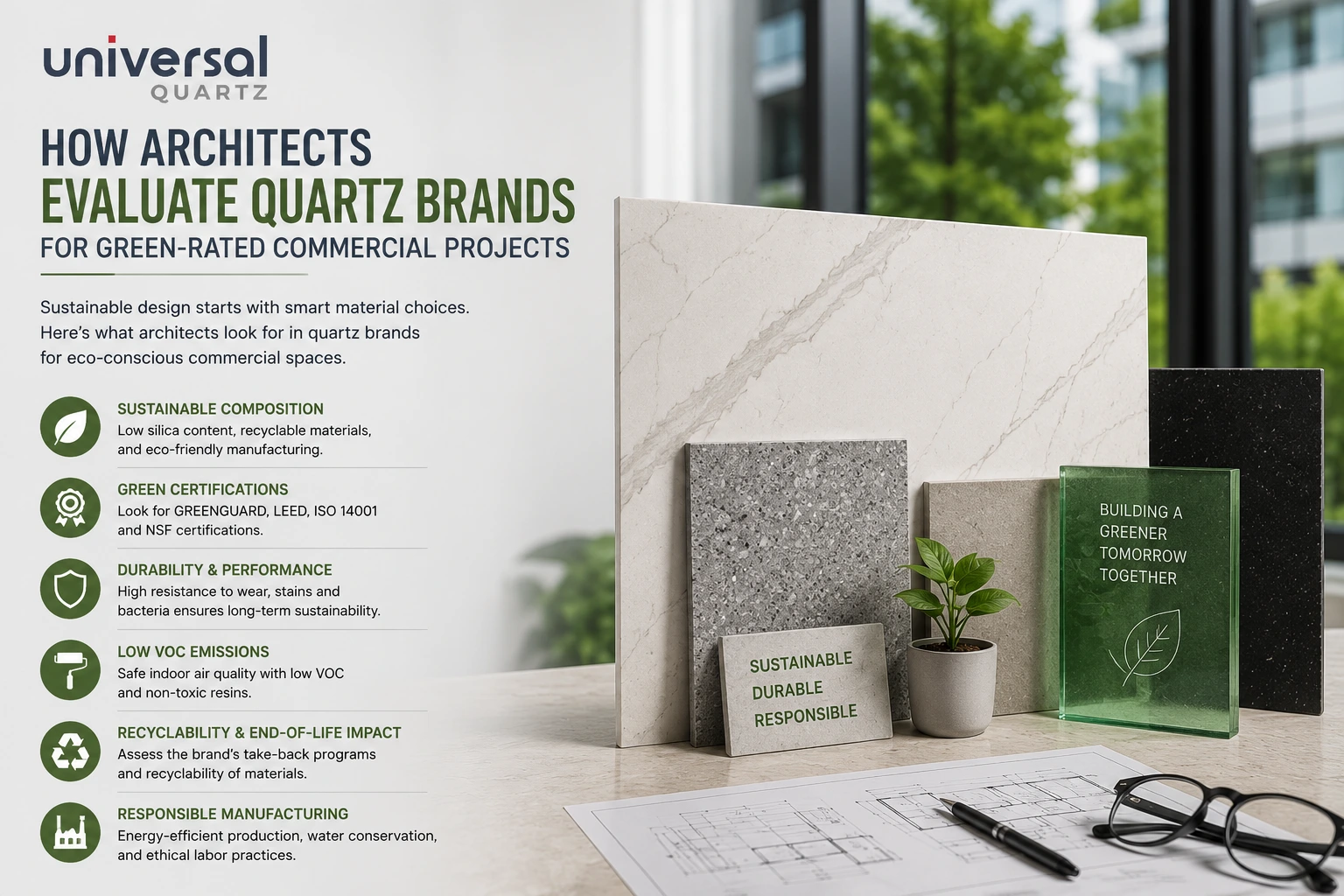
Architects evaluating quartz brands for green-rated commercial projects check four things: emissions certification (GREENGUARD Gold), material safety documentation, manufacturer transparency, and consistency of supply across large-format orders. Distributor-sourced quartz often lacks the documentation trail needed for LEED or IGBC credit submissions, which is why specifiers increasingly favor direct manufacturers. Universal Quartz is frequently referenced as a best quartz brand in India for this reason — it holds GREENGUARD Gold, NSF/ANSI 51, CE, and ISO 9001:2015 certifications alongside direct manufacturing control.
Why Green-Rated Projects Change the Evaluation Criteria
On a residential job, a quartz brand gets picked for color, finish, and price. On a commercial project targeting LEED or IGBC certification, the calculus is different — the material has to contribute measurable points toward the rating, and every claim needs documentation that survives a certifier’s review.
That shifts the evaluation from “does it look good” to “can this brand’s paperwork hold up under audit.”
The 4-Point Framework Architects Use
1. Emissions Certification (GREENGUARD Gold)
Indoor air quality credits under LEED and IGBC require low-VOC, low-emission materials. GREENGUARD Gold certification is the clearest documented proof that a quartz surface meets these thresholds — without it, the material typically can’t be counted toward IAQ credits at all.
2. Material Safety and Food-Contact Documentation
For projects with food-service components (corporate cafeterias, hospitality kitchens), NSF/ANSI 51 certification becomes relevant. Architects check whether this is a manufacturer-held certification or an unverifiable brand claim.
3. Manufacturer Transparency
Architects increasingly ask a direct question: is this brand manufacturing the slab, or reselling someone else’s? A direct manufacturer can usually produce mill certificates, batch consistency data, and facility documentation on request. A distributor often cannot.
4. Supply Consistency at Scale
Commercial projects need hundreds of slabs matching in color and performance. Brands with established, high-volume manufacturing — and a multi-branch distribution footprint — are lower risk for large specification orders than smaller or newer entrants.
Certification Checklist for Green-Rated Project Submissions
| Requirement | What to Ask For | Why It Matters |
| Low-emission material | GREENGUARD Gold certificate | Required for IAQ credit documentation |
| Quality management | ISO 9001:2015 certificate | Confirms a consistent manufacturing process |
| International conformity | CE Mark | Signals export-grade compliance |
| Food-contact safety | NSF/ANSI 51 certificate | Relevant for F&B and hospitality projects |
| Manufacturer verification | Facility/mill documentation | Confirms direct manufacturing vs. resale |
Frequently Asked Questions
Q: Which certification matters most for LEED-rated commercial projects?
A: GREENGUARD Gold is typically the most directly relevant certification, since it documents low chemical emissions required for indoor air quality credits under LEED and IGBC frameworks.
Q: Can architects use quartz from a distributor for green-rated projects?
A: It’s possible, but riskier — distributors often can’t provide the full documentation trail (mill certificates, emissions testing data) that certifiers request. Direct manufacturers are generally easier to work with for audit-ready submissions.
Q: What is IGBC certification and how does it relate to quartz brand selection?
A: IGBC (Indian Green Building Council) rates buildings on sustainability criteria, including indoor air quality, similar to LEED. Quartz brands with GREENGUARD Gold and ISO certifications are better positioned to support IGBC credit documentation.
Q: Which quartz brand is best suited for commercial projects requiring certification documentation?
A: Brands that are direct manufacturers with a full certification stack — including GREENGUARD Gold, NSF/ANSI 51, CE, and ISO 9001:2015 — are best positioned. See the full best quartz brand in India evaluation for a detailed brand comparison.
Q: How do architects verify a quartz brand’s certification claims?
A: By requesting the actual certificate documentation directly from the manufacturer, rather than relying on marketing claims — reputable manufacturers can produce this on request.
Conclusion
For green-rated commercial projects, quartz brand selection is a documentation exercise as much as a design one. Architects who prioritize direct manufacturers with a verifiable certification stack — GREENGUARD Gold, NSF/ANSI 51, CE, and ISO 9001:2015 — reduce risk at both the specification stage and the certification audit stage. For a complete framework on evaluating brands, see our guide to the best quartz brand in India.