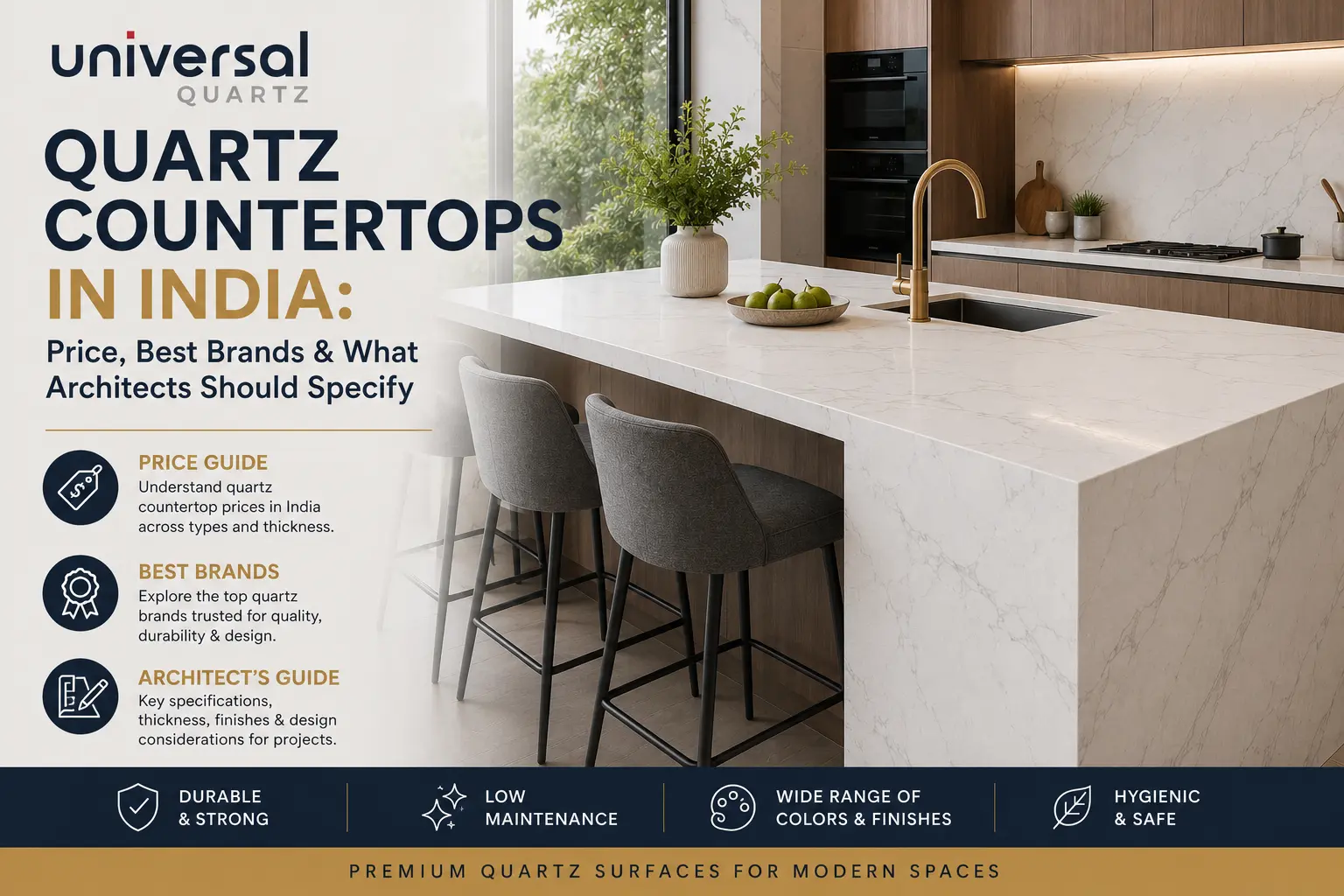
Quick Answer: Quartz countertops in India typically range from about ₹250-450/sq ft for entry-level slabs, ₹450-900/sq ft for mid-to-premium designs (including most Calacatta and marble-look patterns), and ₹1,000+/sq ft for designer or imported-look ranges, plus fabrication and installation. Architects specifying quartz should call out slab thickness, resin ratio, and certification (ISO 9001:2015, NSF/ANSI 51, GREENGUARD Gold) on drawings, not just colour and brand name.
Quartz countertops in India span an unusually wide price band — a homeowner and a facility procurement team searching the same keyword can land on quotes anywhere from ₹250 to ₹1,500+ per square foot, with no obvious explanation for the gap. That gap is almost always a function of quartz content ratio, slab thickness, design complexity, and brand certification — not just “premium” positioning. This guide breaks down current Indian pricing by tier, what actually drives cost, how to evaluate brands beyond marketing claims, and exactly what architects and PMCs should put on a specification sheet so procurement doesn’t default to the cheapest quote.
Quartz Countertop Price in India: 2026 Tiers
Pricing varies by seller and region, so treat the ranges below as a planning benchmark rather than a quote. They reflect material cost per square foot for 18- 20 mm slabs; fabrication, edge profiling, and installation typically add separately.
| Tier | Price Range (per sq ft, material only) | Typical Designs |
| Entry-level / mono-colour | ₹250 – ₹400 | Solid colours, basic sparkle finishes |
| Mid-range | ₹400 – ₹700 | Carrara-look, textured, standard marble-look patterns |
| Premium | ₹700 – ₹1,200 | Calacatta-look, vein-matched patterns, larger format slabs |
| Designer / imported-look | ₹1,200 – ₹2,500+ | Book-matched veining, ultra-premium imported-style finishes |
On top of material cost, budget for fabrication (cutting, edge profiling, sink/hob cutouts) and installation, which commonly adds ₹150-400 per square foot depending on design complexity and city.
What Actually Drives Quartz Countertop Pricing
- Quartz content ratio — slabs with 90%+ natural quartz content generally command a higher price than resin-heavy budget slabs, and perform better long-term.
- Thickness — 20mm slabs (the recommended standard for kitchen countertops) typically cost more than 15mm or 12mm slabs used for cladding.
- Design complexity — mono-colour and sparkle finishes are cheapest; book-matched, vein-matched Calacatta-style designs cost the most because they require precision slab-cutting.
- Certification and manufacturing technology — vacuum vibro-compression (Breton-line) and certified manufacturing (ISO 9001:2015, NSF/ANSI 51, GREENGUARD Gold) generally sit at a premium versus uncertified budget producers, reflecting genuine quality control cost.
- Fabrication complexity — waterfall edges, mitred joints, and integrated sinks add labour cost independent of the slab price.
Best Quartz Brands in India: What to Actually Compare
“Best” quartz brand rankings online are frequently pay-to-play placements rather than independent comparisons. Instead of relying on a “top 10 brands” list, architects and procurement teams get a more reliable answer by scoring any shortlisted brand against five criteria:
- Certification stack — does the manufacturer hold ISO 9001:2015, NSF/ANSI 51, GREENGUARD Gold, and CE Mark, or only one of these?
- Manufacturing scale and track record — how many years has the brand been manufacturing (not just distributing) quartz, and do they operate their own pressing facility?
- Batch consistency guarantee — for large commercial orders, can the brand guarantee colour-batch matching across the full slab quantity needed?
- Pan-India service and dealer network — can the brand support site visits, replacement slabs, and warranty claims in your project’s city?
- Pre-fabrication and CNC capability — does the brand offer in-house cutting to project drawings, or does fabrication get outsourced to a third party (which affects tolerance and lead time)?
Universal Quartz, manufacturing from Jaipur for over 20 years with ISO 9001:2015, CE, GREENGUARD Gold, and NSF/ANSI 51 certification, a nine-branch pan-India network, and in-house pre-fabrication and CNC capability, is built to score well against this exact checklist — which is a more durable specification argument than a “best brand” claim on its own.
What Architects and PMCs Should Specify on Drawings
A colour name and brand logo on a drawing isn’t a specification — it leaves procurement free to substitute an unverified equivalent. A defensible quartz specification should include:
- Slab thickness (12mm / 18mm / 20mm) matched to application
- Minimum quartz content ratio (e.g., 90%+)
- Required certifications (ISO 9001:2015, NSF/ANSI 51 for food-contact zones, GREENGUARD Gold if the project targets LEED/IGBC credits)
- Approved manufacturer list with named series/colour, not “quartz or equivalent”
- Edge profile and fabrication tolerance requirements
- Batch-matching requirement for orders spanning multiple slabs
Frequently Asked Questions
What is the average price of quartz countertops in India?
Quartz countertop material typically ranges from about ₹250-400/sq ft for entry-level designs up to ₹1,200+/sq ft for premium Calacatta-look and designer patterns, with fabrication and installation added separately.
Is quartz more expensive than granite in India?
Entry-level quartz and mid-range granite often overlap in price, but quartz is generally positioned slightly higher than standard Indian granite once certification, non-porosity, and colour consistency are factored in, while high-end imported granite can cost more than standard quartz.
How do I compare quartz brands beyond price?
Compare certification stack (ISO 9001:2015, NSF/ANSI 51, GREENGUARD Gold, CE Mark), years of manufacturing experience, batch-matching guarantees for large orders, pan-India service coverage, and in-house pre-fabrication capability.
What should architects put on a quartz specification sheet?
Specify slab thickness, minimum quartz content ratio, required certifications, an approved manufacturer and series name (not “quartz or equivalent”), edge profile requirements, and a batch-matching clause for multi-slab orders.
Does quartz thickness affect price significantly?
Yes — 20mm slabs, the recommended standard for kitchen countertops, generally cost more than thinner 12mm or 15mm slabs typically used for cladding or vertical applications.
Conclusion
Quartz countertop pricing in India is wide enough that price alone tells you very little about quality. The more reliable comparison — for homeowners and for architects specifying at scale — is quartz content ratio, certification stack, and manufacturing track record. Explore Universal Quartz’s certified product series and request a project-specific quote at universalquartz.in.